
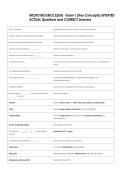
MICRO BIO (BIOL 2260) - Exam 1 (Key Concepts) UPDATED
ACTUAL Questions and CORRECT Answers
Koch's Postulates Established the link between specific microbes and diseases.
Pasteur's Experiment (Spontaneous Generation) Showed that microorganisms do not arise spontaneously.
Buchner's Discovery (Fermentation & Enzymes) Proved that enzymes, not living cells, drive fermentation.
Microbes are responsible for ________________. diseases, fermentation, and biological processes
Enzymes lower activation energy to _______________. speed up chemical reactions.
Competitive Inhibition a molecule mimics the substrate and blocks the active site (e.g., sulfanilamide vs.
PABA).
ATP (Adenosine Triphosphate) the primary energy currency of the cell.
ATP is generated via ____________________ substrate-level phosphorylation, oxidative phosphorylation, and
photophosphorylation.
Feedback Inhibition enzyme activity is regulated by the product of a pathway.
Enzymes regulate _______________ pathways, and ATP powers biochemical, cellular
__________ functions.
Proteins: Made of amino acids with amine (-NH₂) and carboxyl (-COOH) groups.
Lipids: Used in energy storage & membranes (e.g., phospholipids).
Carbohydrates: Serve as energy sources (e.g., glucose) and structural components (e.g.,
peptidoglycan).
Nucleic Acids (DNA & RNA): Store genetic information.
ATP contains a ________ (________) _____used for energy phosphate (-PO₄³⁻) group
transfer.
Functional groups determine ___________ macromolecule properties and functions.
Prokaryotes: No nucleus, 70S ribosomes (e.g., bacteria).
Eukaryotes: Membrane-bound organelles, 80S ribosomes (e.g., plants & animals).
Endoplasmic Reticulum (ER): Rough ER & Smooth ER
ACTUAL Questions and CORRECT Answers
Koch's Postulates Established the link between specific microbes and diseases.
Pasteur's Experiment (Spontaneous Generation) Showed that microorganisms do not arise spontaneously.
Buchner's Discovery (Fermentation & Enzymes) Proved that enzymes, not living cells, drive fermentation.
Microbes are responsible for ________________. diseases, fermentation, and biological processes
Enzymes lower activation energy to _______________. speed up chemical reactions.
Competitive Inhibition a molecule mimics the substrate and blocks the active site (e.g., sulfanilamide vs.
PABA).
ATP (Adenosine Triphosphate) the primary energy currency of the cell.
ATP is generated via ____________________ substrate-level phosphorylation, oxidative phosphorylation, and
photophosphorylation.
Feedback Inhibition enzyme activity is regulated by the product of a pathway.
Enzymes regulate _______________ pathways, and ATP powers biochemical, cellular
__________ functions.
Proteins: Made of amino acids with amine (-NH₂) and carboxyl (-COOH) groups.
Lipids: Used in energy storage & membranes (e.g., phospholipids).
Carbohydrates: Serve as energy sources (e.g., glucose) and structural components (e.g.,
peptidoglycan).
Nucleic Acids (DNA & RNA): Store genetic information.
ATP contains a ________ (________) _____used for energy phosphate (-PO₄³⁻) group
transfer.
Functional groups determine ___________ macromolecule properties and functions.
Prokaryotes: No nucleus, 70S ribosomes (e.g., bacteria).
Eukaryotes: Membrane-bound organelles, 80S ribosomes (e.g., plants & animals).
Endoplasmic Reticulum (ER): Rough ER & Smooth ER


