
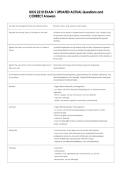
BIOS 2210 EXAM 1 UPDATED ACTUAL Questions and
CORRECT Answers
The type of microorganisms that can colonize humans Bacteria, viruses, fungi, protozoa, and Archaea
describe the role and impact of microbes on the earth microbes are key players in biogeochemical cycles(carbon cycle, nitrogen cycle),
environmental impact(decomposition, bioremediation, climate regulation), human
health(microbiome, disease), and evolution and diversity(early life, genetic
diversity)
Explain the theory of evolution and why it is called a a scientific explanation for the diversity of life on Earth, all species of organisms
theory have descended from common ancestors through gradual change over long
periods of time(natural selection, genetic drift, mutations, gene flow) because it is
a comprehensive, well-supported, and predictive explanation for the diversity of
life on Earth
Explain the ways that humans manipulate organisms for fermentation technology, biotechnology and genetic engineering,
their own uses bioremediation,
Summarize the relative burden of human disease caused Bacterial infections(respiratory, gastrointestinal, STIs, antibiotic resistance), viral
by microbes infections(respiratory, HIV, hepatitis), Fungal infections(opportunistic, respiratory)
and protozoan infections(malaria)
Bacteria - single-celled, prokaryotic microorganisms
- no nucleus, cell wall is composed of peptidoglycan, no membrane bound
organelles
- DNA is a singular, circular chromosome, can have plasmids
- reproduce asexually
- aerobic and aerobic respiration, fermentation, photosynthesis
Archaea - single-celled prokaryotic microorganisms
- no nucleus, cell wall has pseudopeptidoglycan/unique polymers, contain
membrane lipids
- DNA is a singular, circular chromosome
- reproduce asexually
- known for their ability to thrive in extreme environments(high temperatures,
acidic conditions)
Eukaryotes - include protozoa, fungi, algae, and microscopic plants/animals
- have a true nucleus, have membrane bound organelles(mitochondria,
endoplasmic reticulum), cell wall is chitin(fungi), and cellulose(algae)
- DNA is multiple linear chromosomes within the nucleus
- reproduce sexually(meiosis/fertilization) and asexually(mitosis)
Protozoa - eukaryote
- heterotrophic
- unicellular, have organelles(nucleus mitochondria), no cell wall
- asexual and sexual
- decomposers, can be pathogenic
, Fungi - eukaryote
- unicellular or multicellular, cell wall composed of chitin, have typical organelles
- Saprophytic/Parasitic
- asexual and sexual reproduction
- decomposers, can be pathogenic
Algae - eukaryote
- primarily photosynthetic
- unicellular or multicellular, cell wall is composed of cellulose, has typical
organelles
- autotrophic
- asexual and sexual reproduction
Identify two acellular infectious agents that are studied in viruses and prions
microbiology
Virus - composed of genetic material(DNA and RNA) and surrounded by a capsid
- require a host cell to replicate(cell hijacking)
- cause a wide range of diseases in humans, animals, plants, and even bacteria
- can be spread through respiratory droplets, bodily fluids, contaminated
surfaces, vertical transmission
Prion - composed solely of misfiled proteins
- do not contain genetic material
- convert normal, healthy proteins into abnormal, misfiled proteins
- associated with neurodegenerative diseases in animals and humans(Creutzfeldt-
Jakob)
- transmitted by injection of contaminated food, transplanted infectious tissue
size of microbes viruses < bacteria/archaea < fungi(yeasts) < protozoa < algae
late 1600s Antony Van Leeuwenhoek, developed the microscope, observed and described
microorganisms(bacteria, protozoa, yeast)
early 1700s Francesco Redi, conducted experiments that refuted the theory of spontaneous
generation, demonstrating that maggots did not spontaneously arise from
decaying meat but were produced by fly eggs
theory of spontaneous generation abiogenesis, was a widely accepted concept in the ancient world/Middle Ages,
proposed that living organisms could arise spontaneously from non-living matter
under certain conditions
(1)mid to late 1800s Louis Pasteur, Developed the germ theory of disease, demonstrated that
fermentation is caused by microorganisms and developed pasteurization,
developed vaccines for rabies and anthrax
germ theory of disease concept in microbiology that proposes that many diseases are caused by
microorganisms, including bacteria, viruses, fungi, and parasites, framework for
understanding the microbial causes of infectious diseases(Koch and Pasteur)
CORRECT Answers
The type of microorganisms that can colonize humans Bacteria, viruses, fungi, protozoa, and Archaea
describe the role and impact of microbes on the earth microbes are key players in biogeochemical cycles(carbon cycle, nitrogen cycle),
environmental impact(decomposition, bioremediation, climate regulation), human
health(microbiome, disease), and evolution and diversity(early life, genetic
diversity)
Explain the theory of evolution and why it is called a a scientific explanation for the diversity of life on Earth, all species of organisms
theory have descended from common ancestors through gradual change over long
periods of time(natural selection, genetic drift, mutations, gene flow) because it is
a comprehensive, well-supported, and predictive explanation for the diversity of
life on Earth
Explain the ways that humans manipulate organisms for fermentation technology, biotechnology and genetic engineering,
their own uses bioremediation,
Summarize the relative burden of human disease caused Bacterial infections(respiratory, gastrointestinal, STIs, antibiotic resistance), viral
by microbes infections(respiratory, HIV, hepatitis), Fungal infections(opportunistic, respiratory)
and protozoan infections(malaria)
Bacteria - single-celled, prokaryotic microorganisms
- no nucleus, cell wall is composed of peptidoglycan, no membrane bound
organelles
- DNA is a singular, circular chromosome, can have plasmids
- reproduce asexually
- aerobic and aerobic respiration, fermentation, photosynthesis
Archaea - single-celled prokaryotic microorganisms
- no nucleus, cell wall has pseudopeptidoglycan/unique polymers, contain
membrane lipids
- DNA is a singular, circular chromosome
- reproduce asexually
- known for their ability to thrive in extreme environments(high temperatures,
acidic conditions)
Eukaryotes - include protozoa, fungi, algae, and microscopic plants/animals
- have a true nucleus, have membrane bound organelles(mitochondria,
endoplasmic reticulum), cell wall is chitin(fungi), and cellulose(algae)
- DNA is multiple linear chromosomes within the nucleus
- reproduce sexually(meiosis/fertilization) and asexually(mitosis)
Protozoa - eukaryote
- heterotrophic
- unicellular, have organelles(nucleus mitochondria), no cell wall
- asexual and sexual
- decomposers, can be pathogenic
, Fungi - eukaryote
- unicellular or multicellular, cell wall composed of chitin, have typical organelles
- Saprophytic/Parasitic
- asexual and sexual reproduction
- decomposers, can be pathogenic
Algae - eukaryote
- primarily photosynthetic
- unicellular or multicellular, cell wall is composed of cellulose, has typical
organelles
- autotrophic
- asexual and sexual reproduction
Identify two acellular infectious agents that are studied in viruses and prions
microbiology
Virus - composed of genetic material(DNA and RNA) and surrounded by a capsid
- require a host cell to replicate(cell hijacking)
- cause a wide range of diseases in humans, animals, plants, and even bacteria
- can be spread through respiratory droplets, bodily fluids, contaminated
surfaces, vertical transmission
Prion - composed solely of misfiled proteins
- do not contain genetic material
- convert normal, healthy proteins into abnormal, misfiled proteins
- associated with neurodegenerative diseases in animals and humans(Creutzfeldt-
Jakob)
- transmitted by injection of contaminated food, transplanted infectious tissue
size of microbes viruses < bacteria/archaea < fungi(yeasts) < protozoa < algae
late 1600s Antony Van Leeuwenhoek, developed the microscope, observed and described
microorganisms(bacteria, protozoa, yeast)
early 1700s Francesco Redi, conducted experiments that refuted the theory of spontaneous
generation, demonstrating that maggots did not spontaneously arise from
decaying meat but were produced by fly eggs
theory of spontaneous generation abiogenesis, was a widely accepted concept in the ancient world/Middle Ages,
proposed that living organisms could arise spontaneously from non-living matter
under certain conditions
(1)mid to late 1800s Louis Pasteur, Developed the germ theory of disease, demonstrated that
fermentation is caused by microorganisms and developed pasteurization,
developed vaccines for rabies and anthrax
germ theory of disease concept in microbiology that proposes that many diseases are caused by
microorganisms, including bacteria, viruses, fungi, and parasites, framework for
understanding the microbial causes of infectious diseases(Koch and Pasteur)


