

HEMATOLOGY EXAM PRACTICE QUESTIONS
AND ANSWERS
The oncology nurse is caring for a client with tumor lysis syndrome.
Which prescription should the nurse question?
Allopurinol 200 mg PO every 24 hours
1.
Normal saline IV at 150 mL/hr continuous
2.
Sevelamer 800 mg PO 3 times daily with meals
3.
Spironolactone 25 mg PO every 12 hours
4.
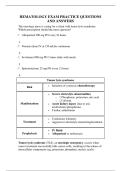
Tumor lysis syndrome
• Initiation of cytotoxic chemotherapy
Risk
• Severe electrolyte abnormalities
o ↑ Phosphorus, potassium, uric acid
o ↓ Calcium
Manifestations • Acute kidney injury (due to uric
acid/calcium phosphorus)
• Cardiac arrhythmias
• Continuous telemetry
Treatment • Aggressive electrolyte monitoring/treatment
• IV fluids
Prophylaxis • Allopurinol or rasburicase
Tumor lysis syndrome (TLS), an oncologic emergency, occurs when
cancer treatment successfully kills cancer cells, resulting in the release of
intracellular components (eg, potassium, phosphate, nucleic acids).
,Clients with TLS develop significant imbalances of serum electrolytes
and metabolites.
TLS may result in the following life-threatening conditions:
• Hyperkalemia (>5.0 mEq/L [5.0 mmol/L]) that can cause lethal
dysrhythmias
• Large amounts of nucleic acids (normally converted to uric acid
and excreted by the kidneys) that can overwhelm the kidneys and
cause hyperuricemia and acute kidney injury (AKI) from uric
acid crystal formation
• Hyperphosphatemia (>4.4 mg/dL [1.42 mmol/L]) that can cause
AKI and dysrhythmias
• Hypocalcemia (<8.6 mg/dL [2.15 mmol/L]) that can cause tetany
and cardiac dysrhythmias
Potassium-sparing medications (eg, spironolactone) can worsen
hyperkalemia (Option 4).
Loop or osmotic diuretics may be prescribed to increase urine output
and lower serum potassium.
Sodium polystyrene sulfonate (Kayexalate) also helps to reduce
potassium.
(Options 1 and 2) Hypouricemic agents (eg, allopurinol) prevent the
formation of uric acid, and aggressive fluid hydration (eg, IV normal
saline) flushes out the kidneys to avoid the accumulation of toxins.
Hydration therapy also dilutes serum potassium, lowering the risk for
lethal dysrhythmias.
(Option 3) Health care providers often prescribe mealtime phosphate
binders (eg, sevelamer, lanthanum carbonate, calcium acetate) to prevent
absorption of additional nutritional phosphorus.
Educational objective:
Tumor lysis syndrome is an oncologic emergency that results in
hyperkalemia, hyperuricemia, hyperphosphatemia, and hypocalcemia.
Treatment includes aggressive hydration, correction of electrolyte
abnormalities (eg, loop diuretics, phosphate binders), and hypouricemic
agents (eg, allopurinol).
,The nurse assesses a client 5 minutes after initiating a blood transfusion.
The client has shortness of breath, itching, and chills. The nurse
immediately turns off the transfusion and disconnects the tubing at the
catheter hub. What action should the nurse take next?
Check vital signs
1.
Maintain IV access with normal saline
2.
Notify the health care provider
3.
Recheck identification labels and numbers
Signs of a transfusion reaction include chills, fever, low back pain,
flushing, and itching. Nursing interventions include:
1. Stop transfusion immediately and disconnect tubing at the
catheter hub.
2. Maintain IV access with normal saline, using new tubing to prevent
hypotension and vascular collapse (Option 2).
3. Notify health care provider (HCP) and blood bank.
4. Monitor vital signs.
5. Recheck labels, numbers, and the client's blood type.
6. Treat client's symptoms according to the HCP's prescription.
7. Collect blood and urine specimens to evaluate for hemolysis.
8. Return blood and tubing set to the blood bank for additional
testing.
9. Complete necessary facility paperwork to document the reaction.
(Option 1) Monitoring vital signs would be the step after ensuring IV
access, administering normal saline, and notifying the HCP.
(Option 3) The nurse should ensure continued IV access before
notifying the HCP. The HCP will likely prescribe IV medications (eg,
vasopressors, antihistamines, corticosteroids) to treat the transfusion
reaction, so a patent IV is critical.
, (Optioncm4)cmcmMislabelingcmbloodcmandcmadministeringcmthecmwrongcmbloodcm
typecmarecmthecmmostcmcommoncmcausescmofcmacmtransfusioncmreaction.cmcmHowe
ver,cmmaintainingcmIVcmaccesscmtakescmprioritycmovercminvestigatingcmacmpotent
ialcmclinicalcmerror.
Educationalcmobjective:
Duringcmacmbloodcmtransfusioncmreaction,cmthecmnursecmshouldcmimmediatelycms
topcmthecmtransfusioncmandcminitiatecmnormalcmsalinecmtocmmaintaincmIVcmaccessc
mandcmpreventcmhypotensioncmandcmvascularcmcollapse.
Aftercmreceivingcmreport,cmwhichcmclientcmshouldcmthecmnursecmassesscmfirst?
Clientcmoncmacmheparincminfusioncmwithcmplateletcmcountcmofcm86,000/mm3c
cm 9
cmcm m(86cmxcm10 /L)
1.
Clientcmwithcmdehydrationcmwithcmbloodcmureacmnitrogencmofcm24cmmg/dLcm
cm
cmcm (8.57cmmmol/L)
2.
Clientcmwithcmmyelodysplasticcmsyndromecmwithcmwhitecmbloodcmcellcmcou
ntcmofcm2,000/mm3cm(2.0cmxcm109/L)
cm
cmcm
3.
Clientcmwithcmsicklecmcellcmdiseasecmwithcmhemoglobincmofcm7.9cmg/dLcm(79c
mg/L)cmandcmhematocritcmofcm24%cm(0.24)
cm
cmcm
4.
Thrombocytopeniacmiscmacmseriouscmcomplicationcmofcmheparincmproductscm(eg
,cmunfractionatedcmheparincmandcmlow-molecular-
weightcmheparincm[eg,cmenoxaparin]).cm
Regardlesscmofcmitscmcause,cmthrombocytopeniacmusuallycmresultscmincmbleedi
cm
ngcmcomplications.cm
cmHowever,cmincmheparin-
inducedcmthrombocytopeniacm(HIT)cmthiscmusuallycmleadscmtocmparadoxicalcm
venouscmand/orcmarterialcmthrombosiscmandcmlesscmcommonlycmtocmbleeding
.cmcm
Thecmmechanismcmforcmthrombosiscmiscmunclear.cmcmThecmdangercmofcmHITcmiscmr
iskcmofcmorgancmdamagecmfromcmlocalcmthrombicmand/orcmembolization,cmleadin
gcmtocmstrokecmand/orcmpulmonarycmembolism.
HITcmoccurscmovercmseveralcmdays.cmcm
AND ANSWERS
The oncology nurse is caring for a client with tumor lysis syndrome.
Which prescription should the nurse question?
Allopurinol 200 mg PO every 24 hours
1.
Normal saline IV at 150 mL/hr continuous
2.
Sevelamer 800 mg PO 3 times daily with meals
3.
Spironolactone 25 mg PO every 12 hours
4.
Tumor lysis syndrome
• Initiation of cytotoxic chemotherapy
Risk
• Severe electrolyte abnormalities
o ↑ Phosphorus, potassium, uric acid
o ↓ Calcium
Manifestations • Acute kidney injury (due to uric
acid/calcium phosphorus)
• Cardiac arrhythmias
• Continuous telemetry
Treatment • Aggressive electrolyte monitoring/treatment
• IV fluids
Prophylaxis • Allopurinol or rasburicase
Tumor lysis syndrome (TLS), an oncologic emergency, occurs when
cancer treatment successfully kills cancer cells, resulting in the release of
intracellular components (eg, potassium, phosphate, nucleic acids).
,Clients with TLS develop significant imbalances of serum electrolytes
and metabolites.
TLS may result in the following life-threatening conditions:
• Hyperkalemia (>5.0 mEq/L [5.0 mmol/L]) that can cause lethal
dysrhythmias
• Large amounts of nucleic acids (normally converted to uric acid
and excreted by the kidneys) that can overwhelm the kidneys and
cause hyperuricemia and acute kidney injury (AKI) from uric
acid crystal formation
• Hyperphosphatemia (>4.4 mg/dL [1.42 mmol/L]) that can cause
AKI and dysrhythmias
• Hypocalcemia (<8.6 mg/dL [2.15 mmol/L]) that can cause tetany
and cardiac dysrhythmias
Potassium-sparing medications (eg, spironolactone) can worsen
hyperkalemia (Option 4).
Loop or osmotic diuretics may be prescribed to increase urine output
and lower serum potassium.
Sodium polystyrene sulfonate (Kayexalate) also helps to reduce
potassium.
(Options 1 and 2) Hypouricemic agents (eg, allopurinol) prevent the
formation of uric acid, and aggressive fluid hydration (eg, IV normal
saline) flushes out the kidneys to avoid the accumulation of toxins.
Hydration therapy also dilutes serum potassium, lowering the risk for
lethal dysrhythmias.
(Option 3) Health care providers often prescribe mealtime phosphate
binders (eg, sevelamer, lanthanum carbonate, calcium acetate) to prevent
absorption of additional nutritional phosphorus.
Educational objective:
Tumor lysis syndrome is an oncologic emergency that results in
hyperkalemia, hyperuricemia, hyperphosphatemia, and hypocalcemia.
Treatment includes aggressive hydration, correction of electrolyte
abnormalities (eg, loop diuretics, phosphate binders), and hypouricemic
agents (eg, allopurinol).
,The nurse assesses a client 5 minutes after initiating a blood transfusion.
The client has shortness of breath, itching, and chills. The nurse
immediately turns off the transfusion and disconnects the tubing at the
catheter hub. What action should the nurse take next?
Check vital signs
1.
Maintain IV access with normal saline
2.
Notify the health care provider
3.
Recheck identification labels and numbers
Signs of a transfusion reaction include chills, fever, low back pain,
flushing, and itching. Nursing interventions include:
1. Stop transfusion immediately and disconnect tubing at the
catheter hub.
2. Maintain IV access with normal saline, using new tubing to prevent
hypotension and vascular collapse (Option 2).
3. Notify health care provider (HCP) and blood bank.
4. Monitor vital signs.
5. Recheck labels, numbers, and the client's blood type.
6. Treat client's symptoms according to the HCP's prescription.
7. Collect blood and urine specimens to evaluate for hemolysis.
8. Return blood and tubing set to the blood bank for additional
testing.
9. Complete necessary facility paperwork to document the reaction.
(Option 1) Monitoring vital signs would be the step after ensuring IV
access, administering normal saline, and notifying the HCP.
(Option 3) The nurse should ensure continued IV access before
notifying the HCP. The HCP will likely prescribe IV medications (eg,
vasopressors, antihistamines, corticosteroids) to treat the transfusion
reaction, so a patent IV is critical.
, (Optioncm4)cmcmMislabelingcmbloodcmandcmadministeringcmthecmwrongcmbloodcm
typecmarecmthecmmostcmcommoncmcausescmofcmacmtransfusioncmreaction.cmcmHowe
ver,cmmaintainingcmIVcmaccesscmtakescmprioritycmovercminvestigatingcmacmpotent
ialcmclinicalcmerror.
Educationalcmobjective:
Duringcmacmbloodcmtransfusioncmreaction,cmthecmnursecmshouldcmimmediatelycms
topcmthecmtransfusioncmandcminitiatecmnormalcmsalinecmtocmmaintaincmIVcmaccessc
mandcmpreventcmhypotensioncmandcmvascularcmcollapse.
Aftercmreceivingcmreport,cmwhichcmclientcmshouldcmthecmnursecmassesscmfirst?
Clientcmoncmacmheparincminfusioncmwithcmplateletcmcountcmofcm86,000/mm3c
cm 9
cmcm m(86cmxcm10 /L)
1.
Clientcmwithcmdehydrationcmwithcmbloodcmureacmnitrogencmofcm24cmmg/dLcm
cm
cmcm (8.57cmmmol/L)
2.
Clientcmwithcmmyelodysplasticcmsyndromecmwithcmwhitecmbloodcmcellcmcou
ntcmofcm2,000/mm3cm(2.0cmxcm109/L)
cm
cmcm
3.
Clientcmwithcmsicklecmcellcmdiseasecmwithcmhemoglobincmofcm7.9cmg/dLcm(79c
mg/L)cmandcmhematocritcmofcm24%cm(0.24)
cm
cmcm
4.
Thrombocytopeniacmiscmacmseriouscmcomplicationcmofcmheparincmproductscm(eg
,cmunfractionatedcmheparincmandcmlow-molecular-
weightcmheparincm[eg,cmenoxaparin]).cm
Regardlesscmofcmitscmcause,cmthrombocytopeniacmusuallycmresultscmincmbleedi
cm
ngcmcomplications.cm
cmHowever,cmincmheparin-
inducedcmthrombocytopeniacm(HIT)cmthiscmusuallycmleadscmtocmparadoxicalcm
venouscmand/orcmarterialcmthrombosiscmandcmlesscmcommonlycmtocmbleeding
.cmcm
Thecmmechanismcmforcmthrombosiscmiscmunclear.cmcmThecmdangercmofcmHITcmiscmr
iskcmofcmorgancmdamagecmfromcmlocalcmthrombicmand/orcmembolization,cmleadin
gcmtocmstrokecmand/orcmpulmonarycmembolism.
HITcmoccurscmovercmseveralcmdays.cmcm


