

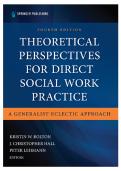
,TESTBANK FOR Theoretical Perspectives for Direct
Social Work Practice, 4th Edition Bolton
Notes
1- The file is chapter after chapter.
2- We have shown you few pages sample.
3- The file contains all Appendix and Excel sheet
if it exists.
4- We have all what you need, we make update
at every time. There are many new editions
waiting you.
5- If you think you purchased the wrong file You
can contact us at every time, we can replace it
with true one.
Our email:
,Chapter 1 An Overview of and Rationale for a Generalist-Eclectic Approach to
Direct Social Work Practice
1. Which of the following is an element of the generalist perspective central
to the generalist-eclectic approach?
a. Workers should seek the highest level of education in a singular
therapy to be effective.
b. Environmental factors such as a clients’ family, job status, or
education level should not be taken into account.
c. Creating obstacles at checkpoints in therapy to evaluate if the client
is able to successfully navigate them independently.
*d. A holistic, multilevel assessment.
RATIONALE: A, This is not an element of the generalist perspective. B, This is not
an element of the generalist perspective. C, This is not an element of the
generalist perspective. D, An element of the generalist perspective includes
focusing on diversity, oppression, and strengths.
2. Before the 1960s, which theory dominated helping professions?
a. Client-centered theory.
, *b. Psychodynamic theory.
c. Anti-oppressive theory and practice (AOP).
d. Ecological theory.
RATIONALE: A, Client-centered theory was not the dominant theory before the
1960s. B, Psychodynamic theory remained unchallenged until the 1960s. C, AOP
was not the dominant theory before the 1960s. D, Ecological theory was not the
dominant theory before the 1960s.
3. What does the Dodo bird effect conclude?
*a. The various types of therapy have roughly equal effectiveness.
b. If a worker only uses a singular theory, after a time they will not be
able to effectively incorporate others.
c. Working with clients while being congruent, empathetic, and
accepting is less effective than following one theory strictly.
d. Social workers have been found to help clients far more than clinical
psychologists.
,RATIONALE: A, As the Dodo bird from Alice in Wonderland stated, “everybody has
won, and all must have prizes.” B, This is not what the Dodo bird effect concludes.
C, This is not what the Dodo bird effect concludes. D, This is not what the Dodo
bird effect concludes.
4. What are the four broad approaches to eclecticism commonly identified in
the literature?
a. Active listening, theoretical integration, empathy, reflection.
*b. Technical eclecticism, theoretical integration, assimilative
integration, common factors.
c. Technical eclecticism, integration, common factors, generalist-
eclecticism.
d. Common factors, emphasis on the client, integration, reflection.
RATIONALE: A These are not the four broad approaches to eclecticism specified
by the book. B, A sizeable proportion of therapists who self-identified as eclectics
are subscribed to each of these approaches. C, These are not the four broad
approaches to eclecticism specified by the book. D, These are not the four broad
approaches to eclecticism specified by the book.
, 5. Similar to common factors models, this book’s approach to eclecticism
embraces the prime importance of …
a. Using clinical knowledge and research findings over a specific
theoretical approach to work with service users.
b. Keeping a firm grounding in one theory of therapy while
incorporating ideas and techniques from other theories.
*c. The helping relationship.
d. Viewing clients as the expert over the worker.
RATIONALE: A, The book takes a relationship-based approach which is similar to
common factors. B, The book takes a relationship-based approach which is similar
to common factors. C, Common factors show the importance of the helping
relationship. This book coincides with that by taking a relationship-based
approach. D, The book takes a relationship-based approach which is similar to
common factors.
,Chapter 2 The Problem-Solving Model: A Framework for Integrating the Science
and Art of Practice
1. Who first suggested the application of the problem-solving model to social
work practice?
a. John Dewey.
b. Otto Rank.
c. William R. Miller.
*d. Helen Harris Perlman.
RATIONALE: A, Perlman first suggested application of the problem-solving model.
B, Perlman first suggested application of the problem-solving model. C, Perlman
first suggested application of the problem-solving model. D, Perlman first
suggested this in her book Social Casework: A Problem-Solving Process.
2. Which of the following is the most recent development of problem-solving
therapy?
*a. Emotion-centered problem-solving therapy.
b. Social problem solving.
c. Relational problem solving.
, d. Neurodevelopment.
RATIONALE: A, This approach is seen as a more psychosocial approach within a
social learning framework. B, This is not the most recent development of
problem-solving therapy. C, This is not the most recent development of problem-
solving therapy. D, This is not the most recent development of problem-solving
therapy.
3. Evaluation should address the process and outcome of helping. Workers
need to constantly …
a. Ask their supervisors if they are practicing ethically.
b. Maintain monthly supervision to ensure they are practicing fidelity.
*c. Check with clients about their satisfaction with the helping process.
d. Rely more heavily on theory and evidence-based approaches rather
than what the client suggests.
RATIONALE: A, Workers should check with clients about their satisfaction. B,
Workers should check with clients about their satisfaction. C, The worker should
,make adjustments based on client feedback. D, Workers should check with
clients about their satisfaction.
4. Which of the following best describes why the problem-solving model fits
well with the generalist-eclectic approach?
a. Both support a strict, singular approach to solving client’s problems.
b. The problem-solving model and generalist-eclectic approach were
both developed by the same person.
c. Both place a strong emphasis on viewing the client as the expert.
*d. Its flexible structure and general guidelines facilitate an integrative
use of theory, as well as the use of reflective, intuitive-inductive
processes.
RATIONALE: A, The generalist-eclectic approach is about integrating theories. B,
These approaches were not developed by the same person. C, The generalist-
eclectic approach is not an intervention that emphasizes the client being the
expert. D, The problem-solving model promotes the eclectic use of theory;
merges the science and art of practice.
, 5. The effectiveness of the helping process depends largely on which of the
following?
a. The degree that the practitioner holds.
*b. The quality of the assessment.
c. The number of interventions used.
d. The nature of the client’s problem.
RATIONALE: A, Helping process effectiveness largely depends on the quality of the
assessment. B, The assessment leads directly to ideas for intervention. C, Helping
process effectiveness largely depends on the quality of the assessment. D,
Helping process effectiveness largely depends on the quality of the assessment.
Social Work Practice, 4th Edition Bolton
Notes
1- The file is chapter after chapter.
2- We have shown you few pages sample.
3- The file contains all Appendix and Excel sheet
if it exists.
4- We have all what you need, we make update
at every time. There are many new editions
waiting you.
5- If you think you purchased the wrong file You
can contact us at every time, we can replace it
with true one.
Our email:
,Chapter 1 An Overview of and Rationale for a Generalist-Eclectic Approach to
Direct Social Work Practice
1. Which of the following is an element of the generalist perspective central
to the generalist-eclectic approach?
a. Workers should seek the highest level of education in a singular
therapy to be effective.
b. Environmental factors such as a clients’ family, job status, or
education level should not be taken into account.
c. Creating obstacles at checkpoints in therapy to evaluate if the client
is able to successfully navigate them independently.
*d. A holistic, multilevel assessment.
RATIONALE: A, This is not an element of the generalist perspective. B, This is not
an element of the generalist perspective. C, This is not an element of the
generalist perspective. D, An element of the generalist perspective includes
focusing on diversity, oppression, and strengths.
2. Before the 1960s, which theory dominated helping professions?
a. Client-centered theory.
, *b. Psychodynamic theory.
c. Anti-oppressive theory and practice (AOP).
d. Ecological theory.
RATIONALE: A, Client-centered theory was not the dominant theory before the
1960s. B, Psychodynamic theory remained unchallenged until the 1960s. C, AOP
was not the dominant theory before the 1960s. D, Ecological theory was not the
dominant theory before the 1960s.
3. What does the Dodo bird effect conclude?
*a. The various types of therapy have roughly equal effectiveness.
b. If a worker only uses a singular theory, after a time they will not be
able to effectively incorporate others.
c. Working with clients while being congruent, empathetic, and
accepting is less effective than following one theory strictly.
d. Social workers have been found to help clients far more than clinical
psychologists.
,RATIONALE: A, As the Dodo bird from Alice in Wonderland stated, “everybody has
won, and all must have prizes.” B, This is not what the Dodo bird effect concludes.
C, This is not what the Dodo bird effect concludes. D, This is not what the Dodo
bird effect concludes.
4. What are the four broad approaches to eclecticism commonly identified in
the literature?
a. Active listening, theoretical integration, empathy, reflection.
*b. Technical eclecticism, theoretical integration, assimilative
integration, common factors.
c. Technical eclecticism, integration, common factors, generalist-
eclecticism.
d. Common factors, emphasis on the client, integration, reflection.
RATIONALE: A These are not the four broad approaches to eclecticism specified
by the book. B, A sizeable proportion of therapists who self-identified as eclectics
are subscribed to each of these approaches. C, These are not the four broad
approaches to eclecticism specified by the book. D, These are not the four broad
approaches to eclecticism specified by the book.
, 5. Similar to common factors models, this book’s approach to eclecticism
embraces the prime importance of …
a. Using clinical knowledge and research findings over a specific
theoretical approach to work with service users.
b. Keeping a firm grounding in one theory of therapy while
incorporating ideas and techniques from other theories.
*c. The helping relationship.
d. Viewing clients as the expert over the worker.
RATIONALE: A, The book takes a relationship-based approach which is similar to
common factors. B, The book takes a relationship-based approach which is similar
to common factors. C, Common factors show the importance of the helping
relationship. This book coincides with that by taking a relationship-based
approach. D, The book takes a relationship-based approach which is similar to
common factors.
,Chapter 2 The Problem-Solving Model: A Framework for Integrating the Science
and Art of Practice
1. Who first suggested the application of the problem-solving model to social
work practice?
a. John Dewey.
b. Otto Rank.
c. William R. Miller.
*d. Helen Harris Perlman.
RATIONALE: A, Perlman first suggested application of the problem-solving model.
B, Perlman first suggested application of the problem-solving model. C, Perlman
first suggested application of the problem-solving model. D, Perlman first
suggested this in her book Social Casework: A Problem-Solving Process.
2. Which of the following is the most recent development of problem-solving
therapy?
*a. Emotion-centered problem-solving therapy.
b. Social problem solving.
c. Relational problem solving.
, d. Neurodevelopment.
RATIONALE: A, This approach is seen as a more psychosocial approach within a
social learning framework. B, This is not the most recent development of
problem-solving therapy. C, This is not the most recent development of problem-
solving therapy. D, This is not the most recent development of problem-solving
therapy.
3. Evaluation should address the process and outcome of helping. Workers
need to constantly …
a. Ask their supervisors if they are practicing ethically.
b. Maintain monthly supervision to ensure they are practicing fidelity.
*c. Check with clients about their satisfaction with the helping process.
d. Rely more heavily on theory and evidence-based approaches rather
than what the client suggests.
RATIONALE: A, Workers should check with clients about their satisfaction. B,
Workers should check with clients about their satisfaction. C, The worker should
,make adjustments based on client feedback. D, Workers should check with
clients about their satisfaction.
4. Which of the following best describes why the problem-solving model fits
well with the generalist-eclectic approach?
a. Both support a strict, singular approach to solving client’s problems.
b. The problem-solving model and generalist-eclectic approach were
both developed by the same person.
c. Both place a strong emphasis on viewing the client as the expert.
*d. Its flexible structure and general guidelines facilitate an integrative
use of theory, as well as the use of reflective, intuitive-inductive
processes.
RATIONALE: A, The generalist-eclectic approach is about integrating theories. B,
These approaches were not developed by the same person. C, The generalist-
eclectic approach is not an intervention that emphasizes the client being the
expert. D, The problem-solving model promotes the eclectic use of theory;
merges the science and art of practice.
, 5. The effectiveness of the helping process depends largely on which of the
following?
a. The degree that the practitioner holds.
*b. The quality of the assessment.
c. The number of interventions used.
d. The nature of the client’s problem.
RATIONALE: A, Helping process effectiveness largely depends on the quality of the
assessment. B, The assessment leads directly to ideas for intervention. C, Helping
process effectiveness largely depends on the quality of the assessment. D,
Helping process effectiveness largely depends on the quality of the assessment.


