

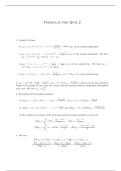
Formulas for Quiz 2
1. Annuity-Certain:
h i
1−v n 1−v n
• an̄|i = v + v 2 + v 3 + · · · + v n = v 1−v = i is pv of the annuity-immediate.
n −1
• sn̄|i = 1 + (1 + i) + · · · + (1 + i)n−1 = (1+i)i is av of the annuity-immediate. We have
sn̄|i = (1 + i)n · an̄|i and an̄|i = v n · sn̄|i .
n 1−v n
• än̄|i = 1 + v + · · · + v n−1 = 1−v
1−v = d is pv of the annuity-due. We have än̄|i =
n
(1 + i)an̄|i = an̄|i + 1 − v = 1 + an−1|i .
(1+i)n −1
• s̈n̄|i = (1 + i) + · · · + (1 + i)n = d = (1 + i)n än̄|i is av of the annuity-due.
−nδ n
= 1−eδ , s̄n̄|i = (1 + i)n ān̄|i = (1+i)δ −1 is the pv at the time payment
Rn n
2. ān̄|i = 0 v t dt = 1−v
δ
begins of an annuity of 1 per year for n years, with the payment spread continuously throughout
(∞)
each year. We have ān̄|i = an̄|i .
3. Increasing and decreasing annuities:
än̄|i −nv n s̈n̄|i −n
• (Ia)n̄| = v + 2v 2 + 3v 3 + · · · + nv n = i , (Is)n̄| = (1 + i)n (Ia)n̄| = i .
n−an̄| n(1+i)n −sn̄|
• (Da)n̄| = nv + (n − 1)v 2 + · · · + v n = i and (Ds)n̄| = (1 + i)n (Da)n̄| = i .
• The continuous versions of the increasing and decreasing annuities are given by
ān̄| − nv n
Z n
s̄n̄| − n
¯ n̄| =
(Iā) tv t dt = , (I¯s̄)n̄| = ;
0 δ δ
n(1 + i)n − s̄n̄|
Z n
n − ān̄|
(D̄ā)n̄| = (n − t)v t dt = , (D̄s̄)n̄| = .
0 δ δ
4. We have
P[Tx ≤ t] = P[T0 − x ≤ t|T0 > x] = P[T0 ≤ x + t|T0 > x]
P[x < T0 ≤ x + t] F0 (x + t) − F0 (x) S0 (x) − S0 (x + t)
= = = .
P[T0 > x] 1 − F0 (x) S0 (x)
1
, 5. For n ≤ t, we have tpx = npx · t−npx+n .
6. For deferred mortality probability, we have
t|u qx = tpx · uqx+t = t+uqx − tqx = tpx − t+upx
S0 (x + t) − S0 (x + t + u)
= P[t < Tx ≤ t + u] =
S0 (x)
= Sx (t) − Sx (t + u).
7. We have
P[Kx = k] = P[k < Tx ≤ k + 1] = k|1qx = k|qx
= kpx · qx+k = kpx − k+1px = k+1qx − k qx .
8. If n ≥ t are integers, then
n−1
X
n qx = t qx + t|n−t qx = qx + 1| qx + · · · + n−1| qx = k| qx .
k=0
d d d d S0′ (x+t)
9. The pdf of Tx is fx (t) = dt Fx (t) = − dt Sx (t) = dt t qx = − dt tpx = tpx · µx+t = − S0 (x) . Some
important relationships involving Tx are
R x+n Rn
• ln( npx ) = − x µs ds = − 0 µx+t dt.
Rn Rn R1
• n qx = P[0 < Tx ≤ n] = 0 fx (s)ds = 0 spx · µx+s ds and qx = 0 spx · µx+s ds
R x+n Rn R∞ R∞
• −
npx = eR x
µs ds
= e− 0 µx+t dt
, npx = P[Tx > n] = n fx (s)ds = n spx · µx+s ds and
t+u
t|u qx = t spx · µx+s ds.
R∞ R∞
• As ∞px = e− 0 µx+s ds
= 0, it follows that 0 µx+s ds = ∞.
R∞
• as a pdf, fx (s) = spx µx+s must satisfy 0 spx µx+s ds = 1.
10. Some life-table formulas:
(i) dx = lx − lx+1 is the number of deaths between ages x and x + 1.
(ii) lx+1 = lx − dx .
(iii) The number of deaths between ages x and x+n is ndx = lx −lx+n = dx +dx+1 +· · ·+dx+n−1 .
2
1. Annuity-Certain:
h i
1−v n 1−v n
• an̄|i = v + v 2 + v 3 + · · · + v n = v 1−v = i is pv of the annuity-immediate.
n −1
• sn̄|i = 1 + (1 + i) + · · · + (1 + i)n−1 = (1+i)i is av of the annuity-immediate. We have
sn̄|i = (1 + i)n · an̄|i and an̄|i = v n · sn̄|i .
n 1−v n
• än̄|i = 1 + v + · · · + v n−1 = 1−v
1−v = d is pv of the annuity-due. We have än̄|i =
n
(1 + i)an̄|i = an̄|i + 1 − v = 1 + an−1|i .
(1+i)n −1
• s̈n̄|i = (1 + i) + · · · + (1 + i)n = d = (1 + i)n än̄|i is av of the annuity-due.
−nδ n
= 1−eδ , s̄n̄|i = (1 + i)n ān̄|i = (1+i)δ −1 is the pv at the time payment
Rn n
2. ān̄|i = 0 v t dt = 1−v
δ
begins of an annuity of 1 per year for n years, with the payment spread continuously throughout
(∞)
each year. We have ān̄|i = an̄|i .
3. Increasing and decreasing annuities:
än̄|i −nv n s̈n̄|i −n
• (Ia)n̄| = v + 2v 2 + 3v 3 + · · · + nv n = i , (Is)n̄| = (1 + i)n (Ia)n̄| = i .
n−an̄| n(1+i)n −sn̄|
• (Da)n̄| = nv + (n − 1)v 2 + · · · + v n = i and (Ds)n̄| = (1 + i)n (Da)n̄| = i .
• The continuous versions of the increasing and decreasing annuities are given by
ān̄| − nv n
Z n
s̄n̄| − n
¯ n̄| =
(Iā) tv t dt = , (I¯s̄)n̄| = ;
0 δ δ
n(1 + i)n − s̄n̄|
Z n
n − ān̄|
(D̄ā)n̄| = (n − t)v t dt = , (D̄s̄)n̄| = .
0 δ δ
4. We have
P[Tx ≤ t] = P[T0 − x ≤ t|T0 > x] = P[T0 ≤ x + t|T0 > x]
P[x < T0 ≤ x + t] F0 (x + t) − F0 (x) S0 (x) − S0 (x + t)
= = = .
P[T0 > x] 1 − F0 (x) S0 (x)
1
, 5. For n ≤ t, we have tpx = npx · t−npx+n .
6. For deferred mortality probability, we have
t|u qx = tpx · uqx+t = t+uqx − tqx = tpx − t+upx
S0 (x + t) − S0 (x + t + u)
= P[t < Tx ≤ t + u] =
S0 (x)
= Sx (t) − Sx (t + u).
7. We have
P[Kx = k] = P[k < Tx ≤ k + 1] = k|1qx = k|qx
= kpx · qx+k = kpx − k+1px = k+1qx − k qx .
8. If n ≥ t are integers, then
n−1
X
n qx = t qx + t|n−t qx = qx + 1| qx + · · · + n−1| qx = k| qx .
k=0
d d d d S0′ (x+t)
9. The pdf of Tx is fx (t) = dt Fx (t) = − dt Sx (t) = dt t qx = − dt tpx = tpx · µx+t = − S0 (x) . Some
important relationships involving Tx are
R x+n Rn
• ln( npx ) = − x µs ds = − 0 µx+t dt.
Rn Rn R1
• n qx = P[0 < Tx ≤ n] = 0 fx (s)ds = 0 spx · µx+s ds and qx = 0 spx · µx+s ds
R x+n Rn R∞ R∞
• −
npx = eR x
µs ds
= e− 0 µx+t dt
, npx = P[Tx > n] = n fx (s)ds = n spx · µx+s ds and
t+u
t|u qx = t spx · µx+s ds.
R∞ R∞
• As ∞px = e− 0 µx+s ds
= 0, it follows that 0 µx+s ds = ∞.
R∞
• as a pdf, fx (s) = spx µx+s must satisfy 0 spx µx+s ds = 1.
10. Some life-table formulas:
(i) dx = lx − lx+1 is the number of deaths between ages x and x + 1.
(ii) lx+1 = lx − dx .
(iii) The number of deaths between ages x and x+n is ndx = lx −lx+n = dx +dx+1 +· · ·+dx+n−1 .
2


