
FOR MORE EXAMS
EMAIL:
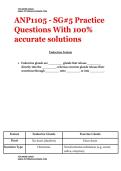
ANP1105 - SG#5 Practice
Questions With 100%
accurate solutions
Endocrine System
1. Endocrine glands are __________ glands that release __________
directly into the __________, whereas exocrine glands release their
secretions through __________ onto __________ or into __________.
Feature Endocrine Glands Exocrine Glands
Ducts No ducts (ductless) Have ducts
Secretion Type Hormones Non-hormonal substances (e.g. sweat,
saliva, enzymes)
FOR MORE EXAMS
EMAIL:
, FOR MORE EXAMS
EMAIL:
Secretion Into bloodstream or lymph Onto body surface or into body cavity
Pathway
Example Organs Pituitary, thyroid, adrenal Sweat glands, salivary glands, pancreas
glands (both)
Function Internal communication via External secretion for localized effects
hormones
Mode of Via Exocytosis into - Merocrine: by exocytosis (e.g. salivary,
Secretion surrounding ECM sweat glands)
- Apocrine: part of cell pinches off (e.g.
mammary glands)
- Holocrine: entire cell ruptures (e.g.
sebaceous glands)
2. With respect to hormone classification, what are the 2 main
structural group classes? Can you provide an example hormone for
each one?
• .
• .
Hormone Class Description Examples
FOR MORE EXAMS
EMAIL:
, FOR MORE EXAMS
EMAIL:
Amino acid– Made from amino acids; usually - Insulin (pancreas)
based (proteins watersoluble and act via second
- Epinephrine (adrenal medulla)
& peptides) messengers (cannot cross cell
membrane). - Growth hormone (GH) (anterior
pituitary)
- Thyroid hormone (unique: amino
acid–based but acts like a steroid)
Steroid Synthesized from cholesterol; - Cortisol (adrenal cortex)
hormones lipidsoluble, diffuse through
- Aldosterone (adrenal cortex)
(cholesterol membranes and act via direct
derivatives) gene activation. - Estrogen, Testosterone, Progesterone
(gonads)
3. A hormones chemical structure determines its solubility properties,
what are the 2 hormone solubility classifications?
• .
FOR MORE EXAMS
EMAIL:
EMAIL:
ANP1105 - SG#5 Practice
Questions With 100%
accurate solutions
Endocrine System
1. Endocrine glands are __________ glands that release __________
directly into the __________, whereas exocrine glands release their
secretions through __________ onto __________ or into __________.
Feature Endocrine Glands Exocrine Glands
Ducts No ducts (ductless) Have ducts
Secretion Type Hormones Non-hormonal substances (e.g. sweat,
saliva, enzymes)
FOR MORE EXAMS
EMAIL:
, FOR MORE EXAMS
EMAIL:
Secretion Into bloodstream or lymph Onto body surface or into body cavity
Pathway
Example Organs Pituitary, thyroid, adrenal Sweat glands, salivary glands, pancreas
glands (both)
Function Internal communication via External secretion for localized effects
hormones
Mode of Via Exocytosis into - Merocrine: by exocytosis (e.g. salivary,
Secretion surrounding ECM sweat glands)
- Apocrine: part of cell pinches off (e.g.
mammary glands)
- Holocrine: entire cell ruptures (e.g.
sebaceous glands)
2. With respect to hormone classification, what are the 2 main
structural group classes? Can you provide an example hormone for
each one?
• .
• .
Hormone Class Description Examples
FOR MORE EXAMS
EMAIL:
, FOR MORE EXAMS
EMAIL:
Amino acid– Made from amino acids; usually - Insulin (pancreas)
based (proteins watersoluble and act via second
- Epinephrine (adrenal medulla)
& peptides) messengers (cannot cross cell
membrane). - Growth hormone (GH) (anterior
pituitary)
- Thyroid hormone (unique: amino
acid–based but acts like a steroid)
Steroid Synthesized from cholesterol; - Cortisol (adrenal cortex)
hormones lipidsoluble, diffuse through
- Aldosterone (adrenal cortex)
(cholesterol membranes and act via direct
derivatives) gene activation. - Estrogen, Testosterone, Progesterone
(gonads)
3. A hormones chemical structure determines its solubility properties,
what are the 2 hormone solubility classifications?
• .
FOR MORE EXAMS
EMAIL:


