

ECE 3030 FINAL EXAM PAUL BERGER Q&A
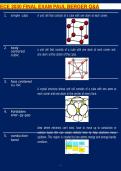
1. simple cubic A unit cell that consists of a cube with one atom at each corner.
2. body a unit cell that consists of a cube with one atom at each corner and
centered
cubic one atom at the center of the cube.
3. face centered
cu- bic
A crystal structure whose unit cell consists of a cube with one atom at
each corner and one atom in the center of every face.
4. Forbidden
ener- gy gap
Area where electrons can't exist, have to move up to conduction or
valence band. We can create defects here to help electrons move
5. conduction up/down. This region is created by two atoms merge and energy bands
band
combine.
,ECE 3030 FINAL EXAM PAUL BERGER Q&A
A band of molecular orbitals lying higher in energy than the occupied
valence band, and distinctly separated from it.
6. valence band A band of closely spaced molecular orbitals that is essentially fully occupied
by
electrons. Holes are created here.
7. Interstitial defect A point defect produced when an atom is placed into the crystal at a site
that is
normally not a lattice point.
8. Insulator large in this material.
band gap
9. Semiconducto
r band gap
small in this material.
,ECE 3030 FINAL EXAM PAUL BERGER Q&A
10. Metal band gap overlapping in this material.
11. Fermi-Dirac dis- Tells us the probability of finding an electron at an energy state E with
tribution
temper- ature T. This is one of the items that binds the extrema of carrier
concentration "sails". When Fermi levels are near conduction band, the
probability of finding an electron is high and when it is near the
valence band, the probability of finding an electron is low as the whole
distribution moves down (electrons are already occupied) so therefore
there are more holes.
12. electron hole A vacant position in a crystal left by the absence of an electron, especially a
position in a semiconductor that acts as a carrier of positive electric
,ECE 3030 FINAL EXAM PAUL BERGER Q&A
charge.
13.
1. simple cubic A unit cell that consists of a cube with one atom at each corner.
2. body a unit cell that consists of a cube with one atom at each corner and
centered
cubic one atom at the center of the cube.
3. face centered
cu- bic
A crystal structure whose unit cell consists of a cube with one atom at
each corner and one atom in the center of every face.
4. Forbidden
ener- gy gap
Area where electrons can't exist, have to move up to conduction or
valence band. We can create defects here to help electrons move
5. conduction up/down. This region is created by two atoms merge and energy bands
band
combine.
,ECE 3030 FINAL EXAM PAUL BERGER Q&A
A band of molecular orbitals lying higher in energy than the occupied
valence band, and distinctly separated from it.
6. valence band A band of closely spaced molecular orbitals that is essentially fully occupied
by
electrons. Holes are created here.
7. Interstitial defect A point defect produced when an atom is placed into the crystal at a site
that is
normally not a lattice point.
8. Insulator large in this material.
band gap
9. Semiconducto
r band gap
small in this material.
,ECE 3030 FINAL EXAM PAUL BERGER Q&A
10. Metal band gap overlapping in this material.
11. Fermi-Dirac dis- Tells us the probability of finding an electron at an energy state E with
tribution
temper- ature T. This is one of the items that binds the extrema of carrier
concentration "sails". When Fermi levels are near conduction band, the
probability of finding an electron is high and when it is near the
valence band, the probability of finding an electron is low as the whole
distribution moves down (electrons are already occupied) so therefore
there are more holes.
12. electron hole A vacant position in a crystal left by the absence of an electron, especially a
position in a semiconductor that acts as a carrier of positive electric
,ECE 3030 FINAL EXAM PAUL BERGER Q&A
charge.
13.


