

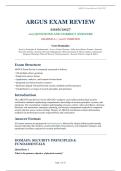
ARGUS Exam Review 2026/2027
ARGUS EXAM REVIEW
2026/2027
100 QUESTIONS AND CORRECT ANSWERS
GRADED A+ | 100% VERIFIED
Core Domains
Security Principles & Fundamentals | Access Control Systems | Video Surveillance Systems | Intrusion
Detection Systems | Security Personnel Management | Risk Assessment & Threat Analysis | Emergency
Response Planning | Physical Security Countermeasures | Security Policies, Legal & Ethics
Exam Structure
ARGUS Exam Review is commonly structured as follows:
• 100 multiple-choice questions
• Single-best-answer format
• Application-, analysis-, and scenario-focused items
• Integrated case-based security scenarios
• Questions aligned with professional security standards and best practices
• Comprehensive coverage of security principles and operations
Introduction
This ARGUS Exam Review for the 2026/2027 academic cycle reflects professional security
certification standards emphasizing comprehensive knowledge of security principles, systems, and
operations. The examination evaluates understanding of access control, video surveillance, intrusion
detection, risk assessment, emergency planning, and security management required for competent
security practice across various settings. Mastery of ARGUS examination content demonstrates
readiness for professional security responsibilities and certification.
Answer Format
All correct answers are presented in bold and green, followed by clearly defined, professionally
focused rationales that reinforce security principles, best practices, risk mitigation strategies, and
operational excellence required for security professionals.
DOMAIN: SECURITY PRINCIPLES &
FUNDAMENTALS
Question 1
What is the primary objective of physical security?
Page 1 of 33
, ARGUS Exam Review 2026/2027
A. To maximize profit
B. To protect people, property, and information
C. To minimize employee workload
D. To reduce insurance costs
Correct Answer: To protect people, property, and information
Rationale: The primary objective of physical security is the protection of people, property, and
information from harm, loss, or unauthorized access. This fundamental principle guides all security
decisions and resource allocations. Physical security measures create layers of protection that deter,
detect, delay, and deny potential threats. The protection of human life always takes precedence over
property and information protection in security planning and emergency response scenarios.
Question 2
What does the acronym DDDI represent in security?
A. Detect, Deter, Delay, Investigate
B. Deter, Detect, Delay, Intervention
C. Document, Detect, Deter, Inspect
D. Deny, Detect, Delay, Investigate
Correct Answer: Deter, Detect, Delay, Intervention
Rationale: DDDI represents the four key functions of physical security: Deter (discourage potential
threats through visible security measures), Detect (identify security breaches or suspicious activity),
Delay (slow down intruders to allow response), and Intervention (respond appropriately to security
incidents). This framework guides the design and implementation of comprehensive security
programs. Each element works together to create an effective security posture that reduces
vulnerability and risk.
Question 3
What is the concept of 'defense in depth'?
A. Using a single strong security barrier
B. Multiple layers of security measures working together
C. Focusing only on perimeter security
D. Relying solely on technology for protection
Correct Answer: Multiple layers of security measures working together
Rationale: Defense in depth is a security strategy that employs multiple layers of protection to
safeguard assets. If one layer fails, additional layers provide continued protection. This approach
includes physical barriers, electronic systems, procedures, and personnel working together. The
concept recognizes that no single security measure is foolproof, and redundancy is essential for
effective protection. Layers typically include outer perimeter, building exterior, interior zones, and
asset-specific protection.
Question 4
What is the 'security triangle' concept?
A. Cost, Quality, Speed
B. Deterrence, Detection, Delay
C. People, Procedures, Physical Security
D. Prevention, Protection, Prosecution
Correct Answer: People, Procedures, Physical Security
Page 2 of 33
, ARGUS Exam Review 2026/2027
Rationale: The security triangle consists of three interdependent elements: People (security personnel
and employees), Procedures (policies and protocols), and Physical Security (barriers, locks, and
technology). All three elements must work together for an effective security program. Weakness in
any one element compromises the entire security system. This model emphasizes that security is not
solely about technology or guards, but requires integration of human resources, documented
procedures, and physical measures.
Question 5
What is the primary purpose of a security assessment?
A. To reduce security costs
B. To identify vulnerabilities and recommend improvements
C. To terminate security personnel
D. To document employee behavior
Correct Answer: To identify vulnerabilities and recommend improvements
Rationale: A security assessment systematically evaluates existing security measures, identifies
vulnerabilities, and recommends improvements to reduce risk. Assessments examine physical
security, procedures, personnel, and technology to determine adequacy and effectiveness. Regular
assessments are essential for maintaining current protection as threats and assets evolve. The
assessment process includes threat identification, asset valuation, vulnerability analysis, and risk
mitigation recommendations tailored to the organization's specific needs.
Question 6
What is 'target hardening' in security?
A. Training security personnel
B. Strengthening security measures to make attacks more difficult
C. Increasing the number of security cameras
D. Improving employee awareness programs
Correct Answer: Strengthening security measures to make attacks more difficult
Rationale: Target hardening involves strengthening security measures to make a facility or asset more
difficult to attack or penetrate. This includes physical improvements such as reinforced doors,
upgraded locks, improved lighting, and enhanced barriers. The goal is to increase the effort, time, and
resources required for a successful attack, thereby reducing the likelihood of attack success. Target
hardening is a fundamental strategy in crime prevention through environmental design (CPTED) and
physical security planning.
Question 7
What is the 'broken windows theory' in security?
A. Buildings with broken windows have better security
B. Visible signs of disorder encourage further crime and disorder
C. Security should focus on window protection
D. Criminals avoid buildings with broken windows
Correct Answer: Visible signs of disorder encourage further crime and disorder
Rationale: The broken windows theory suggests that visible signs of disorder, neglect, and minor
offenses (like broken windows) create an environment that encourages more serious crime.
Maintaining order, promptly repairing damage, and addressing minor violations prevents escalation to
serious criminal activity. This theory supports proactive security measures and emphasizes the
Page 3 of 33
, ARGUS Exam Review 2026/2027
importance of environmental maintenance in crime prevention. Security programs should address
small problems before they create opportunities for larger security breaches.
Question 8
What is the difference between 'threat' and 'risk'?
A. They are the same concept
B. Threat is potential danger; risk is the likelihood and impact of that danger
C. Threat is internal; risk is external
D. Threat is minor; risk is major
Correct Answer: Threat is potential danger; risk is the likelihood and impact of that danger
Rationale: A threat is any potential danger that could exploit a vulnerability to cause harm, while risk
is the combination of the likelihood that a threat will occur and the impact if it does. Risk = Threat ×
Vulnerability × Consequence. Understanding this distinction is crucial for risk assessment and
resource allocation. Organizations must identify threats, assess vulnerabilities, and evaluate potential
consequences to determine acceptable risk levels and implement appropriate mitigation strategies.
Question 9
What is 'situational crime prevention'?
A. Punishing criminals after offenses
B. Reducing opportunities for crime through environmental design and management
C. Increasing police presence everywhere
D. Educating the public about crime statistics
Correct Answer: Reducing opportunities for crime through environmental design and
management
Rationale: Situational crime prevention focuses on reducing opportunities for crime through
environmental design, management, and strategic interventions. It increases the effort and risk for
offenders while reducing potential rewards. Techniques include access control, surveillance, territorial
reinforcement, and target hardening. This proactive approach addresses the conditions that enable
crime rather than focusing solely on offender motivation. Effective situational prevention considers
the specific environment, patterns of criminal behavior, and practical intervention opportunities.
Question 10
What is the '3-D approach' to security?
A. Detect, Document, Detain
B. Deter, Detect, Delay
C. Define, Design, Deploy
D. Deny, Defend, Document
Correct Answer: Deter, Detect, Delay
Rationale: The 3-D approach to security (Deter, Detect, Delay) provides a framework for designing
effective security programs. Deter involves visible security measures that discourage potential threats.
Detect involves systems and procedures that identify security breaches or suspicious activity. Delay
involves barriers and procedures that slow intruders, providing time for response. This approach
ensures comprehensive protection by addressing prevention, identification, and response timing in
security planning.
Question 11
What is 'natural surveillance' in CPTED?
Page 4 of 33
ARGUS EXAM REVIEW
2026/2027
100 QUESTIONS AND CORRECT ANSWERS
GRADED A+ | 100% VERIFIED
Core Domains
Security Principles & Fundamentals | Access Control Systems | Video Surveillance Systems | Intrusion
Detection Systems | Security Personnel Management | Risk Assessment & Threat Analysis | Emergency
Response Planning | Physical Security Countermeasures | Security Policies, Legal & Ethics
Exam Structure
ARGUS Exam Review is commonly structured as follows:
• 100 multiple-choice questions
• Single-best-answer format
• Application-, analysis-, and scenario-focused items
• Integrated case-based security scenarios
• Questions aligned with professional security standards and best practices
• Comprehensive coverage of security principles and operations
Introduction
This ARGUS Exam Review for the 2026/2027 academic cycle reflects professional security
certification standards emphasizing comprehensive knowledge of security principles, systems, and
operations. The examination evaluates understanding of access control, video surveillance, intrusion
detection, risk assessment, emergency planning, and security management required for competent
security practice across various settings. Mastery of ARGUS examination content demonstrates
readiness for professional security responsibilities and certification.
Answer Format
All correct answers are presented in bold and green, followed by clearly defined, professionally
focused rationales that reinforce security principles, best practices, risk mitigation strategies, and
operational excellence required for security professionals.
DOMAIN: SECURITY PRINCIPLES &
FUNDAMENTALS
Question 1
What is the primary objective of physical security?
Page 1 of 33
, ARGUS Exam Review 2026/2027
A. To maximize profit
B. To protect people, property, and information
C. To minimize employee workload
D. To reduce insurance costs
Correct Answer: To protect people, property, and information
Rationale: The primary objective of physical security is the protection of people, property, and
information from harm, loss, or unauthorized access. This fundamental principle guides all security
decisions and resource allocations. Physical security measures create layers of protection that deter,
detect, delay, and deny potential threats. The protection of human life always takes precedence over
property and information protection in security planning and emergency response scenarios.
Question 2
What does the acronym DDDI represent in security?
A. Detect, Deter, Delay, Investigate
B. Deter, Detect, Delay, Intervention
C. Document, Detect, Deter, Inspect
D. Deny, Detect, Delay, Investigate
Correct Answer: Deter, Detect, Delay, Intervention
Rationale: DDDI represents the four key functions of physical security: Deter (discourage potential
threats through visible security measures), Detect (identify security breaches or suspicious activity),
Delay (slow down intruders to allow response), and Intervention (respond appropriately to security
incidents). This framework guides the design and implementation of comprehensive security
programs. Each element works together to create an effective security posture that reduces
vulnerability and risk.
Question 3
What is the concept of 'defense in depth'?
A. Using a single strong security barrier
B. Multiple layers of security measures working together
C. Focusing only on perimeter security
D. Relying solely on technology for protection
Correct Answer: Multiple layers of security measures working together
Rationale: Defense in depth is a security strategy that employs multiple layers of protection to
safeguard assets. If one layer fails, additional layers provide continued protection. This approach
includes physical barriers, electronic systems, procedures, and personnel working together. The
concept recognizes that no single security measure is foolproof, and redundancy is essential for
effective protection. Layers typically include outer perimeter, building exterior, interior zones, and
asset-specific protection.
Question 4
What is the 'security triangle' concept?
A. Cost, Quality, Speed
B. Deterrence, Detection, Delay
C. People, Procedures, Physical Security
D. Prevention, Protection, Prosecution
Correct Answer: People, Procedures, Physical Security
Page 2 of 33
, ARGUS Exam Review 2026/2027
Rationale: The security triangle consists of three interdependent elements: People (security personnel
and employees), Procedures (policies and protocols), and Physical Security (barriers, locks, and
technology). All three elements must work together for an effective security program. Weakness in
any one element compromises the entire security system. This model emphasizes that security is not
solely about technology or guards, but requires integration of human resources, documented
procedures, and physical measures.
Question 5
What is the primary purpose of a security assessment?
A. To reduce security costs
B. To identify vulnerabilities and recommend improvements
C. To terminate security personnel
D. To document employee behavior
Correct Answer: To identify vulnerabilities and recommend improvements
Rationale: A security assessment systematically evaluates existing security measures, identifies
vulnerabilities, and recommends improvements to reduce risk. Assessments examine physical
security, procedures, personnel, and technology to determine adequacy and effectiveness. Regular
assessments are essential for maintaining current protection as threats and assets evolve. The
assessment process includes threat identification, asset valuation, vulnerability analysis, and risk
mitigation recommendations tailored to the organization's specific needs.
Question 6
What is 'target hardening' in security?
A. Training security personnel
B. Strengthening security measures to make attacks more difficult
C. Increasing the number of security cameras
D. Improving employee awareness programs
Correct Answer: Strengthening security measures to make attacks more difficult
Rationale: Target hardening involves strengthening security measures to make a facility or asset more
difficult to attack or penetrate. This includes physical improvements such as reinforced doors,
upgraded locks, improved lighting, and enhanced barriers. The goal is to increase the effort, time, and
resources required for a successful attack, thereby reducing the likelihood of attack success. Target
hardening is a fundamental strategy in crime prevention through environmental design (CPTED) and
physical security planning.
Question 7
What is the 'broken windows theory' in security?
A. Buildings with broken windows have better security
B. Visible signs of disorder encourage further crime and disorder
C. Security should focus on window protection
D. Criminals avoid buildings with broken windows
Correct Answer: Visible signs of disorder encourage further crime and disorder
Rationale: The broken windows theory suggests that visible signs of disorder, neglect, and minor
offenses (like broken windows) create an environment that encourages more serious crime.
Maintaining order, promptly repairing damage, and addressing minor violations prevents escalation to
serious criminal activity. This theory supports proactive security measures and emphasizes the
Page 3 of 33
, ARGUS Exam Review 2026/2027
importance of environmental maintenance in crime prevention. Security programs should address
small problems before they create opportunities for larger security breaches.
Question 8
What is the difference between 'threat' and 'risk'?
A. They are the same concept
B. Threat is potential danger; risk is the likelihood and impact of that danger
C. Threat is internal; risk is external
D. Threat is minor; risk is major
Correct Answer: Threat is potential danger; risk is the likelihood and impact of that danger
Rationale: A threat is any potential danger that could exploit a vulnerability to cause harm, while risk
is the combination of the likelihood that a threat will occur and the impact if it does. Risk = Threat ×
Vulnerability × Consequence. Understanding this distinction is crucial for risk assessment and
resource allocation. Organizations must identify threats, assess vulnerabilities, and evaluate potential
consequences to determine acceptable risk levels and implement appropriate mitigation strategies.
Question 9
What is 'situational crime prevention'?
A. Punishing criminals after offenses
B. Reducing opportunities for crime through environmental design and management
C. Increasing police presence everywhere
D. Educating the public about crime statistics
Correct Answer: Reducing opportunities for crime through environmental design and
management
Rationale: Situational crime prevention focuses on reducing opportunities for crime through
environmental design, management, and strategic interventions. It increases the effort and risk for
offenders while reducing potential rewards. Techniques include access control, surveillance, territorial
reinforcement, and target hardening. This proactive approach addresses the conditions that enable
crime rather than focusing solely on offender motivation. Effective situational prevention considers
the specific environment, patterns of criminal behavior, and practical intervention opportunities.
Question 10
What is the '3-D approach' to security?
A. Detect, Document, Detain
B. Deter, Detect, Delay
C. Define, Design, Deploy
D. Deny, Defend, Document
Correct Answer: Deter, Detect, Delay
Rationale: The 3-D approach to security (Deter, Detect, Delay) provides a framework for designing
effective security programs. Deter involves visible security measures that discourage potential threats.
Detect involves systems and procedures that identify security breaches or suspicious activity. Delay
involves barriers and procedures that slow intruders, providing time for response. This approach
ensures comprehensive protection by addressing prevention, identification, and response timing in
security planning.
Question 11
What is 'natural surveillance' in CPTED?
Page 4 of 33


