
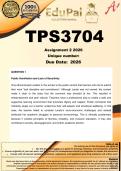
TPS3704
Assignment 2 2026
Unique number:
Due Date: 2026
QUESTION 1
Public Humiliation and Lack of Sensitivity
One ethical breach evident in the extract is the public remark that learners who fail to submit
their work “lack discipline and commitment.” Although Lerato was not named, the context
made it clear to the class that the comment was directed at her. This resulted in
embarrassment and peer ridicule. Teachers have a professional duty to create a safe and
supportive learning environment that promotes dignity and respect. Public comments that
indirectly single out a learner undermine their self-esteem and emotional wellbeing. In this
case, the teacher failed to consider Lerato’s socio-economic challenges and instead
attributed her academic struggles to personal shortcomings. This is ethically problematic
because it violates principles of fairness, empathy, and inclusive education. It may also
contribute to anxiety, disengagement, and further academic decline.
Terms of use
By making use of this document you agree to:
Use this document as a guide for learning, comparison and reference purpose,
Terms of use
Not to duplicate, reproduce and/or misrepresent the contents of this document as your own work,
By making use of this document you agree to:
Use this document
Fully accept the consequences
solely as a guide forshould you plagiarise
learning, reference,or and
misuse this document.
comparison purposes,
Ensure originality of your own work, and fully accept the consequences should you plagiarise or misuse this document.
Comply with all relevant standards, guidelines, regulations, and legislation governing academic and written work.
Disclaimer
Great care has been taken in the preparation of this document; however, the contents are provided "as is" without any express or
implied representations or warranties. The author accepts no responsibility or liability for any actions taken based on the
information contained within this document. This document is intended solely for comparison, research, and reference purposes.
Reproduction, resale, or transmission of any part of this document, in any form or by any means, is strictly prohibited.
, +27 81 278 3372
QUESTION 1
Public Humiliation and Lack of Sensitivity
One ethical breach evident in the extract is the public remark that learners who fail to
submit their work “lack discipline and commitment.” Although Lerato was not named, the
context made it clear to the class that the comment was directed at her. This resulted in
embarrassment and peer ridicule. Teachers have a professional duty to create a safe and
supportive learning environment that promotes dignity and respect. Public comments that
indirectly single out a learner undermine their self-esteem and emotional wellbeing. In this
case, the teacher failed to consider Lerato’s socio-economic challenges and instead
attributed her academic struggles to personal shortcomings. This is ethically problematic
because it violates principles of fairness, empathy, and inclusive education. It may also
contribute to anxiety, disengagement, and further academic decline.
Breach of Confidentiality
A second ethical breach involves discussing Lerato’s academic difficulties with another
student teacher in a public corridor where learners could overhear. Learners’ personal and
academic information must be treated as confidential. Educators are entrusted with
sensitive information and are expected to handle it discreetly. Discussing a learner’s
challenges in an open space compromises confidentiality and may expose the learner to
further humiliation or stigma. Confidentiality is central to professional trust in education.
When breached, it damages the learner-teacher relationship and undermines the learner’s
sense of safety within the school environment.
Unprofessional Use of Social Media
The third ethical breach relates to posting a frustrated comment about learners on social
media, accompanied by a classroom photograph. Even though no names were
mentioned, the post reflects negatively on learners and the school community. Teachers
are expected to uphold professional conduct both inside and outside the classroom.
Publicly criticising learners on social media demonstrates poor professional judgement
and may harm the reputation of the school and the teaching profession. Additionally,
sharing classroom images without clear consent raises privacy concerns. Such behaviour
Disclaimer
Great care has been taken in the preparation of this document; however, the contents are provided "as is"
without any express or implied representations or warranties. The author accepts no responsibility or
liability for any actions taken based on the information contained within this document. This document is
intended solely for comparison, research, and reference purposes. Reproduction, resale, or transmission
of any part of this document, in any form or by any means, is strictly prohibited.
Assignment 2 2026
Unique number:
Due Date: 2026
QUESTION 1
Public Humiliation and Lack of Sensitivity
One ethical breach evident in the extract is the public remark that learners who fail to submit
their work “lack discipline and commitment.” Although Lerato was not named, the context
made it clear to the class that the comment was directed at her. This resulted in
embarrassment and peer ridicule. Teachers have a professional duty to create a safe and
supportive learning environment that promotes dignity and respect. Public comments that
indirectly single out a learner undermine their self-esteem and emotional wellbeing. In this
case, the teacher failed to consider Lerato’s socio-economic challenges and instead
attributed her academic struggles to personal shortcomings. This is ethically problematic
because it violates principles of fairness, empathy, and inclusive education. It may also
contribute to anxiety, disengagement, and further academic decline.
Terms of use
By making use of this document you agree to:
Use this document as a guide for learning, comparison and reference purpose,
Terms of use
Not to duplicate, reproduce and/or misrepresent the contents of this document as your own work,
By making use of this document you agree to:
Use this document
Fully accept the consequences
solely as a guide forshould you plagiarise
learning, reference,or and
misuse this document.
comparison purposes,
Ensure originality of your own work, and fully accept the consequences should you plagiarise or misuse this document.
Comply with all relevant standards, guidelines, regulations, and legislation governing academic and written work.
Disclaimer
Great care has been taken in the preparation of this document; however, the contents are provided "as is" without any express or
implied representations or warranties. The author accepts no responsibility or liability for any actions taken based on the
information contained within this document. This document is intended solely for comparison, research, and reference purposes.
Reproduction, resale, or transmission of any part of this document, in any form or by any means, is strictly prohibited.
, +27 81 278 3372
QUESTION 1
Public Humiliation and Lack of Sensitivity
One ethical breach evident in the extract is the public remark that learners who fail to
submit their work “lack discipline and commitment.” Although Lerato was not named, the
context made it clear to the class that the comment was directed at her. This resulted in
embarrassment and peer ridicule. Teachers have a professional duty to create a safe and
supportive learning environment that promotes dignity and respect. Public comments that
indirectly single out a learner undermine their self-esteem and emotional wellbeing. In this
case, the teacher failed to consider Lerato’s socio-economic challenges and instead
attributed her academic struggles to personal shortcomings. This is ethically problematic
because it violates principles of fairness, empathy, and inclusive education. It may also
contribute to anxiety, disengagement, and further academic decline.
Breach of Confidentiality
A second ethical breach involves discussing Lerato’s academic difficulties with another
student teacher in a public corridor where learners could overhear. Learners’ personal and
academic information must be treated as confidential. Educators are entrusted with
sensitive information and are expected to handle it discreetly. Discussing a learner’s
challenges in an open space compromises confidentiality and may expose the learner to
further humiliation or stigma. Confidentiality is central to professional trust in education.
When breached, it damages the learner-teacher relationship and undermines the learner’s
sense of safety within the school environment.
Unprofessional Use of Social Media
The third ethical breach relates to posting a frustrated comment about learners on social
media, accompanied by a classroom photograph. Even though no names were
mentioned, the post reflects negatively on learners and the school community. Teachers
are expected to uphold professional conduct both inside and outside the classroom.
Publicly criticising learners on social media demonstrates poor professional judgement
and may harm the reputation of the school and the teaching profession. Additionally,
sharing classroom images without clear consent raises privacy concerns. Such behaviour
Disclaimer
Great care has been taken in the preparation of this document; however, the contents are provided "as is"
without any express or implied representations or warranties. The author accepts no responsibility or
liability for any actions taken based on the information contained within this document. This document is
intended solely for comparison, research, and reference purposes. Reproduction, resale, or transmission
of any part of this document, in any form or by any means, is strictly prohibited.



