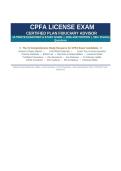
CPFA LICENSE EXAM
CERTIFIED PLAN FIDUCIARY ADVISOR
ULTIMATE EXAM PREP & STUDY GUIDE | 2026–2027 EDITION | 500+ Practice
Questions
★ The #1 Comprehensive Study Resource for CPFA Exam Candidates ★
✔ Answers Clearly Marked | 📋 Full ERISA Rationale | 💡 Exam Tips on Every Question
🎯 Fiduciary Standards • ERISA Law • Plan Roles & Responsibilities • Investment Duties
🎯 Prohibited Transactions • Plan Documents • Fee Disclosure • Co-Fiduciary Liability
🎯 ERISA Preemption • DOL Guidance • IRS Compliance • Participant Rights
Includes Quick-Reference Tables • Case Scenarios • SATA Questions • Role Classification Drills • DOL/IRS Cross-
Reference
,TABLE OF CONTENTS
Section Topic Page
Section 1 ERISA Overview & Fiduciary Standards of Care (Section 404) 3
Section 2 Who is a Fiduciary? Definitions, Roles & Personal Liability 7
Section 3 Plan Sponsor Duties — Prudent Selection & Monitoring 11
Section 4 Plan Administrator vs. Trustee — Roles & Responsibilities 15
Section 5 Investment Fiduciary Duties — Prudence, Diversification & Monitoring 19
Section 6 Prohibited Transactions & Exemptions (Section 406) 23
Section 7 Co-Fiduciary Liability & Delegation of Duties 27
Section 8 Plan Documents, Governing Instruments & ERISA Compliance 31
Section 9 Fee Disclosure & Transparency (408(b)(2) & 404(a)(5)) 35
Section 10 Participant Rights, Claims & Benefit Protections 39
Section 11 DOL Enforcement, Civil Liability & Penalties 43
Section 12 SATA & Priority Classification Questions 47
Section 13 Clinical Case Scenarios — Fiduciary Decision Making 51
Section 14 Comprehensive Quick-Reference Tables 55
, SECTION 1: ERISA Overview & The Fiduciary Standard of Care
(Section 404)
The 4 fiduciary standards | Exclusive benefit rule | Prudent expert standard | Diversification | Plan documents
The 4 Fiduciary Standards of Care — Section 404(a) ERISA
• 1. LOYALTY (Exclusive Purpose Rule): Act solely in the interest of participants and beneficiaries —
providing benefits and defraying reasonable plan expenses. NEVER act in the interest of the
employer, owner, or key employees
• 2. PRUDENCE (Prudent Expert Standard): Act with the care, skill, prudence, and diligence of a
knowledgeable person familiar with such matters. Investigate before deciding; document the
decision-making process; hire experts when lacking knowledge; monitor ongoing decisions
• 3. DIVERSIFICATION: Diversify plan investments to minimize the risk of large losses, unless it is
clearly prudent not to do so. Consider: plan purpose, amount of assets, investment sophistication of
participants, participant demographics
• 4. FOLLOW THE PLAN DOCUMENTS: Operate the plan according to its governing documents, to
the extent those documents are consistent with ERISA. Plan document provisions that violate ERISA
are overridden by ERISA
Q1 [Section 404]
What are the 4 basic fiduciary standards under the Fiduciary Standard of Care (Section
404)?
• A. Loyalty, Prudence, Diversification, Follow Plan Documents
• B. Loyalty, Honesty, Transparency, Documentation
• C. Prudence, Confidentiality, Reporting, Diversification
• D. Loyalty, Fiduciary Duty, ERISA Compliance, Reporting
✔ ANSWER: A — Loyalty, Prudence, Diversification, Follow Plan Documents | Exam
Level: Application/Analysis
📋 Rationale: Section 404(a) of ERISA establishes four core fiduciary duties: (1) Loyalty — exclusive
purpose rule, acting solely for participants/beneficiaries; (2) Prudence — prudent expert standard with
investigation and documentation; (3) Diversification — minimize risk of large losses; (4) Follow plan
documents — to the extent not contrary to ERISA. All four must be satisfied simultaneously.
💡 Exam Tip: Memory mnemonic: 'LPDF' — Loyalty, Prudence, Diversification, Follow. ERISA
Section 404 is the foundational section for fiduciary conduct. Every CPFA exam question about
standards of care comes back to these four. Note: The standard is the 'prudent EXPERT' — not just a
reasonable person, but someone knowledgeable in retirement plan administration.
Q2 [Loyalty]
The Loyalty standard under Section 404 requires fiduciaries to act exclusively for which
parties?
• A. The employer and plan sponsor
• B. Plan participants and their beneficiaries, including defraying reasonable plan expenses
• C. The government and plan regulators
• D. All parties equally — employer, employees, and government
, ✔ ANSWER: B — Plan participants and their beneficiaries | Exam Level: Application/Analysis
📋 Rationale: The Loyalty (Exclusive Purpose) rule is absolute: fiduciaries must act SOLELY in the
interests of plan participants and their beneficiaries. The two exclusive purposes are: (1) providing
benefits to participants and beneficiaries, and (2) defraying reasonable expenses of administering the
plan. Acting to benefit the employer, owners, or key employees violates this standard — even
incidentally.
💡 Exam Tip: Critical distinction: The plan exists for participants, not for the employer. Even if an
investment decision benefits the company, if it harms participants, it violates the Loyalty standard.
Self-dealing — using plan assets for the fiduciary's own benefit — is not only a breach of loyalty but
also a Prohibited Transaction under Section 406.
Q3 [Prudence]
The Prudence standard requires a fiduciary to act with the care, skill, and diligence of which
standard?
• A. A reasonable layperson with average knowledge
• B. A knowledgeable person familiar with matters of administering retirement plans — the
'prudent expert'
• C. A licensed attorney or CPA
• D. An investment banker with 20+ years of experience
✔ ANSWER: B — Prudent expert standard | Exam Level: Application/Analysis
📋 Rationale: ERISA's Prudence standard is NOT the 'prudent person' standard from trust law — it
is the higher 'PRUDENT EXPERT' standard. The fiduciary must act with the care of someone
KNOWLEDGEABLE in such matters. This means: investigate before making decisions, document the
decision-making process, hire experts when lacking knowledge or skills, and monitor whether
decisions remain appropriate.
💡 Exam Tip: The prudent expert standard has two important implications: (1) If you don't have the
expertise, you must HIRE someone who does (and then prudently monitor that expert); (2) You must
DOCUMENT your process — a well-documented decision process can protect a fiduciary even if an
investment performs poorly. Process, not outcome, is judged.
Q4 [Diversification]
When evaluating the Diversification standard, which factors may a fiduciary appropriately
consider?
• A. Only the expected return on each investment
• B. The purpose of the plan, amount of plan assets, investment sophistication of participants,
and participant demographics
• C. Only the employer's financial needs
• D. Only historical investment performance
✔ ANSWER: B — Purpose of plan, amount of assets, investment acumen of participants,
and participant demographics | Exam Level: Application/Analysis
📋 Rationale: Diversification under ERISA Section 404(a)(1)(C) requires prudent diversification to
minimize the risk of large losses. The fiduciary must consider the circumstances of the specific plan:
What is the plan designed to accomplish? How large is it? How investment-savvy are the
CERTIFIED PLAN FIDUCIARY ADVISOR
ULTIMATE EXAM PREP & STUDY GUIDE | 2026–2027 EDITION | 500+ Practice
Questions
★ The #1 Comprehensive Study Resource for CPFA Exam Candidates ★
✔ Answers Clearly Marked | 📋 Full ERISA Rationale | 💡 Exam Tips on Every Question
🎯 Fiduciary Standards • ERISA Law • Plan Roles & Responsibilities • Investment Duties
🎯 Prohibited Transactions • Plan Documents • Fee Disclosure • Co-Fiduciary Liability
🎯 ERISA Preemption • DOL Guidance • IRS Compliance • Participant Rights
Includes Quick-Reference Tables • Case Scenarios • SATA Questions • Role Classification Drills • DOL/IRS Cross-
Reference
,TABLE OF CONTENTS
Section Topic Page
Section 1 ERISA Overview & Fiduciary Standards of Care (Section 404) 3
Section 2 Who is a Fiduciary? Definitions, Roles & Personal Liability 7
Section 3 Plan Sponsor Duties — Prudent Selection & Monitoring 11
Section 4 Plan Administrator vs. Trustee — Roles & Responsibilities 15
Section 5 Investment Fiduciary Duties — Prudence, Diversification & Monitoring 19
Section 6 Prohibited Transactions & Exemptions (Section 406) 23
Section 7 Co-Fiduciary Liability & Delegation of Duties 27
Section 8 Plan Documents, Governing Instruments & ERISA Compliance 31
Section 9 Fee Disclosure & Transparency (408(b)(2) & 404(a)(5)) 35
Section 10 Participant Rights, Claims & Benefit Protections 39
Section 11 DOL Enforcement, Civil Liability & Penalties 43
Section 12 SATA & Priority Classification Questions 47
Section 13 Clinical Case Scenarios — Fiduciary Decision Making 51
Section 14 Comprehensive Quick-Reference Tables 55
, SECTION 1: ERISA Overview & The Fiduciary Standard of Care
(Section 404)
The 4 fiduciary standards | Exclusive benefit rule | Prudent expert standard | Diversification | Plan documents
The 4 Fiduciary Standards of Care — Section 404(a) ERISA
• 1. LOYALTY (Exclusive Purpose Rule): Act solely in the interest of participants and beneficiaries —
providing benefits and defraying reasonable plan expenses. NEVER act in the interest of the
employer, owner, or key employees
• 2. PRUDENCE (Prudent Expert Standard): Act with the care, skill, prudence, and diligence of a
knowledgeable person familiar with such matters. Investigate before deciding; document the
decision-making process; hire experts when lacking knowledge; monitor ongoing decisions
• 3. DIVERSIFICATION: Diversify plan investments to minimize the risk of large losses, unless it is
clearly prudent not to do so. Consider: plan purpose, amount of assets, investment sophistication of
participants, participant demographics
• 4. FOLLOW THE PLAN DOCUMENTS: Operate the plan according to its governing documents, to
the extent those documents are consistent with ERISA. Plan document provisions that violate ERISA
are overridden by ERISA
Q1 [Section 404]
What are the 4 basic fiduciary standards under the Fiduciary Standard of Care (Section
404)?
• A. Loyalty, Prudence, Diversification, Follow Plan Documents
• B. Loyalty, Honesty, Transparency, Documentation
• C. Prudence, Confidentiality, Reporting, Diversification
• D. Loyalty, Fiduciary Duty, ERISA Compliance, Reporting
✔ ANSWER: A — Loyalty, Prudence, Diversification, Follow Plan Documents | Exam
Level: Application/Analysis
📋 Rationale: Section 404(a) of ERISA establishes four core fiduciary duties: (1) Loyalty — exclusive
purpose rule, acting solely for participants/beneficiaries; (2) Prudence — prudent expert standard with
investigation and documentation; (3) Diversification — minimize risk of large losses; (4) Follow plan
documents — to the extent not contrary to ERISA. All four must be satisfied simultaneously.
💡 Exam Tip: Memory mnemonic: 'LPDF' — Loyalty, Prudence, Diversification, Follow. ERISA
Section 404 is the foundational section for fiduciary conduct. Every CPFA exam question about
standards of care comes back to these four. Note: The standard is the 'prudent EXPERT' — not just a
reasonable person, but someone knowledgeable in retirement plan administration.
Q2 [Loyalty]
The Loyalty standard under Section 404 requires fiduciaries to act exclusively for which
parties?
• A. The employer and plan sponsor
• B. Plan participants and their beneficiaries, including defraying reasonable plan expenses
• C. The government and plan regulators
• D. All parties equally — employer, employees, and government
, ✔ ANSWER: B — Plan participants and their beneficiaries | Exam Level: Application/Analysis
📋 Rationale: The Loyalty (Exclusive Purpose) rule is absolute: fiduciaries must act SOLELY in the
interests of plan participants and their beneficiaries. The two exclusive purposes are: (1) providing
benefits to participants and beneficiaries, and (2) defraying reasonable expenses of administering the
plan. Acting to benefit the employer, owners, or key employees violates this standard — even
incidentally.
💡 Exam Tip: Critical distinction: The plan exists for participants, not for the employer. Even if an
investment decision benefits the company, if it harms participants, it violates the Loyalty standard.
Self-dealing — using plan assets for the fiduciary's own benefit — is not only a breach of loyalty but
also a Prohibited Transaction under Section 406.
Q3 [Prudence]
The Prudence standard requires a fiduciary to act with the care, skill, and diligence of which
standard?
• A. A reasonable layperson with average knowledge
• B. A knowledgeable person familiar with matters of administering retirement plans — the
'prudent expert'
• C. A licensed attorney or CPA
• D. An investment banker with 20+ years of experience
✔ ANSWER: B — Prudent expert standard | Exam Level: Application/Analysis
📋 Rationale: ERISA's Prudence standard is NOT the 'prudent person' standard from trust law — it
is the higher 'PRUDENT EXPERT' standard. The fiduciary must act with the care of someone
KNOWLEDGEABLE in such matters. This means: investigate before making decisions, document the
decision-making process, hire experts when lacking knowledge or skills, and monitor whether
decisions remain appropriate.
💡 Exam Tip: The prudent expert standard has two important implications: (1) If you don't have the
expertise, you must HIRE someone who does (and then prudently monitor that expert); (2) You must
DOCUMENT your process — a well-documented decision process can protect a fiduciary even if an
investment performs poorly. Process, not outcome, is judged.
Q4 [Diversification]
When evaluating the Diversification standard, which factors may a fiduciary appropriately
consider?
• A. Only the expected return on each investment
• B. The purpose of the plan, amount of plan assets, investment sophistication of participants,
and participant demographics
• C. Only the employer's financial needs
• D. Only historical investment performance
✔ ANSWER: B — Purpose of plan, amount of assets, investment acumen of participants,
and participant demographics | Exam Level: Application/Analysis
📋 Rationale: Diversification under ERISA Section 404(a)(1)(C) requires prudent diversification to
minimize the risk of large losses. The fiduciary must consider the circumstances of the specific plan:
What is the plan designed to accomplish? How large is it? How investment-savvy are the