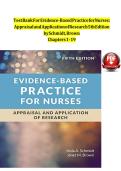
Test Bank For Evidence-Based Practice for Nurses:
n6 n6 n6 n6 n6 n6
Appraisal and Application of Research 5th Edition
n6 n6 n6 n6 n6 n6 n6
by Schmidt, Brown
n6 n6 n6 n6
Chapters 1 - 19 n6 n6 n6
,Test Bank For Evidence-Based Practice for Nurses: Appraisal and Application of
n6 n6 n6 n6 n6 n6 n6 n6 n6 n6
Research 5th Edition by Schmidt, Brown
6
n n6 n6 n6 n6 n6
Table of Contents: n6 n6
Chapter 1 What Is Evidence-Based Practice?
n6 n6 n6 n6 n6
Chapter 2 Using Evidence Through Collaboration To Promote Excellence In Nursing Practice
n6 n6 n6 n6 n6 n6 n6 n6 n6 n6 n6
Chapter 3 Identifying Research Questions
n6 n6 n6 n6
Chapter 4 Finding Sources Of Evidence
n6 n6 n6 n6 n6
Chapter 5 Linking Theory, Research, And Practice
n6 n6 n6 n6 n6 n6
Chapter 6 KeyPrinciples Of Quantitative Designs
n6 n6 n6 n6 n6 n6
Chapter 7 Quantitative Designs: Using Numbers To Provide Evidence
n6 n6 n6 n6 n6 n6 n6 n6
Chapter 8 Epidemiologic Designs: Using Data To Understand Populations
n6 n6 n6 n6 n6 n6 n6 n6
Chapter 9 Qualitative Designs: Using Words To Provide Evidence
n6 n6 n6 n6 n6 n6 n6 n6
Chapter 10 Collecting Evidence
n6 n6 n6
Chapter 11 Using Samples To Provide Evidence
n6 n6 n6 n6 n6 n6
Chapter 12 Other Sources Of Evidence
n6 n6 n6 n6 n6
Chapter 13 What Do The Quantitative Data Mean?
n6 n6 n6 n6 n6 n6 n6
Chapter 14 What Do The Qualitative Data Mean?
n6 n6 n6 n6 n6 n6 n6
Chapter 15 Weighing In On The Evidence
n6 n6 n6 n6 n6 n6
Chapter 16 Transitioning Evidence To Practice
n6 n6 n6 n6 n6
Chapter 17 Developing Oneself As An Innovator
n6 n6 n6 n6 n6 n6
Chapter 18 Evaluating Outcomes Of Innovations
n6 n6 n6 n6 n6
Chapter 19 Sharing The Insights With Others
n6 n6 n6 n6 n6 n6
,CHAPTER 1: WHAT IS EVIDENCE BASED PRACTICE?
n6 n6 n6 n6 n6 n6
Test Bank Evidence-Based Practice forNurses: Appraisal and Application ofResearch 5th
n6 n6 n6 n6 6
n n6 n6 n6 n6 n6 n6
Edition Schmidt, Brown
6
n
n6 n6
Multiple Choice n6
Definition of research (p. 14)
n6 n6 n6 n6
1. Which of the following is the best definition of research?
n6 n6 n6 n6 n6 n6 n6 n6 n6
a. Criticallythinking about problems that occur in health care to determine possible n6 n6 n6 n6 n6 n6 n6 n6 n6 n6 n6
solutions. n6
b. Information that is based on personal experience or tradition. n6 n6 n6 n6 n6 n6 n6 n6
c. Planned and systematic activity that leads to new knowledge and/or the n6 n6 n6 n6 n6 n6 n6 n6 n6 n6
discovery of solutions to problems or questions.
6
n n6 n6 n6 n6 n6 n6
d. Trying a variety of approaches to a clinical problem and settling on the approachthat n6 n6 n6 n6 n6 n6 n6 n6 n6 n6 n6 n6 n6 n6
is effective more often than not. n6 n6 n6 n6 n6 n6
Definition of research utilization (p. 4)
n6 n6 n6 n6 n6
2. Which of the following is the best definition of research utilization?
n6 n6 n6 n6 n6 n6 n6 n6 n6 n6
a. Applying research findings from individual studies to practice. n6 n6 n6 n6 n6 n6 n6
b. Analyzing multiple research studies to synthesize findings. n6 n6 n6 n6 n6 n6
c. Appreciatingthe importance of clinical decision making. n6 n6 n6 n6 n6 n6
d. Using previous personal experience to build confidence. n6 n6 n6 n6 n6 n6
Definition of EBP (pp. 4-5) n6 n6 n6 n6
3. Which of the following is the best definition of evidence-based practice (EBP)?
n6 n6 n6 n6 n6 n6 n6 n6 n6 n6 n6
a. Application of research findings based on scientific theories in a clinical setting. n6 n6 n6 n6 n6 n6 n6 n6 n6 n6 n6
b. Research studies that correspond to nationally established priorities for healthcare, n6 n6 n6 n6 n6 n6 n6 n6 n6
conducted by experts in their fields. n6 n6 n6 n6 n6 n6
c. Use of theory-derived, research-based information in making decisions aboutn6 n6 n6 n6 n6 n6 n6 n6
health care delivery, with consideration of individual needs and preferences and
6
n n6 n6 n6 n6 n6 n6 n6 n6 n6 n6
the clinical expertise of the provider. n6 n6 n6 n6 n6 n6
d. Using the individual health care provider’s perception of truth without conscious n6 n6 n6 n6 n6 n6 n6 n6 n6 n6
attention or reasoning. n6 n6 n6
Difference between research utilization and EBP (pp. 4-5)
n6 n6 n6 n6 n6 n6 n6
4. Which of the following best describes the difference between research utilization and
n6 n6 n6 n6 n6 n6 n6 n6 n6 n6 n6
EBP?
n6
a. Research utilization is a process of evaluating multiple studies for the most n6 n6 n6 n6 n6 n6 n6 n6 n6 n6 n6
generalizable findings; EBP is use of the most recent studyon a topic.
n6 n6 n6 n6 n6 n6 n6 n6 n6 n6 n6 n6 n6
, b. Research utilization involves changing practice based on findings of a single n6 n6 n6 n6 n6 n6 n6 n6 n6 n6
research study; EBP is the syntheses of findings from multiple studies to
6
n n6 n6 n6 n6 n6 n6 n6 n6 n6 n6 n6
incorporate with practitioner skills and client preference to determine best
n6 n6 n6 n6 n6 n6 n6 n6 n6 n6
care. n6
c. Research utilization is theapplication of research findings to health carepractice;EBP n6 n6 n6 n6 n6 n6 n6 n6 n6 n6 n6 n6
is considered in selecting medication options.
n6 n6 n6 n6 n6 n6
d. Research utilization is review of research publications; EBP is using the n6 n6 n6 n6 n6 n6 n6 n6 n6 n6
healthcare provider’s perception of what care would be best in individual
n6 n6 n6 n6 n6 n6 n6 n6 n6 n6 n6
situations. n6
Evidence from other disciplines (p. 6)
n6 n6 n6 n6 n6
5. In what way can evidence from disciplines other than nursing be helpful?
n6 n6 n6 n6 n6 n6 n6 n6 n6 n6 n6
a. Theory based non-nursing evidence can provide a basis on which to build n6 n6 n6 n6 n6 n6 n6 n6 n6 n6 n6
new evidence. 6
n n6
b. Non-nursing evidence supports the use of nursing knowledge obtained bytrialand n6 n6 n6 n6 n6 n6 n6 n6 n6 n6 n6
error. n6
c. Clinical decision making can be based on findings from single non-nursing n6 n6 n6 n6 n6 n6 n6 n6 n6 n6
research studies. n6 n6
d. All evidence is equallyimportant to the practice of nursing. n6 n6 n6 n6 n6 n6 n6 n6 n6
Identification of sources of evidence (p. 6)
n6 n6 n6 n6 n6 n6
6. You are a new nurse working at XYZ hospital. Your preceptor tells you to dangle Ms. Jones’
n6 n6 n6 n6 n6 n6 n6 n6 n6 n6 n6 n6 n6 n6 n6 n6
legs on the side of the bed before you attempt to assist her to a chair. You ask yourpreceptor why
n6 n6 n6 n6 n6 n6 n6 n6 n6 n6 n6 n6 n6 n6 n6 n6 n6 n6 n6 n6 n6
this is done and shNeUaRnSsIw
n6 n6
NeGrTsB
n6 , “.CTOhM
is is what we have always done, so go do it.” This is an
n6 n6 n 6 n6 n6 n6 n6 n6 n6 n6 n6 n6 n6 n6 n6 n6
example of which type of evidence?
n6 n6 n6 n6 n6 n6
a. Trial and error n6 n6
b. Intuition
c. Borrowed evidence n6
d. Tradition
Identification of sources of evidence (p. 6)
n6 n6 n6 n6 n6 n6
7. You are a new nurse working at XYZ hospital. Your preceptor tells you to dangle Ms. Jones’
n6 n6 n6 n6 n6 n6 n6 n6 n6 n6 n6 n6 n6 n6 n6 n6
legs on the side of the bed before you attempt to assist her to a chair. You ask yourpreceptor why
n6 n6 n6 n6 n6 n6 n6 n6 n6 n6 n6 n6 n6 n6 n6 n6 n6 n6 n6 n6 n6
this is done and she answers, “Because I said so.” This is an example of which type of
n6 n6 n6 n6 n6 n6 n6 n6 n6 n6 n6 n6 n6 n6 n6 n6 n6 n6
evidence?
n6
a. Intuition
b. Tradition
c. Authority
d. Borrowed evidence n6
Identification of sources of evidence (p. 6)
n6 n6 n6 n6 n6 n6
8. Trial and error is not a preferred approach for delivering nursing care because
n6 n6 n6 n6 n6 n6 n6 n6 n6 n6 n6 n6
a. it is not based on systematic scientific approaches. n6 n6 n6 n6 n6 n6 n6
b. it is not a sanctioned method bythe American Nurses Association.
n6 n6 n6 n6 n6 n6 n6 n6 n6 n6
c. it is based onlyon intuition and therefore not scientificallybased.
n6 n6 n6 n6 n6 n6 n6 n6 n6 n6
d. patient outcomes are always based onlyon level 1 evidence. n6 n6 n6 n6 n6 n6 n6 n6 n6
n6 n6 n6 n6 n6 n6
Appraisal and Application of Research 5th Edition
n6 n6 n6 n6 n6 n6 n6
by Schmidt, Brown
n6 n6 n6 n6
Chapters 1 - 19 n6 n6 n6
,Test Bank For Evidence-Based Practice for Nurses: Appraisal and Application of
n6 n6 n6 n6 n6 n6 n6 n6 n6 n6
Research 5th Edition by Schmidt, Brown
6
n n6 n6 n6 n6 n6
Table of Contents: n6 n6
Chapter 1 What Is Evidence-Based Practice?
n6 n6 n6 n6 n6
Chapter 2 Using Evidence Through Collaboration To Promote Excellence In Nursing Practice
n6 n6 n6 n6 n6 n6 n6 n6 n6 n6 n6
Chapter 3 Identifying Research Questions
n6 n6 n6 n6
Chapter 4 Finding Sources Of Evidence
n6 n6 n6 n6 n6
Chapter 5 Linking Theory, Research, And Practice
n6 n6 n6 n6 n6 n6
Chapter 6 KeyPrinciples Of Quantitative Designs
n6 n6 n6 n6 n6 n6
Chapter 7 Quantitative Designs: Using Numbers To Provide Evidence
n6 n6 n6 n6 n6 n6 n6 n6
Chapter 8 Epidemiologic Designs: Using Data To Understand Populations
n6 n6 n6 n6 n6 n6 n6 n6
Chapter 9 Qualitative Designs: Using Words To Provide Evidence
n6 n6 n6 n6 n6 n6 n6 n6
Chapter 10 Collecting Evidence
n6 n6 n6
Chapter 11 Using Samples To Provide Evidence
n6 n6 n6 n6 n6 n6
Chapter 12 Other Sources Of Evidence
n6 n6 n6 n6 n6
Chapter 13 What Do The Quantitative Data Mean?
n6 n6 n6 n6 n6 n6 n6
Chapter 14 What Do The Qualitative Data Mean?
n6 n6 n6 n6 n6 n6 n6
Chapter 15 Weighing In On The Evidence
n6 n6 n6 n6 n6 n6
Chapter 16 Transitioning Evidence To Practice
n6 n6 n6 n6 n6
Chapter 17 Developing Oneself As An Innovator
n6 n6 n6 n6 n6 n6
Chapter 18 Evaluating Outcomes Of Innovations
n6 n6 n6 n6 n6
Chapter 19 Sharing The Insights With Others
n6 n6 n6 n6 n6 n6
,CHAPTER 1: WHAT IS EVIDENCE BASED PRACTICE?
n6 n6 n6 n6 n6 n6
Test Bank Evidence-Based Practice forNurses: Appraisal and Application ofResearch 5th
n6 n6 n6 n6 6
n n6 n6 n6 n6 n6 n6
Edition Schmidt, Brown
6
n
n6 n6
Multiple Choice n6
Definition of research (p. 14)
n6 n6 n6 n6
1. Which of the following is the best definition of research?
n6 n6 n6 n6 n6 n6 n6 n6 n6
a. Criticallythinking about problems that occur in health care to determine possible n6 n6 n6 n6 n6 n6 n6 n6 n6 n6 n6
solutions. n6
b. Information that is based on personal experience or tradition. n6 n6 n6 n6 n6 n6 n6 n6
c. Planned and systematic activity that leads to new knowledge and/or the n6 n6 n6 n6 n6 n6 n6 n6 n6 n6
discovery of solutions to problems or questions.
6
n n6 n6 n6 n6 n6 n6
d. Trying a variety of approaches to a clinical problem and settling on the approachthat n6 n6 n6 n6 n6 n6 n6 n6 n6 n6 n6 n6 n6 n6
is effective more often than not. n6 n6 n6 n6 n6 n6
Definition of research utilization (p. 4)
n6 n6 n6 n6 n6
2. Which of the following is the best definition of research utilization?
n6 n6 n6 n6 n6 n6 n6 n6 n6 n6
a. Applying research findings from individual studies to practice. n6 n6 n6 n6 n6 n6 n6
b. Analyzing multiple research studies to synthesize findings. n6 n6 n6 n6 n6 n6
c. Appreciatingthe importance of clinical decision making. n6 n6 n6 n6 n6 n6
d. Using previous personal experience to build confidence. n6 n6 n6 n6 n6 n6
Definition of EBP (pp. 4-5) n6 n6 n6 n6
3. Which of the following is the best definition of evidence-based practice (EBP)?
n6 n6 n6 n6 n6 n6 n6 n6 n6 n6 n6
a. Application of research findings based on scientific theories in a clinical setting. n6 n6 n6 n6 n6 n6 n6 n6 n6 n6 n6
b. Research studies that correspond to nationally established priorities for healthcare, n6 n6 n6 n6 n6 n6 n6 n6 n6
conducted by experts in their fields. n6 n6 n6 n6 n6 n6
c. Use of theory-derived, research-based information in making decisions aboutn6 n6 n6 n6 n6 n6 n6 n6
health care delivery, with consideration of individual needs and preferences and
6
n n6 n6 n6 n6 n6 n6 n6 n6 n6 n6
the clinical expertise of the provider. n6 n6 n6 n6 n6 n6
d. Using the individual health care provider’s perception of truth without conscious n6 n6 n6 n6 n6 n6 n6 n6 n6 n6
attention or reasoning. n6 n6 n6
Difference between research utilization and EBP (pp. 4-5)
n6 n6 n6 n6 n6 n6 n6
4. Which of the following best describes the difference between research utilization and
n6 n6 n6 n6 n6 n6 n6 n6 n6 n6 n6
EBP?
n6
a. Research utilization is a process of evaluating multiple studies for the most n6 n6 n6 n6 n6 n6 n6 n6 n6 n6 n6
generalizable findings; EBP is use of the most recent studyon a topic.
n6 n6 n6 n6 n6 n6 n6 n6 n6 n6 n6 n6 n6
, b. Research utilization involves changing practice based on findings of a single n6 n6 n6 n6 n6 n6 n6 n6 n6 n6
research study; EBP is the syntheses of findings from multiple studies to
6
n n6 n6 n6 n6 n6 n6 n6 n6 n6 n6 n6
incorporate with practitioner skills and client preference to determine best
n6 n6 n6 n6 n6 n6 n6 n6 n6 n6
care. n6
c. Research utilization is theapplication of research findings to health carepractice;EBP n6 n6 n6 n6 n6 n6 n6 n6 n6 n6 n6 n6
is considered in selecting medication options.
n6 n6 n6 n6 n6 n6
d. Research utilization is review of research publications; EBP is using the n6 n6 n6 n6 n6 n6 n6 n6 n6 n6
healthcare provider’s perception of what care would be best in individual
n6 n6 n6 n6 n6 n6 n6 n6 n6 n6 n6
situations. n6
Evidence from other disciplines (p. 6)
n6 n6 n6 n6 n6
5. In what way can evidence from disciplines other than nursing be helpful?
n6 n6 n6 n6 n6 n6 n6 n6 n6 n6 n6
a. Theory based non-nursing evidence can provide a basis on which to build n6 n6 n6 n6 n6 n6 n6 n6 n6 n6 n6
new evidence. 6
n n6
b. Non-nursing evidence supports the use of nursing knowledge obtained bytrialand n6 n6 n6 n6 n6 n6 n6 n6 n6 n6 n6
error. n6
c. Clinical decision making can be based on findings from single non-nursing n6 n6 n6 n6 n6 n6 n6 n6 n6 n6
research studies. n6 n6
d. All evidence is equallyimportant to the practice of nursing. n6 n6 n6 n6 n6 n6 n6 n6 n6
Identification of sources of evidence (p. 6)
n6 n6 n6 n6 n6 n6
6. You are a new nurse working at XYZ hospital. Your preceptor tells you to dangle Ms. Jones’
n6 n6 n6 n6 n6 n6 n6 n6 n6 n6 n6 n6 n6 n6 n6 n6
legs on the side of the bed before you attempt to assist her to a chair. You ask yourpreceptor why
n6 n6 n6 n6 n6 n6 n6 n6 n6 n6 n6 n6 n6 n6 n6 n6 n6 n6 n6 n6 n6
this is done and shNeUaRnSsIw
n6 n6
NeGrTsB
n6 , “.CTOhM
is is what we have always done, so go do it.” This is an
n6 n6 n 6 n6 n6 n6 n6 n6 n6 n6 n6 n6 n6 n6 n6 n6
example of which type of evidence?
n6 n6 n6 n6 n6 n6
a. Trial and error n6 n6
b. Intuition
c. Borrowed evidence n6
d. Tradition
Identification of sources of evidence (p. 6)
n6 n6 n6 n6 n6 n6
7. You are a new nurse working at XYZ hospital. Your preceptor tells you to dangle Ms. Jones’
n6 n6 n6 n6 n6 n6 n6 n6 n6 n6 n6 n6 n6 n6 n6 n6
legs on the side of the bed before you attempt to assist her to a chair. You ask yourpreceptor why
n6 n6 n6 n6 n6 n6 n6 n6 n6 n6 n6 n6 n6 n6 n6 n6 n6 n6 n6 n6 n6
this is done and she answers, “Because I said so.” This is an example of which type of
n6 n6 n6 n6 n6 n6 n6 n6 n6 n6 n6 n6 n6 n6 n6 n6 n6 n6
evidence?
n6
a. Intuition
b. Tradition
c. Authority
d. Borrowed evidence n6
Identification of sources of evidence (p. 6)
n6 n6 n6 n6 n6 n6
8. Trial and error is not a preferred approach for delivering nursing care because
n6 n6 n6 n6 n6 n6 n6 n6 n6 n6 n6 n6
a. it is not based on systematic scientific approaches. n6 n6 n6 n6 n6 n6 n6
b. it is not a sanctioned method bythe American Nurses Association.
n6 n6 n6 n6 n6 n6 n6 n6 n6 n6
c. it is based onlyon intuition and therefore not scientificallybased.
n6 n6 n6 n6 n6 n6 n6 n6 n6 n6
d. patient outcomes are always based onlyon level 1 evidence. n6 n6 n6 n6 n6 n6 n6 n6 n6