2/1/26, 12:25 PM Checkpoint 3: Applications of Integral Calculus: Attempt review
Calculus 1l / Checkpoint 3: Applications of Integral Calculus / Checkpoint 3: Applications of Integral Calculus
Startedon Sunday, February 1, 2026, 1:21 PM
State Finished
Completed on Sunday, February 1, 2026, 1:22 PM
Time taken 1 min42secs
Question 1
Correct
1.00 points out of 1.00
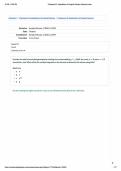
Consider the solid of revolution generated by rotating the area bounded by y = /cosz, the x-axis,z = 0 and z = 7r/ 2
around the x-axis. What will be the variable integration in the formula to determine the volume using disks?
Select one:
a.
b. r
c. zv
d y
You are rotating the region around the x-axis, so you will want to stack disks in the x-direction.
https://moodle.straighterline.com/mod/quiz/review.php?attempt=7113482&cmid=128393 117
,2/1/26, 12:25 PM Checkpoint 3: Applications of Integral Calculus: Attempt review
Question 2
Not answered
Points out of 1.00
What is the volume of the solid of revolution generated by rotating the area bounded by y= 10, y=8, x=-1,and x=3
around the x-axis?
Select one:
a. 8 units?
b. T2 units®
c. 144w units?
d. 2167 units?
The area described is a rectangle. The solid of revolution is a cylinder with another one “cored out” of it. You know
X]_ = _1, X2 = 3, router= 10, and rinner= 8-
2 2 2
V=j ['x("‘oufer) _fl(fi'nner) ]dx
n
3
- xj (102 -8 )ax
-1
3
= j 36dx
-1
- 36mf,
- (108+36) =
=144x uflits3
https://moodle.straighterline.com/mod/quiz/review.php?attempt=7113482&cmid=128393 2/17
, 2/1/26, 12:25 PM Checkpoint 3: Applications of Integral Calculus: Attempt review
Question 3
Not answered
Points out of 1.00
Evaluate the following as true or false:
The work done by a varying force Fover a distance Dis equal to the work done by the average value of the force Fheld
constant over the entire distance D.
Select one:
True
False
If the force 1s not constant, the work
b
1s calculated by W = j F(x)dx.
Q
If the force 1s constant, the work 1s
calculated by W = FAD.
In the case where the force 7 1s equal
to the average value of the force 7 (x),
F 15 given by the constant value
1 b
F= —j F(x)dx
a=gy
Therefore the equation for the work
done by this force is
1 b
W= [—j F(x)dx]AD.
b-a),
Since b—a =AD,
1 b
W=— j F(x)dx |AD
M Q
b
= j F(x)dx.
This is the formula for the work done by the non-constant force F(x). Thus the expressions for work done by a varying
force and that done by the average value of the varying force are the same. So the statement is true.
https://moodle.straighterline.com/mod/quiz/review.php?attempt=7113482&cmid=128393 3/17
Calculus 1l / Checkpoint 3: Applications of Integral Calculus / Checkpoint 3: Applications of Integral Calculus
Startedon Sunday, February 1, 2026, 1:21 PM
State Finished
Completed on Sunday, February 1, 2026, 1:22 PM
Time taken 1 min42secs
Question 1
Correct
1.00 points out of 1.00
Consider the solid of revolution generated by rotating the area bounded by y = /cosz, the x-axis,z = 0 and z = 7r/ 2
around the x-axis. What will be the variable integration in the formula to determine the volume using disks?
Select one:
a.
b. r
c. zv
d y
You are rotating the region around the x-axis, so you will want to stack disks in the x-direction.
https://moodle.straighterline.com/mod/quiz/review.php?attempt=7113482&cmid=128393 117
,2/1/26, 12:25 PM Checkpoint 3: Applications of Integral Calculus: Attempt review
Question 2
Not answered
Points out of 1.00
What is the volume of the solid of revolution generated by rotating the area bounded by y= 10, y=8, x=-1,and x=3
around the x-axis?
Select one:
a. 8 units?
b. T2 units®
c. 144w units?
d. 2167 units?
The area described is a rectangle. The solid of revolution is a cylinder with another one “cored out” of it. You know
X]_ = _1, X2 = 3, router= 10, and rinner= 8-
2 2 2
V=j ['x("‘oufer) _fl(fi'nner) ]dx
n
3
- xj (102 -8 )ax
-1
3
= j 36dx
-1
- 36mf,
- (108+36) =
=144x uflits3
https://moodle.straighterline.com/mod/quiz/review.php?attempt=7113482&cmid=128393 2/17
, 2/1/26, 12:25 PM Checkpoint 3: Applications of Integral Calculus: Attempt review
Question 3
Not answered
Points out of 1.00
Evaluate the following as true or false:
The work done by a varying force Fover a distance Dis equal to the work done by the average value of the force Fheld
constant over the entire distance D.
Select one:
True
False
If the force 1s not constant, the work
b
1s calculated by W = j F(x)dx.
Q
If the force 1s constant, the work 1s
calculated by W = FAD.
In the case where the force 7 1s equal
to the average value of the force 7 (x),
F 15 given by the constant value
1 b
F= —j F(x)dx
a=gy
Therefore the equation for the work
done by this force is
1 b
W= [—j F(x)dx]AD.
b-a),
Since b—a =AD,
1 b
W=— j F(x)dx |AD
M Q
b
= j F(x)dx.
This is the formula for the work done by the non-constant force F(x). Thus the expressions for work done by a varying
force and that done by the average value of the varying force are the same. So the statement is true.
https://moodle.straighterline.com/mod/quiz/review.php?attempt=7113482&cmid=128393 3/17