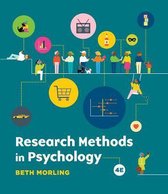
Test Bank for
Research Methods in Psychology; Evaluating A World of Information
4th Edition (W. W. Norton & Company, 202) by Beth Morling,
, Table of Contents are Given Below
1. Psychology Is a Way of Thinking
2. Sources of Information: Why Research Is Best and How to Find It
3. Three Claims, Four Validities: Interrogation Tools for Consumers of Research
4. Ethical Guidelines for Psychology Research
5. Identifying Good Measurement
6. Surveys and Observations: Describing What People Do
7. Sampling: Estimating the Frequency of Behaviors and Beliefs
8. Bivariate Correlational Research
9. Multivariate Correlational Research
10. Introduction to Simple Experiments
11. More on Experiments: Confounding and Obscuring Variables
12. Experiments with More Than One Independent Variable
13. Quasi-Experiments and Small-N Designs
14. Replication, Generalization, and the Real World
PAGE 1
,CHAPTER 1: PSYCHOLOGY IS A WAY OF
THINKING 1-10
1. What is the primary focus of psychological research?
A) Understanding physical processes
B) Studying human behavior and mental processes
C) Exploring chemical reactions
D) Analyzing astronomical data
Answer: B) Studying human behavior and mental processes
Explanation: Psychology primarily aims to understand human behavior and mental processes
through systematic research and analysis.
2. Which of the following best describes the scientific method in psychology?
A) A set of unchanging rules
B) A flexible framework for conducting research
C) A strict protocol that must always be followed
D) A collection of theories without practical application
Answer: B) A flexible framework for conducting research
Explanation: The scientific method in psychology is a flexible framework that guides researchers
through hypothesis formation, data collection, analysis, and conclusion.
PAGE 2
, 3. Critical thinking in psychology involves:
A) Accepting information at face value
B) Evaluating evidence and arguments systematically
C) Relying solely on intuition
D) Ignoring contradictory evidence
Answer: B) Evaluating evidence and arguments systematically
Explanation: Critical thinking requires systematically evaluating evidence and arguments to
form well- reasoned conclusions.
4. Which of the following is NOT a characteristic of scientific thinking?
A) Objectivity
B) Skepticism
C) Subjectivity
PAGE 3
Research Methods in Psychology; Evaluating A World of Information
4th Edition (W. W. Norton & Company, 202) by Beth Morling,
, Table of Contents are Given Below
1. Psychology Is a Way of Thinking
2. Sources of Information: Why Research Is Best and How to Find It
3. Three Claims, Four Validities: Interrogation Tools for Consumers of Research
4. Ethical Guidelines for Psychology Research
5. Identifying Good Measurement
6. Surveys and Observations: Describing What People Do
7. Sampling: Estimating the Frequency of Behaviors and Beliefs
8. Bivariate Correlational Research
9. Multivariate Correlational Research
10. Introduction to Simple Experiments
11. More on Experiments: Confounding and Obscuring Variables
12. Experiments with More Than One Independent Variable
13. Quasi-Experiments and Small-N Designs
14. Replication, Generalization, and the Real World
PAGE 1
,CHAPTER 1: PSYCHOLOGY IS A WAY OF
THINKING 1-10
1. What is the primary focus of psychological research?
A) Understanding physical processes
B) Studying human behavior and mental processes
C) Exploring chemical reactions
D) Analyzing astronomical data
Answer: B) Studying human behavior and mental processes
Explanation: Psychology primarily aims to understand human behavior and mental processes
through systematic research and analysis.
2. Which of the following best describes the scientific method in psychology?
A) A set of unchanging rules
B) A flexible framework for conducting research
C) A strict protocol that must always be followed
D) A collection of theories without practical application
Answer: B) A flexible framework for conducting research
Explanation: The scientific method in psychology is a flexible framework that guides researchers
through hypothesis formation, data collection, analysis, and conclusion.
PAGE 2
, 3. Critical thinking in psychology involves:
A) Accepting information at face value
B) Evaluating evidence and arguments systematically
C) Relying solely on intuition
D) Ignoring contradictory evidence
Answer: B) Evaluating evidence and arguments systematically
Explanation: Critical thinking requires systematically evaluating evidence and arguments to
form well- reasoned conclusions.
4. Which of the following is NOT a characteristic of scientific thinking?
A) Objectivity
B) Skepticism
C) Subjectivity
PAGE 3