

Geschrieben von Student*innen, die bestanden haben Sofort verfügbar nach Zahlung Online lesen oder als PDF Falsches Dokument? Kostenlos tauschen 4,6 TrustPilot
logo-home
Prüfung

COM3712 Assignment 2 (COMPLETE ANSWERS) Semester 1 2026 - DUE 17 April 2026

Bewertung
-
Verkauft
-
seiten
18
Klasse
A+
Hochgeladen auf
17-02-2026
geschrieben in
2025/2026

COM3712 Assignment 2 (COMPLETE ANSWERS) Semester 1 2026 - DUE 17 April 2026; 100% TRUSTED Complete, trusted solutions and explanations. For assistance, Whats-App 0.8.1..2.7.8..3.3.7.2... Ensure your success with us. In South Africa, as in many democratic countries, government bodies are required to follow a transparent and participatory process when developing new policies and regulations. After a draft policy has been developed, it must be published for public comment before it can be finalised and implemented. This public consultation period allows various stakeholders, including civil society organisations, industry representatives, academic experts, and ordinary citizens, to review the proposed policy and submit written comments, concerns, and recommendations. Government bodies are then required to consider these submissions before finalising the policy. This consultation process is a crucial element of participatory democracy and helps ensure that policies are well-informed, take into account diverse perspectives, and serve the public interest. For this assignment, you will participate in this consultation process by preparing a formal written submission in response to a draft policy that has been released for public comment. You are a senior policy analyst working for Digital Justice South Africa (DJSA), a civil society organisation that advocates for digital rights, online freedom, privacy, and equitable access to digital technologies. DJSA works to ensure that South Africa's digital policies protect fundamental rights whilst promoting inclusion and reflecting the lived experiences of all South Africans, particularly marginalised communities. The Department of Communications and Digital Technologies, in conjunction with ICASA, has published a draft policy document for public comment in the Government Gazette, inviting all interested parties to submit written comments within 60 days. The draft policy addresses both digital platform content moderation and the digitisation of government services. DJSA has decided to participate in this public consultation process by submitting a comprehensive written policy submission. You have been asked to prepare this submission on behalf of DJSA. The policy context: In response to growing concerns about online harms, the South African government has indicated its intention to develop new regulatory frameworks for digital platforms and online content. Simultaneously, government departments are increasingly digitising public services, requiring citizens to access essential services online. These developments have raised significant concerns amongst digital rights advocates about potential threats to fundamental rights and the exclusion of digitally marginalised communities. In response the draft policy recently published for comment by the Department of Communications and Digital Technologies and ICASA tries to address the “digital divide” so that citizens won’t be denied access to government online services. Whilst digitisation can improve efficiency and reduce bureaucratic burdens, DJSA has previously documented how mandatory online services are excluding millions of South 3 Africans who face digital inequality. Whilst DJSA recognises the legitimate concerns about harmful content online, including hate speech, incitement to violence, and disinformation, the organisation notes that while the draft policy attempts to address these concerns this is done with vague clauses that over-simply the complexity of digital content moderation. The draft policy appears heavily influenced by legislation from other countries, particularly from the European Union and the United States of America, and seems to have been developed with limited meaningful consultation with affected South African communities. In South Africa, as in many democratic countries, government bodies are required to follow a transparent and participatory process when developing new policies and regulations. After a draft policy has been developed, it must be published for public comment before it can be finalised and implemented. This public consultation period allows various stakeholders, including civil society organisations, industry representatives, academic experts, and ordinary citizens, to review the proposed policy and submit written comments, concerns, and recommendations. Government bodies are then required to consider these submissions before finalising the policy. This consultation process is a crucial element of participatory democracy and helps ensure that policies are well-informed, take into account diverse perspectives, and serve the public interest. For this assignment, you will participate in this consultation process by preparing a formal written submission in response to a draft policy that has been released for public comment. You are a senior policy analyst working for Digital Justice South Africa (DJSA), a civil society organisation that advocates for digital rights, online freedom, privacy, and equitable access to digital technologies. DJSA works to ensure that South Africa's digital policies protect fundamental rights whilst promoting inclusion and reflecting the lived experiences of all South Africans, particularly marginalised communities. The Department of Communications and Digital Technologies, in conjunction with ICASA, has published a draft policy document for public comment in the Government Gazette, inviting all interested parties to submit written comments within 60 days. The draft policy addresses both digital platform content moderation and the digitisation of government services. DJSA has decided to participate in this public consultation process by submitting a comprehensive written policy submission. You have been asked to prepare this submission on behalf of DJSA. The policy context: In response to growing concerns about online harms, the South African government has indicated its intention to develop new regulatory frameworks for digital platforms and online content. Simultaneously, government departments are increasingly digitising public services, requiring citizens to access essential services online. These developments have raised significant concerns amongst digital rights advocates about potential threats to The draft policy aims to introduce new rules for content moderation on social media platforms as another policy goal. But the policy document contains very little detail on how this could be done and tends to over-simply the issue of content moderation. Write an explanation of some of the key issues that need to be considered regarding digital media policy and regulation that you could include in your formal written submission on the policy fundamental rights and the exclusion of digitally marginalised communities. In response the draft policy recently published for comment by the Department of Communications and Digital Technologies and ICASA tries to address the “digital divide” so that citizens won’t be denied access to government online services. The draft policy seeks to address communication inequality as a policy goal. However, the draft policy defines the concept of the “digital divide” in terms of access and/or connectedness only. Write an explanation of why it is important to adopt a broader understanding of digital inequality that you could include in your formal written submission on the policy Whilst digitisation can improve efficiency and reduce bureaucratic burdens, DJSA has previously documented how mandatory online services are excluding millions of South 3 Africans who face digital inequality. Whilst DJSA recognises the legitimate concerns about harmful content online, including hate speech, incitement to violence, and disinformation, the organisation notes that while the draft policy attempts to address these concerns this is done with vague clauses that over-simply the complexity of digital content moderation. You have been presented with a draft policy that has been circulated for public comment and input. In order to prepare formal written submission on the policy document you first need to analyse the policy. Describe how you would analyse the draft policy by explaining the process of policy analysis, including the five key steps for conducting policy analysis The draft policy appears heavily influenced by legislation from other countries, particularly from the European Union and the United States of America, and seems to have been developed with limited meaningful consultation with affected South African communities. n South Africa, as in many democratic countries, government bodies are required to follow a transparent and participatory process when developing new policies and regulations. After a draft policy has been developed, it must be published for public comment before it can be finalised and implemented. This public consultation period allows various stakeholders, including civil society organisations, industry representatives, academic experts, and ordinary citizens, to review the proposed policy and submit written comments, concerns, and recommendations. Government bodies are then required to consider these submissions before finalising the policy. This consultation process is a crucial element of participatory democracy and helps ensure that policies are well-informed, take into account diverse perspectives, and serve the public interest. For this assignment, you will participate in this consultation process by preparing a formal written submission in response to a draft policy that has been released for public comment. You are a senior policy analyst working for Digital Justice South Africa (DJSA), a civil society organisation that advocates for digital rights, online freedom, privacy, and equitable access to digital technologies. DJSA works to ensure that South Africa's digital policies protect fundamental rights whilst promoting inclusion and reflecting the lived experiences of all South Africans, particularly marginalised communities. The Department of Communications and Digital Technologies, in conjunction with ICASA, has published a draft policy document for public comment in the Government Gazette, inviting all interested parties to submit written comments within 60 days. The draft policy addresses both digital platform content moderation and the digitisation of government services. DJSA has decided to participate in this public consultation process by submitting a comprehensive written policy submission. You have been asked to prepare this submission on behalf of DJSA. The policy context: In response to growing concerns about online harms, the South African government has indicated its intention to develop new regulatory frameworks for digital platforms and online content. Simultaneously, government departments are increasingly digitising public services, requiring citizens to access essential services online. These developments have raised significant concerns amongst digital rights advocates about potential threats to fundamental rights and the exclusion of digitally marginalised communities. In response the draft policy recently published for comment by the Department of Communications and Digital Technologies and ICASA tries to address the “digital divide” so that citizens won’t be denied access to government online services. Whilst digitisation can improve efficiency and reduce bureaucratic burdens, DJSA has previously documented how mandatory online services are excluding millions of South 3 Africans who face digital inequality. Whilst DJSA recognises the legitimate concerns about harmful content online, including hate speech, incitement to violence, and disinformation, the organisation notes that while the draft policy attempts to address these concerns this is done with vague clauses that over-simply the complexity of digital content moderation. The draft policy appears heavily influenced by legislation from other countries, particularly from the European Union and the United States of America, and seems to have been developed with limited meaningful consultation with affected South African communities. In South Africa, as in many democratic countries, government bodies are required to follow a transparent and participatory process when developing new policies and regulations. After a draft policy has been developed, it must be published for public comment before it can be finalised and implemented. This public consultation period allows various stakeholders, including civil society organisations, industry representatives, academic experts, and ordinary citizens, to review the proposed policy and submit written comments, concerns, and recommendations. Government bodies are then required to consider these submissions before finalising the policy. This consultation process is a crucial element of participatory democracy and helps ensure that policies are well-informed, take into account diverse perspectives, and serve the public interest. For this assignment, you will participate in this consultation process by preparing a formal written submission in response to a draft policy that has been released for public comment. You are a senior policy analyst working for Digital Justice South Africa (DJSA), a civil society organisation that advocates for digital rights, online freedom, privacy, and equitable access to digital technologies. DJSA works to ensure that South Africa's digital policies protect fundamental rights whilst promoting inclusion and reflecting the lived experiences of all South Africans, particularly marginalised communities. The Department of Communications and Digital Technologies, in conjunction with ICASA, has published a draft policy document for public comment in the Government Gazette, inviting all interested parties to submit written comments within 60 days. The draft policy addresses both digital platform content moderation and the digitisation of government services. DJSA has decided to participate in this public consultation process by submitting a comprehensive written policy submission. You have been asked to prepare this submission on behalf of DJSA. The policy context: In response to growing concerns about online harms, the South African government has indicated its intention to develop new regulatory frameworks for digital platforms and online content. Simultaneously, government departments are increasingly digitising public services, requiring citizens to access essential services online. These developments have raised significant concerns amongst digital rights advocates about potential threats to The draft policy aims to introduce new rules for content moderation on social media platforms as another policy goal. But the policy document contains very little detail on how this could be done and tends to over-simply the issue of content moderation. Write an explanation of some of the key issues that need to be considered regarding digital media policy and regulation that you could include in your formal written submission on the policy fundamental rights and the exclusion of digitally marginalised communities. In response the draft policy recently published for comment by the Department of Communications and Digital Technologies and ICASA tries to address the “digital divide” so that citizens won’t be denied access to government online services. The draft policy seeks to address communication inequality as a policy goal. However, the draft policy defines the concept of the “digital divide” in terms of access and/or connectedness only. Write an explanation of why it is important to adopt a broader understanding of digital inequality that you could include in your formal written submission on the policy Whilst digitisation can improve efficiency and reduce bureaucratic burdens, DJSA has previously documented how mandatory online services are excluding millions of South 3 Africans who face digital inequality. Whilst DJSA recognises the legitimate concerns about harmful content online, including hate speech, incitement to violence, and disinformation, the organisation notes that while the draft policy attempts to address these concerns this is done with vague clauses that over-simply the complexity of digital content moderation. You have been presented with a draft policy that has been circulated for public comment and input. In order to prepare formal written submission on the policy document you first need to analyse the policy. Describe how you would analyse the draft policy by explaining the process of policy analysis, including the five key steps for conducting policy analysis The draft policy appears heavily influenced by legislation from other countries, particularly from the European Union and the United States of America, and seems to have been developed with limited meaningful consultation with affected South African communities. n South Africa, as in many democratic countries, government bodies are required to follow a transparent and participatory process when developing new policies and regulations. After a draft policy has been developed, it must be published for public comment before it can be finalised and implemented. This public consultation period allows various stakeholders, including civil society organisations, industry representatives, academic experts, and ordinary citizens, to review the proposed policy and submit written comments, concerns, and recommendations. Government bodies are then required to consider these submissions before finalising the policy. This consultation process is a crucial element of participatory democracy and helps ensure that policies are well-informed, take into account diverse perspectives, and serve the public interest. For this assignment, you will participate in this consultation process by preparing a formal written submission in response to a draft policy that has been released for public comment. You are a senior policy analyst working for Digital Justice South Africa (DJSA), a civil society organisation that advocates for digital rights, online freedom, privacy, and equitable access to digital technologies. DJSA works to ensure that South Africa's digital policies protect fundamental rights whilst promoting inclusion and reflecting the lived experiences of all South Africans, particularly marginalised communities. The Department of Communications and Digital Technologies, in conjunction with ICASA, has published a draft policy document for public comment in the Government Gazette, inviting all interested parties to submit written comments within 60 days. The draft policy addresses both digital platform content moderation and the digitisation of government services. DJSA has decided to participate in this public consultation process by submitting a comprehensive written policy submission. You have been asked to prepare this submission on behalf of DJSA. The policy context: In response to growing concerns about online harms, the South African government has indicated its intention to develop new regulatory frameworks for digital platforms and online content. Simultaneously, government departments are increasingly digitising public services, requiring citizens to access essential services online. These developments have raised significant concerns amongst digital rights advocates about potential threats to fundamental rights and the exclusion of digitally marginalised communities. In response the draft policy recently published for comment by the Department of Communications and Digital Technologies and ICASA tries to address the “digital divide” so that citizens won’t be denied access to government online services. Whilst digitisation can improve efficiency and reduce bureaucratic burdens, DJSA has previously documented how mandatory online services are excluding millions of South 3 Africans who face digital inequality. Whilst DJSA recognises the legitimate concerns about harmful content online, including hate speech, incitement to violence, and disinformation, the organisation notes that while the draft policy attempts to address these concerns this is done with vague clauses that over-simply the complexity of digital content moderation. The draft policy appears heavily influenced by legislation from other countries, particularly from the European Union and the United States of America, and seems to have been developed with limited meaningful consultation with affected South African communities. In South Africa, as in many democratic countries, government bodies are required to follow a transparent and participatory process when developing new policies and regulations. After a draft policy has been developed, it must be published for public comment before it can be finalised and implemented. This public consultation period allows various stakeholders, including civil society organisations, industry representatives, academic experts, and ordinary citizens, to review the proposed policy and submit written comments, concerns, and recommendations. Government bodies are then required to consider these submissions before finalising the policy. This consultation process is a crucial element of participatory democracy and helps ensure that policies are well-informed, take into account diverse perspectives, and serve the public interest. For this assignment, you will participate in this consultation process by preparing a formal written submission in response to a draft policy that has been released for public comment. You are a senior policy analyst working for Digital Justice South Africa (DJSA), a civil society organisation that advocates for digital rights, online freedom, privacy, and equitable access to digital technologies. DJSA works to ensure that South Africa's digital policies protect fundamental rights whilst promoting inclusion and reflecting the lived experiences of all South Africans, particularly marginalised communities. The Department of Communications and Digital Technologies, in conjunction with ICASA, has published a draft policy document for public comment in the Government Gazette, inviting all interested parties to submit written comments within 60 days. The draft policy addresses both digital platform content moderation and the digitisation of government services. DJSA has decided to participate in this public consultation process by submitting a comprehensive written policy submission. You have been asked to prepare this submission on behalf of DJSA. The policy context: In response to growing concerns about online harms, the South African government has indicated its intention to develop new regulatory frameworks for digital platforms and online content. Simultaneously, government departments are increasingly digitising public services, requiring citizens to access essential services online. These developments have raised significant concerns amongst digital rights advocates about potential threats to The draft policy aims to introduce new rules for content moderation on social media platforms as another policy goal. But the policy document contains very little detail on how this could be done and tends to over-simply the issue of content moderation. Write an explanation of some of the key issues that need to be considered regarding digital media policy and regulation that you could include in your formal written submission on the policy fundamental rights and the exclusion of digitally marginalised communities. In response the draft policy recently published for comment by the Department of Communications and Digital Technologies and ICASA tries to address the “digital divide” so that citizens won’t be denied access to government online services. The draft policy seeks to address communication inequality as a policy goal. However, the draft policy defines the concept of the “digital divide” in terms of access and/or connectedness only. Write an explanation of why it is important to adopt a broader understanding of digital inequality that you could include in your formal written submission on the policy Whilst digitisation can improve efficiency and reduce bureaucratic burdens, DJSA has previously documented how mandatory online services are excluding millions of South 3 Africans who face digital inequality. Whilst DJSA recognises the legitimate concerns about harmful content online, including hate speech, incitement to violence, and disinformation, the organisation notes that while the draft policy attempts to address these concerns this is done with vague clauses that over-simply the complexity of digital content moderation. You have been presented with a draft policy that has been circulated for public comment and input. In order to prepare formal written submission on the policy document you first need to analyse the policy. Describe how you would analyse the draft policy by explaining the process of policy analysis, including the five key steps for conducting policy analysis The draft policy appears heavily influenced by legislation from other countries, particularly from the European Union and the United States of America, and seems to have been developed with limited meaningful consultation with affected South African communities.

Mehr anzeigen Weniger lesen
Hochschule
Kurs

Inhaltsvorschau

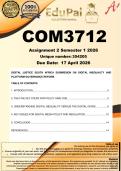
COM3712
Assignment 2 Semester 1 2026
Unique number: 354205
Due Date: 17 April 2026

DIGITAL JUSTICE SOUTH AFRICA SUBMISSION ON DIGITAL INEQUALITY AND
PLATFORM GOVERNANCE REFORM

TABLE OF CONTENTS

1. INTRODUCTION ............................................................................................................. 3


2. THE FIVE KEY STEPS FOR POLICY ANALYSIS .......................................................... 3


3. UNDERSTANDING DIGITAL INEQUALITY VERSUS THE DIGITAL DIVIDE ................ 6


4. KEY ISSUES FOR DIGITAL MEDIA POLICY AND REGULATION .............................. 10


5. CONCLUSION .............................................................................................................. 14


REFERENCES .................................................................................................................. 14

Terms of use
By making use of this document you agree to:
 Use this document as a guide for learning, comparison and reference purpose,
Terms of use
 Not to duplicate, reproduce and/or misrepresent the contents of this document as your own work,
By making use of this document you agree to:
 Use this document
Fully accept the consequences
solely as a guide forshould you plagiarise
learning, reference,or and
misuse this document.
comparison purposes,
 Ensure originality of your own work, and fully accept the consequences should you plagiarise or misuse this document.
 Comply with all relevant standards, guidelines, regulations, and legislation governing academic and written work.

Disclaimer
Great care has been taken in the preparation of this document; however, the contents are provided "as is" without any express or
implied representations or warranties. The author accepts no responsibility or liability for any actions taken based on the
information contained within this document. This document is intended solely for comparison, research, and reference purposes.
Reproduction, resale, or transmission of any part of this document, in any form or by any means, is strictly prohibited.

, +27 81 278 3372


DIGITAL JUSTICE SOUTH AFRICA SUBMISSION ON DIGITAL INEQUALITY AND
PLATFORM GOVERNANCE REFORM

TABLE OF CONTENTS

1. INTRODUCTION ............................................................................................................. 3


2. THE FIVE KEY STEPS FOR POLICY ANALYSIS .......................................................... 3


3. UNDERSTANDING DIGITAL INEQUALITY VERSUS THE DIGITAL DIVIDE ................ 6


4. KEY ISSUES FOR DIGITAL MEDIA POLICY AND REGULATION .............................. 10


5. CONCLUSION .............................................................................................................. 14


REFERENCES .................................................................................................................. 14


Disclaimer
Great care has been taken in the preparation of this document; however, the contents are provided "as is"
without any express or implied representations or warranties. The author accepts no responsibility or
liability for any actions taken based on the information contained within this document. This document is
intended solely for comparison, research, and reference purposes. Reproduction, resale, or transmission
of any part of this document, in any form or by any means, is strictly prohibited.


Verknüpftes buch

Schule, Studium & Fach

Hochschule
Kurs

Dokument Information

Hochgeladen auf
17. februar 2026
Anzahl der Seiten
18
geschrieben in
2025/2026
Typ
Prüfung
Enthält
Fragen & Antworten

Themen

$4.82
Vollständigen Zugriff auf das Dokument erhalten:

Falsches Dokument? Kostenlos tauschen Innerhalb von 14 Tagen nach dem Kauf und vor dem Herunterladen kannst du ein anderes Dokument wählen. Du kannst den Betrag einfach neu ausgeben.
Geschrieben von Student*innen, die bestanden haben
Sofort verfügbar nach Zahlung
Online lesen oder als PDF

Lerne den Verkäufer kennen

Seller avatar
Bewertungen des Ansehens basieren auf der Anzahl der Dokumente, die ein Verkäufer gegen eine Gebühr verkauft hat, und den Bewertungen, die er für diese Dokumente erhalten hat. Es gibt drei Stufen: Bronze, Silber und Gold. Je besser das Ansehen eines Verkäufers ist, desto mehr kannst du dich auf die Qualität der Arbeiten verlassen.
EduPal University of South Africa (Unisa)
Folgen Sie müssen sich einloggen, um Studenten oder Kursen zu folgen.
Verkauft
153227
Mitglied seit
7 Jahren
Anzahl der Follower
36023
Dokumente
4951
Zuletzt verkauft
11 Jahren vor

At EduPal we provide academic assistance, exam preparation, detailed notes, and exam packs to help college students study with confidence. Our tutoring is comprehensive and personalised, focusing on your subject needs and deadlines. We guarantee quality support, clear guidance, and proven strategies that improve understanding, marks, and pass rates. For more information Whats-App 0.8.1..2.7.8..3.3.7.2..

4.2

14258 rezensionen

5
8277
4
2783
3
1868
2
485
1
845

Warum sich Studierende für Stuvia entscheiden

on Mitstudent*innen erstellt, durch Bewertungen verifiziert

Geschrieben von Student*innen, die bestanden haben und bewertet von anderen, die diese Studiendokumente verwendet haben.

Nicht zufrieden? Wähle ein anderes Dokument

Kein Problem! Du kannst direkt ein anderes Dokument wählen, das besser zu dem passt, was du suchst.

Bezahle wie du möchtest, fange sofort an zu lernen

Kein Abonnement, keine Verpflichtungen. Bezahle wie gewohnt per Kreditkarte oder Sofort und lade dein PDF-Dokument sofort herunter.

Student with book image

“Gekauft, heruntergeladen und bestanden. So einfach kann es sein.”

Alisha Student

Arbeitest du an deiner Quellenangabe?

Erstelle korrekte Quellenangaben in APA, MLA und Harvard mit unserem kostenlosen Zitiergenerator.

Arbeitest du an deiner Quellenangabe?

Häufig gestellte Fragen
