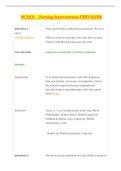
NCLEX _ Nursing Interventions TEST BANK | Explanations and references included
NCLEX _ Nursing Interventions TEST BANK Question 1: When performing an abdominal assessment, the nurse uses a (see full question) different order of techniques than with other systems. Which of the following represents this order You selected: Inspection, auscultation, percussion, palpation Correct Explanation: In an abdominal assessment, start with inspection, then auscultation, percussion, and palpation. This is the preferred approach because palpation and percussion before auscultation may alter the sounds heard. (less) Reference: Taylor, C., et al. Fundamentals of Nursing, 8th ed. Philadelphia: Wolters Kluwer Health/Lippincott Williams & Wilkins; 2015, Chapter 25: Health Assessment, p. 658. Chapter 25: Health Assessment - Page 658 Question 2: The nurse in post-anesthesia recovery (PAR) is caring for a 27- (see full question) year-old client following an appendectomy. Twenty minutes after receiving 4 mg of intravenous (IV) morphine for abdominal pain, the client continues to report abdominal discomfort and requests more morphine. Which action by the nurse is best? You selected: Observe the abdomen for distention and rigidity. Correct Explanation: Continued abdominal pain after administration of IV morphine is an unexpected occurrence and requires further assessment by the nurse to rule out peritonitis or internal bleeding by observing the abdomen for distention and rigidity. Administration of more morphine could mask the cause of the abdominal pain and delay diagnosis of a possible postoperative complication. Applying heat to the abdomen would increase blood flow to the area and potentially increase pain or internal bleeding. Positioning the client in a knees- flexed position may relieve the discomfort, but an assessment is needed before any intervention is implemented. (less) Reference: Taylor, C. R. Fundamentals of Nursing, 8th ed. Philadelphia: Wolters Kluwer Health/Lippincott Williams & Wilkins, 2015, Chapter 25: Health Assessment, p. 658. Chapter 25: Health Assessment - Page 658 Question 3: The nurse will obtain the greatest amount of information about the (see full question) thyroid gland by using which technique of assessment? You selected: Palpation Correct Explanation: The thyroid gland is assessed by palpation, although it is not normally palpable in some patients. Reference: Taylor, C., et al. Fundamentals of Nursing, 8th ed. Philadelphia: Wolters Kluwer Health/Lippincott Williams & Wilkins; 2015, Chapter 25: Health Assessment, pp. 647-648. Chapter 25: Health Assessment - Page 647 Question 4: The nurse is asking admission interview questions and the client (see full question) has explained the reason for seeking care. Which of the following is the most appropriate way to document the response? You selected: Client describes shortness of breath and increased sputum production. Incorrect Correct response: Client states, "I feel winded all of the time and yesterday I started spitting up a lot of phlegm." Explanation: The client's reason for seeking care should always be stated in the client's own words. Reference: Taylor, C., et al. Fundamentals of Nursing, 8th ed. Philadelphia: Wolters Kluwer Health/Lippincott Williams & Wilkins; 2015, Chapter 25: Health Assessment, p. 628. Chapter 25: Health Assessment - Page 628 Question 5: The nurse in the emergency department observes a client (see full question) experiencing a generalized tonic–clonic seizure. What is the priority intervention for the nurse to take? You selected: Assess and maintain the client's airway. Correct Explanation: Risk for aspiration is a concern during a seizure because the client will have copious oral secretions that will need to be suctioned and allowed to drain out of the mouth. The nurse should assess the client's airway and maintain it by placing the client in a side-lying position, which will allow the oral secretions to drain from his mouth and not accumulate in his throat and compromise the airway. It is contraindicated to place anything in the mouth of a person who is actively convulsing. Reorienting the client and documenting the seizure are important actions after the postictal phase, but client safety is the priority intervention during a seizure. (less) Reference: Taylor, C. R. Fundamentals of Nursing, 8th ed. Philadelphia: Wolters Kluwer Health/Lippincott Williams & Wilkins, 2015, Chapter 25: Health Assessment, p. 625. Chapter 25: Health Assessment - Page 625 Question 6: The nurse is caring for a client who just informed her that he (see full question) noticed some blood in the toilet after a bowel movement. The nurse n t f er er Question 8: (see full question) Which assessment measure would the nurse use to assess the location, shape, size, and density of a tumor? You selected: Percussion Correct Explanation: Percussion is the act of striking one object against another to produce sound. The fingertips are used to tap the body over body tissues to produce vibrations and sound waves. The location, shape, size, and density of organs or tumors are assessed with this method. Observation is visually looking at an object. The characteristics that can be determined about a tumor by palpation include shape, size, consistency, surface, mobility, tenderness, and pulsatile. (less) Reference: Taylor, C.R. Fundamentals of Nursing, 8th ed., Philadelphia: Wolters Kluwer Health, 2015, Chapter 25, Health Assessment, p. 635 Question 9: (see full question) The nurse is palpating the skin of a 30-year old patient and documents that when picked up in a fold, the skin fold slowly returns to normal. What would be the next action of the nurse based on this finding? You selected: Assess the patient for dehydration. - - - - - Continued
Document information
- Uploaded on
- April 5, 2021
- Number of pages
- 665
- Written in
- 2020/2021
- Type
- Exam (elaborations)
- Contains
- Questions & answers