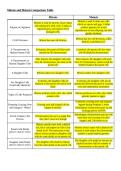
Mitosis and Meiosis Comparison Table
Mitosis Meiosis
Meiosis is used to make sex cells,
Mitosis is used for growth, tissue repair,
which are sperm and eggs. It helps
and making new body cells. It helps an
Purpose in Organism produce gametes for sexual
organism grow and replace old or
reproduction so that offspring can have
damaged cells.
genetic variation.
Meiosis has two cell divisions, called
# Cell Divisions Mitosis has one cell division.
Meiosis I and Meiosis II.
# Chromosomes in In humans, the parent cell that starts In meiosis, the parent cell also starts
Human Parents Cells mitosis has 46 chromosomes. with 46 (diploid) chromosomes.
After mitosis, the daughter cells each After meiosis, the daughter cells each
# Chromosomes in
have 46 chromosomes, the same as the have 23 chromosomes, which is half the
Human Daughter Cells
parent cell. number found in the parent cell.
# Daughter Cells Mitosis makes two daughter cells. Meiosis makes four daughter cells.
In mitosis, the daughter cells are In meiosis, the daughter cells are all
Are Daughter Cells
identical to the parent cell and to each genetically different because of crossing
Genetically Identical?
other. over and independent assortment.
Mitosis produces body cells, also called Meiosis produces sex cells, also called
Types of Cells Produced
somatic cells. gametes (sperm or eggs).
In meiosis, crossing over and synapsis
Homolog Crossing Over Crossing over and synapsis do not happen during Prophase I, when
and Synapsis? When? happen in mitosis. homologous chromosomes pair up and
exchange pieces of DNA
Homologous chromosomes pair up with
Events Unique to the Chromosomes line up in a single line;
each other and crossing over does
Process they don’t cross over though
happen, and 2 divisions occur
Mitosis usually starts with a diploid
cell, but it can happen in cells of any Meiosis always starts with a diploid cell
Parent Cells Ploidy ploidy level. The main point is that because it must reduce the chromosome
(Diploid / Haploid / Either)
mitosis always produces daughter cells number to make haploid gametes.
with the same ploidy as the parent cell.
The daughter cells made by meiosis are
Daughter Cells Ploidy The daughter cells made by mitosis
haploid and have half the number of
(Diploid / Haploid / Either) have the same ploidy as the parent cell.
chromosomes as the parent cell.
Mitosis Meiosis
Meiosis is used to make sex cells,
Mitosis is used for growth, tissue repair,
which are sperm and eggs. It helps
and making new body cells. It helps an
Purpose in Organism produce gametes for sexual
organism grow and replace old or
reproduction so that offspring can have
damaged cells.
genetic variation.
Meiosis has two cell divisions, called
# Cell Divisions Mitosis has one cell division.
Meiosis I and Meiosis II.
# Chromosomes in In humans, the parent cell that starts In meiosis, the parent cell also starts
Human Parents Cells mitosis has 46 chromosomes. with 46 (diploid) chromosomes.
After mitosis, the daughter cells each After meiosis, the daughter cells each
# Chromosomes in
have 46 chromosomes, the same as the have 23 chromosomes, which is half the
Human Daughter Cells
parent cell. number found in the parent cell.
# Daughter Cells Mitosis makes two daughter cells. Meiosis makes four daughter cells.
In mitosis, the daughter cells are In meiosis, the daughter cells are all
Are Daughter Cells
identical to the parent cell and to each genetically different because of crossing
Genetically Identical?
other. over and independent assortment.
Mitosis produces body cells, also called Meiosis produces sex cells, also called
Types of Cells Produced
somatic cells. gametes (sperm or eggs).
In meiosis, crossing over and synapsis
Homolog Crossing Over Crossing over and synapsis do not happen during Prophase I, when
and Synapsis? When? happen in mitosis. homologous chromosomes pair up and
exchange pieces of DNA
Homologous chromosomes pair up with
Events Unique to the Chromosomes line up in a single line;
each other and crossing over does
Process they don’t cross over though
happen, and 2 divisions occur
Mitosis usually starts with a diploid
cell, but it can happen in cells of any Meiosis always starts with a diploid cell
Parent Cells Ploidy ploidy level. The main point is that because it must reduce the chromosome
(Diploid / Haploid / Either)
mitosis always produces daughter cells number to make haploid gametes.
with the same ploidy as the parent cell.
The daughter cells made by meiosis are
Daughter Cells Ploidy The daughter cells made by mitosis
haploid and have half the number of
(Diploid / Haploid / Either) have the same ploidy as the parent cell.
chromosomes as the parent cell.