

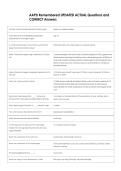
AAPD Remembered UPDATED ACTUAL Questions and
CORRECT Answers
In infants, what is the best indicator for future caries? plaque on maxillary anteriors
A pea-sized amount of fluoridated toothpaste is age 2-5
appropriate for what age range?
In a child under the age of 3, what factors automatically White spot lesions, any carious lesion on a smooth surface
assign that child an S-ECC status?
Name 7 factors that assign a high caries risk to a 0-5 year 1) Mother/caregiver with active caries; 2) Parent/caregiver low SES; 3) greater than
old. three between-meal sugar-containing snacks or beverages per day; 4) Child is put
to bed with a bottle containing natural or added sugar; 5) child has greater than 1
DMFS; 6) Child has active white spot lesions or enamel defects; 7) Child has
elevated MS levels
Name 3 factors that assign a moderate caries risk to a 0-5 1) Child has special health care needs; 2) Child is a recent immigrant; 3) Child has
year old. plaque on teeth
Name the 4 caries protective factors. 1) Child receives optimally-fluoridated drinking water or fluoride supplements; 2)
Child has teeth brushed daily with fluoridated toothpaste; 3) Child receives
topical fluoride from health professional; 4) Child has dental home/regular dental
care
Neural crest cells develop from ______. Name some 1) ectoderm on the lateral border of the neural plate. 2) bone, cartilage, dentin,
structures that neural crests are responsible for forming. dermis (not enamel)
Dental lamina begins formation at _____ embryonic age. 6 weeks
From what structure does dental lamina form? basal layer of oral epithelium
What structures form from dental lamina? tooth buds
At what age does the permanent first molar begin 1) 16 weeks in utero 2) 4-5 years
initiation? At what age does the permanent 2nd molar
begin initiation?
Name the components of the tooth bud. enamel organ, dental papilla, dental sac
Name the components of the enamel organ. Inner enamel epithelium (concavity), outer enamel epithelium (convexity), stellate
reticulum (center)
The dental papilla forms from_____ _. neural crest
Name the stages of tooth development in order. Bud stage, cap stage, bell stage, advanced bell stage
, Hertwig's epithelial root sheath is composed of what inner and outer enamel epithelia (not stratum intermedium or stellate reticulum)
structures?
The remnants of Hertwig's root sheath persist as __ _. rests of Malassez
Problems in the initiation stage of tooth development Tooth number
lead to anomalies of ____ _.
Problems in the proliferation stage of tooth development size, proportion, number, twinning
lead to anomalies of ____ _.
Problems in the histodifferentiation stage of tooth anomalies of enamel and dentin (enamel hypoplasia, AI, DI, DD)
development lead to anomalies of _____.
Problems in the morphodifferentiation stage of tooth Anomalies of enamel, dentin, and cementum
development lead to _____ _.
Is hyperdontia more common in males or females? males (2:1)
Is hyperdontia more common in primary or permanent permanent dentition (5:1)
dentition?
Is hyperdontia more common in the maxilla or the maxilla (9:1)
mandible?
Name the most common teeth affected by hypodontia in 3rd molars, mandibular 2nd premolar, maxillary lateral, maxillary 2nd premolar
order of frequency.
Name (9) syndromes associated with hyperdontia. Apert's, cleidocranial dysplasia, Gardner syndrome, Crouzon syndrome, Sturge-
Weber syndrome, Orofaciodigital syndrome I, Hallerman-Strieff syndrome, cleft
lip and palate, Down syndrome
Describe features of Apert Syndrome. supernumerary teeth, cleft palate, delayed/ectopic eruption, shovel shaped
incisors, hypoplastic midface, syndactyly, craniosynostosis, hypertelorism, class III
with anterior openbite, crowded dentition
Describe features of cleidocranial dysplasia. supernumerary teeth, delayed development/eruption, midface hypoplasia,
enamel hypoplasia, missing clavicle, craniosynostosis
Describe features of Gardner Syndrome supernumerary teeth, osteomas of the jaw, delayed eruption, colonic polyps
Describe features of Crouzon syndrome. supernumerary teeth, midface hypoplasia, inverted V shaped palate,
craniosynostosis, exopthalamos
Describe features of Sturge-Weber syndrome port-wine stains which follow the trigeminal nerve, supernumerary teeth,
overgrowth of maxilla, ipsilateral gyriform calcifications of cerebral cortex, 100%
have seizures, hemiplegia, ocular defects, bleeding and gingival hyperplasia,
alveolar bone loss, pyogenic granulomas
CORRECT Answers
In infants, what is the best indicator for future caries? plaque on maxillary anteriors
A pea-sized amount of fluoridated toothpaste is age 2-5
appropriate for what age range?
In a child under the age of 3, what factors automatically White spot lesions, any carious lesion on a smooth surface
assign that child an S-ECC status?
Name 7 factors that assign a high caries risk to a 0-5 year 1) Mother/caregiver with active caries; 2) Parent/caregiver low SES; 3) greater than
old. three between-meal sugar-containing snacks or beverages per day; 4) Child is put
to bed with a bottle containing natural or added sugar; 5) child has greater than 1
DMFS; 6) Child has active white spot lesions or enamel defects; 7) Child has
elevated MS levels
Name 3 factors that assign a moderate caries risk to a 0-5 1) Child has special health care needs; 2) Child is a recent immigrant; 3) Child has
year old. plaque on teeth
Name the 4 caries protective factors. 1) Child receives optimally-fluoridated drinking water or fluoride supplements; 2)
Child has teeth brushed daily with fluoridated toothpaste; 3) Child receives
topical fluoride from health professional; 4) Child has dental home/regular dental
care
Neural crest cells develop from ______. Name some 1) ectoderm on the lateral border of the neural plate. 2) bone, cartilage, dentin,
structures that neural crests are responsible for forming. dermis (not enamel)
Dental lamina begins formation at _____ embryonic age. 6 weeks
From what structure does dental lamina form? basal layer of oral epithelium
What structures form from dental lamina? tooth buds
At what age does the permanent first molar begin 1) 16 weeks in utero 2) 4-5 years
initiation? At what age does the permanent 2nd molar
begin initiation?
Name the components of the tooth bud. enamel organ, dental papilla, dental sac
Name the components of the enamel organ. Inner enamel epithelium (concavity), outer enamel epithelium (convexity), stellate
reticulum (center)
The dental papilla forms from_____ _. neural crest
Name the stages of tooth development in order. Bud stage, cap stage, bell stage, advanced bell stage
, Hertwig's epithelial root sheath is composed of what inner and outer enamel epithelia (not stratum intermedium or stellate reticulum)
structures?
The remnants of Hertwig's root sheath persist as __ _. rests of Malassez
Problems in the initiation stage of tooth development Tooth number
lead to anomalies of ____ _.
Problems in the proliferation stage of tooth development size, proportion, number, twinning
lead to anomalies of ____ _.
Problems in the histodifferentiation stage of tooth anomalies of enamel and dentin (enamel hypoplasia, AI, DI, DD)
development lead to anomalies of _____.
Problems in the morphodifferentiation stage of tooth Anomalies of enamel, dentin, and cementum
development lead to _____ _.
Is hyperdontia more common in males or females? males (2:1)
Is hyperdontia more common in primary or permanent permanent dentition (5:1)
dentition?
Is hyperdontia more common in the maxilla or the maxilla (9:1)
mandible?
Name the most common teeth affected by hypodontia in 3rd molars, mandibular 2nd premolar, maxillary lateral, maxillary 2nd premolar
order of frequency.
Name (9) syndromes associated with hyperdontia. Apert's, cleidocranial dysplasia, Gardner syndrome, Crouzon syndrome, Sturge-
Weber syndrome, Orofaciodigital syndrome I, Hallerman-Strieff syndrome, cleft
lip and palate, Down syndrome
Describe features of Apert Syndrome. supernumerary teeth, cleft palate, delayed/ectopic eruption, shovel shaped
incisors, hypoplastic midface, syndactyly, craniosynostosis, hypertelorism, class III
with anterior openbite, crowded dentition
Describe features of cleidocranial dysplasia. supernumerary teeth, delayed development/eruption, midface hypoplasia,
enamel hypoplasia, missing clavicle, craniosynostosis
Describe features of Gardner Syndrome supernumerary teeth, osteomas of the jaw, delayed eruption, colonic polyps
Describe features of Crouzon syndrome. supernumerary teeth, midface hypoplasia, inverted V shaped palate,
craniosynostosis, exopthalamos
Describe features of Sturge-Weber syndrome port-wine stains which follow the trigeminal nerve, supernumerary teeth,
overgrowth of maxilla, ipsilateral gyriform calcifications of cerebral cortex, 100%
have seizures, hemiplegia, ocular defects, bleeding and gingival hyperplasia,
alveolar bone loss, pyogenic granulomas


