
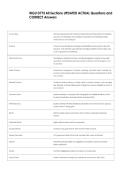
WGU D775 All Sections UPDATED ACTUAL Questions and
CORRECT Answers
Accounting Past-focused process that records and reports financial transactions for historical
accuracy, tax reporting, and compliance. Example: Summarizing last year's
revenue for an annual report.
Finance Future-focused discipline managing assets/liabilities to plan growth, allocate
resources, and maximize value. Example: Deciding whether to invest surplus cash
in new equipment or marketing.
Personal Finance Managing an individual's money, including budgeting, investing, saving, debt
repayment, and retirement planning. Example: Creating a monthly budget to save
for a home.
Public Finance Government management of taxation, spending, and public debt to stabilize the
economy and provide public services. Example: Issuing municipal bonds to build
new schools.
Business Finance Corporate decision-making on raising capital, investing in projects, and managing
risks. Example: A startup raising equity funding from venture capitalists to launch a
new product.
Common Stock Equity ownership in a company with voting rights and variable dividends. Last to
be paid in liquidation. Example: Shares of Apple (AAPL).
Preferred Stock Equity ownership with fixed dividends and priority over common stock in payouts,
usually without voting rights.
Bonds Debt securities where issuers borrow from investors, repaying principal plus
interest.
Corporate Bonds Higher yield and risk; issued by companies.
Municipal Bonds Issued by local governments; often tax-free interest income.
Treasury Securities U.S. government debt with low risk; includes T-bills, notes, and bonds.
Options Derivatives giving the right (not obligation) to buy/sell an asset at a set price
before expiration.
Futures Contracts obligating buy/sell at a set price on a future date.
Mutual Funds Pooled investments managed by professionals; priced once daily (NAV).
, ETFs Exchange-Traded Funds — trade like stocks; often track an index.
Hedge Funds High-risk pooled investments seeking high returns; open to accredited investors.
Pension Funds Investment pools for employee retirement benefits.
Public Markets Regulated exchanges like NYSE and NASDAQ; high liquidity and transparency.
Private Markets Transactions between private investors (VC, PE); less regulated and less liquid.
Primary Market Where new securities are issued; money goes directly to issuer (e.g., IPO).
Secondary Market Trading of existing securities between investors; issuer doesn't receive funds.
Dealer Market Dealers set prices and profit from bid-ask spreads (NASDAQ).
Auction Market Buyers/sellers meet at a single price; matching via bids (NYSE).
GDP Gross Domestic Product — value of all goods/services produced domestically.
Growth signals expansion; decline signals contraction.
CPI Consumer Price Index — measures inflation for households.
PPI Producer Price Index — measures inflation at the wholesale level.
Demand-Pull Inflation Prices rise due to high demand.
Cost-Push Inflation Prices rise due to higher production costs.
Yield Curve Graph of interest rate vs maturity; normal indicates growth, inverted can signal
recession.
Interest Rates Low rates stimulate spending; high rates slow economic activity.
Shareholders Owners of a corporation who expect transparency and accountability.
Agency Problem Conflict between managers and owners; mitigated through incentives and
independent boards.
CSR/ESG Corporate Social Responsibility and Environmental, Social, and Governance
principles — integrating ethical and sustainable practices into business decisions.
Balance Sheet Shows a company's financial position: Assets = Liabilities + Equity.
Income Statement Shows profitability over a period: Revenue − Expenses = Net Income.
Cash Flow Statement Tracks cash movement across operating, investing, and financing activities.
CORRECT Answers
Accounting Past-focused process that records and reports financial transactions for historical
accuracy, tax reporting, and compliance. Example: Summarizing last year's
revenue for an annual report.
Finance Future-focused discipline managing assets/liabilities to plan growth, allocate
resources, and maximize value. Example: Deciding whether to invest surplus cash
in new equipment or marketing.
Personal Finance Managing an individual's money, including budgeting, investing, saving, debt
repayment, and retirement planning. Example: Creating a monthly budget to save
for a home.
Public Finance Government management of taxation, spending, and public debt to stabilize the
economy and provide public services. Example: Issuing municipal bonds to build
new schools.
Business Finance Corporate decision-making on raising capital, investing in projects, and managing
risks. Example: A startup raising equity funding from venture capitalists to launch a
new product.
Common Stock Equity ownership in a company with voting rights and variable dividends. Last to
be paid in liquidation. Example: Shares of Apple (AAPL).
Preferred Stock Equity ownership with fixed dividends and priority over common stock in payouts,
usually without voting rights.
Bonds Debt securities where issuers borrow from investors, repaying principal plus
interest.
Corporate Bonds Higher yield and risk; issued by companies.
Municipal Bonds Issued by local governments; often tax-free interest income.
Treasury Securities U.S. government debt with low risk; includes T-bills, notes, and bonds.
Options Derivatives giving the right (not obligation) to buy/sell an asset at a set price
before expiration.
Futures Contracts obligating buy/sell at a set price on a future date.
Mutual Funds Pooled investments managed by professionals; priced once daily (NAV).
, ETFs Exchange-Traded Funds — trade like stocks; often track an index.
Hedge Funds High-risk pooled investments seeking high returns; open to accredited investors.
Pension Funds Investment pools for employee retirement benefits.
Public Markets Regulated exchanges like NYSE and NASDAQ; high liquidity and transparency.
Private Markets Transactions between private investors (VC, PE); less regulated and less liquid.
Primary Market Where new securities are issued; money goes directly to issuer (e.g., IPO).
Secondary Market Trading of existing securities between investors; issuer doesn't receive funds.
Dealer Market Dealers set prices and profit from bid-ask spreads (NASDAQ).
Auction Market Buyers/sellers meet at a single price; matching via bids (NYSE).
GDP Gross Domestic Product — value of all goods/services produced domestically.
Growth signals expansion; decline signals contraction.
CPI Consumer Price Index — measures inflation for households.
PPI Producer Price Index — measures inflation at the wholesale level.
Demand-Pull Inflation Prices rise due to high demand.
Cost-Push Inflation Prices rise due to higher production costs.
Yield Curve Graph of interest rate vs maturity; normal indicates growth, inverted can signal
recession.
Interest Rates Low rates stimulate spending; high rates slow economic activity.
Shareholders Owners of a corporation who expect transparency and accountability.
Agency Problem Conflict between managers and owners; mitigated through incentives and
independent boards.
CSR/ESG Corporate Social Responsibility and Environmental, Social, and Governance
principles — integrating ethical and sustainable practices into business decisions.
Balance Sheet Shows a company's financial position: Assets = Liabilities + Equity.
Income Statement Shows profitability over a period: Revenue − Expenses = Net Income.
Cash Flow Statement Tracks cash movement across operating, investing, and financing activities.


