
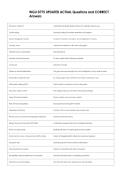
WGU D775 UPDATED ACTUAL Questions and CORRECT
Answers
Risk-return trade-off A principle that guides business finance to optimize resource use.
Capital raising Securing funding for business operations and projects.
Money management activity Involves the creation, circulation, and management of money.
Common stock A share of ownership in a firm with voting rights.
Preferred stock characteristic Fixed dividends.
Purpose of bonds for issuers To raise capital without diluting ownership.
Junk bonds Speculative bonds.
Options in financial derivatives They give the buyer the right, but not the obligation, to buy or sell an asset.
Economies of scale for funds By making large-scale investments that reduce transaction costs.
Initial public offering (IPO) The first sale of a company's stock to the public.
Secondary market activity The trading of stocks on the New York Stock Exchange.
Types of financial markets Primary markets and secondary markets.
Role of financial regulators Ensuring fair and transparent markets.
Depository institutions Institutions that accept deposits and provide loans.
Primary source of revenue for depository institutions Interest income from loans.
Rising Consumer Price Index (CPI) effect It indicates increased costs for raw materials and labor.
Return on equity goals Beating their return on equity goals for each quarter
Environmental, social, and governance (ESG) criteria Impact of integrating ESG criteria into investment decisions
Long-term risks Seeking long-term risks to protect stakeholders
Financial ratios for investors Purpose of using financial ratios for investors
Standardized basis for performance evaluation How financial ratios help in comparing companies
Performance benchmarking How financial ratios aid in performance benchmarking
, Profitability ratios What do profitability ratios indicate?
Current ratio What does the current ratio evaluate?
High average collection period What does a high average collection period indicate?
High current ratio What does a high current ratio suggest about a company's financial health?
High accounts receivable turnover rate What does a high accounts receivable turnover rate indicate?
High debt-to-assets ratio What does a high debt-to-assets ratio suggest?
High times interest earned ratio What does a high times interest earned ratio signify?
High return on assets What does a high return on assets suggest?
Times interest earned ratio Which ratio reflects an ability to pay interest on debt as it becomes due?
Fixed asset turnover vs return on assets What is the primary difference between fixed asset turnover and return on assets?
Return on equity Which ratio identifies the profitability relative to equity?
Firm with low profit margins A business that operates with minimal profit relative to its sales.
Firm providing mostly services A company that primarily offers services rather than physical products.
Firm with high debt A business that has a significant amount of borrowed money compared to its
equity.
Firm with high inventory A company that maintains a large amount of stock in its warehouses or stores.
Inventory turnover ratio A measure of how efficiently a company sells and replaces its stock of goods.
Goal of increasing inventory turnover The target of raising the inventory turnover ratio from below 3 to 5.
High quick ratio during economic downturn Indicates the company can cover obligations without selling inventory.
Debt-to-assets ratio A financial ratio that indicates the proportion of a company's assets that are
financed by debt.
Time-interest earned ratio A measure of a company's ability to meet its debt obligations based on its
earnings.
Least expensive way to finance Using debt when the firm has favorable leverage ratios.
Profit margins comparison Analyzing the profitability of two companies based on their profit margins.
Answers
Risk-return trade-off A principle that guides business finance to optimize resource use.
Capital raising Securing funding for business operations and projects.
Money management activity Involves the creation, circulation, and management of money.
Common stock A share of ownership in a firm with voting rights.
Preferred stock characteristic Fixed dividends.
Purpose of bonds for issuers To raise capital without diluting ownership.
Junk bonds Speculative bonds.
Options in financial derivatives They give the buyer the right, but not the obligation, to buy or sell an asset.
Economies of scale for funds By making large-scale investments that reduce transaction costs.
Initial public offering (IPO) The first sale of a company's stock to the public.
Secondary market activity The trading of stocks on the New York Stock Exchange.
Types of financial markets Primary markets and secondary markets.
Role of financial regulators Ensuring fair and transparent markets.
Depository institutions Institutions that accept deposits and provide loans.
Primary source of revenue for depository institutions Interest income from loans.
Rising Consumer Price Index (CPI) effect It indicates increased costs for raw materials and labor.
Return on equity goals Beating their return on equity goals for each quarter
Environmental, social, and governance (ESG) criteria Impact of integrating ESG criteria into investment decisions
Long-term risks Seeking long-term risks to protect stakeholders
Financial ratios for investors Purpose of using financial ratios for investors
Standardized basis for performance evaluation How financial ratios help in comparing companies
Performance benchmarking How financial ratios aid in performance benchmarking
, Profitability ratios What do profitability ratios indicate?
Current ratio What does the current ratio evaluate?
High average collection period What does a high average collection period indicate?
High current ratio What does a high current ratio suggest about a company's financial health?
High accounts receivable turnover rate What does a high accounts receivable turnover rate indicate?
High debt-to-assets ratio What does a high debt-to-assets ratio suggest?
High times interest earned ratio What does a high times interest earned ratio signify?
High return on assets What does a high return on assets suggest?
Times interest earned ratio Which ratio reflects an ability to pay interest on debt as it becomes due?
Fixed asset turnover vs return on assets What is the primary difference between fixed asset turnover and return on assets?
Return on equity Which ratio identifies the profitability relative to equity?
Firm with low profit margins A business that operates with minimal profit relative to its sales.
Firm providing mostly services A company that primarily offers services rather than physical products.
Firm with high debt A business that has a significant amount of borrowed money compared to its
equity.
Firm with high inventory A company that maintains a large amount of stock in its warehouses or stores.
Inventory turnover ratio A measure of how efficiently a company sells and replaces its stock of goods.
Goal of increasing inventory turnover The target of raising the inventory turnover ratio from below 3 to 5.
High quick ratio during economic downturn Indicates the company can cover obligations without selling inventory.
Debt-to-assets ratio A financial ratio that indicates the proportion of a company's assets that are
financed by debt.
Time-interest earned ratio A measure of a company's ability to meet its debt obligations based on its
earnings.
Least expensive way to finance Using debt when the firm has favorable leverage ratios.
Profit margins comparison Analyzing the profitability of two companies based on their profit margins.


