NUR 5461 Exam 2 | Questions and Answers | 2026 Update | 100% Correct-
WPU.
Correct
Incorrect
Questions and answers
1 of 86
Term
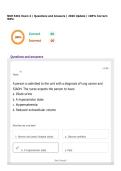
A person is admitted to the unit with a diagnosis of lung cancer and
SIADH. The nurse expects the person to have:
a. Dilute urine
b. A hypoosmolar state
c. Hypernatremia
d. Reduced extracellular volume
Give this one a try later!
b. Narrow and pencil shaped stools a. Detursor areflexia
b. A hypoosmolar state a. Fats
Don't know?
, 2 of 86
Definition
Immune mechanisms and inflammation are the major cause of injury for
both primary and secondary types. In nearly all types of acute
glomerulonephritis, the epithelial or podocyte layer of the glomerular
capillary membrane is disturbed with loss of negative charges and
changes in membrane permeability; the mesangial matrix may be
expanded or the basement membrane thickened. Decreased
glomerular perfusion occurs as a result of inflamation.
Clinical manifestations: Hematauria with RBC casts, proteinuria
exceeding 3-5 g/day with albumin, severe or progressive glomerular
disease
Give this one a try later!
Describe the pathophysiological mechanisms and clinical manifestations of
acute glomerulonephritis
Describe the pathophysiological mechanisms and clinical manifestations of
ulcerative colitis
Describe the transfusion reaction. What antigens and antibodies are involved and
how? What are the effects for the patient?
Compare and contrast the physiological and clinical differences between type I and
type II diabetes mellitus. How are they different, how are they similar?
, Don't know?
3 of 86
Term
Which information is correct regarding the secondary immune
response?
a. A latent period or lag phase occurs.
b. IgM is the primary immunoglobulin.
c. IgG is significantly increased.
d. Memory cells have to develop
Give this one a try later!
Malaria is a common parasitic
IgG is significantly increased.
infection.
d. The parietal cells secrete
a. Pathalogic fractures
gastroferrin
Don't know?
4 of 86
Term
A child has a UTI. Which assessment finding is most typical in this
condition?
, a. Enlarging asymptomatic upper abdominal mass
b. Periorbital edema that descends into the extremities
c. Prodromal gastrointestinal illness with diarrhea
d. Incontinence in a previously dry child
Give this one a try later!
d. Incontinence in a previously
a. Is usually caused by parainfluenza.
dry child
c. Insulin facilitates the uptake of c. Insulin facilitates the uptake of
glucose by cells. glucose by cells
Don't know?
5 of 86
Term
Sensitivity of a target cell is down-regulated when the:
a. Level of hormone that binds with the receptor is high
b. Number of receptors for the hormone is high.
c. Direct effects of the hormone are detected
d. Permissive effects of the hormone are detected
Give this one a try later!
WPU.
Correct
Incorrect
Questions and answers
1 of 86
Term
A person is admitted to the unit with a diagnosis of lung cancer and
SIADH. The nurse expects the person to have:
a. Dilute urine
b. A hypoosmolar state
c. Hypernatremia
d. Reduced extracellular volume
Give this one a try later!
b. Narrow and pencil shaped stools a. Detursor areflexia
b. A hypoosmolar state a. Fats
Don't know?
, 2 of 86
Definition
Immune mechanisms and inflammation are the major cause of injury for
both primary and secondary types. In nearly all types of acute
glomerulonephritis, the epithelial or podocyte layer of the glomerular
capillary membrane is disturbed with loss of negative charges and
changes in membrane permeability; the mesangial matrix may be
expanded or the basement membrane thickened. Decreased
glomerular perfusion occurs as a result of inflamation.
Clinical manifestations: Hematauria with RBC casts, proteinuria
exceeding 3-5 g/day with albumin, severe or progressive glomerular
disease
Give this one a try later!
Describe the pathophysiological mechanisms and clinical manifestations of
acute glomerulonephritis
Describe the pathophysiological mechanisms and clinical manifestations of
ulcerative colitis
Describe the transfusion reaction. What antigens and antibodies are involved and
how? What are the effects for the patient?
Compare and contrast the physiological and clinical differences between type I and
type II diabetes mellitus. How are they different, how are they similar?
, Don't know?
3 of 86
Term
Which information is correct regarding the secondary immune
response?
a. A latent period or lag phase occurs.
b. IgM is the primary immunoglobulin.
c. IgG is significantly increased.
d. Memory cells have to develop
Give this one a try later!
Malaria is a common parasitic
IgG is significantly increased.
infection.
d. The parietal cells secrete
a. Pathalogic fractures
gastroferrin
Don't know?
4 of 86
Term
A child has a UTI. Which assessment finding is most typical in this
condition?
, a. Enlarging asymptomatic upper abdominal mass
b. Periorbital edema that descends into the extremities
c. Prodromal gastrointestinal illness with diarrhea
d. Incontinence in a previously dry child
Give this one a try later!
d. Incontinence in a previously
a. Is usually caused by parainfluenza.
dry child
c. Insulin facilitates the uptake of c. Insulin facilitates the uptake of
glucose by cells. glucose by cells
Don't know?
5 of 86
Term
Sensitivity of a target cell is down-regulated when the:
a. Level of hormone that binds with the receptor is high
b. Number of receptors for the hormone is high.
c. Direct effects of the hormone are detected
d. Permissive effects of the hormone are detected
Give this one a try later!