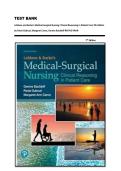
TEST BANK
LeMone and Burke's Medical-Surgical Nursing: Clinical Reasoning in Patient Care 7th Edition
by Paula Gubrud, Margaret Carno, Gerene Bauldoff RN PhD FAAN
7th Edition
,Table of Contents
Unit 1 Dimensions of Medical-Surgical Nursing ...................................... 5
Chapter 1: Chapter 1 Medical-Surgical Nursing in the 21st Century .......................................... 5
Chapter 2: Health and Illness Care of Adults ............................................................................ 12
Unit 2 Alterations in Patterns of Health ................................................ 17
Chapter 3: Nursing Care of the Patient with Alterations of Sleep ............................................ 17
CHAPTER 4: Nursing Care of Patients Having Surgery .............................................................. 24
Chapter 5: Palliative and End-of-Life Care ................................................................................ 29
Chapter 6: Nursing Care of Patients with Problems of Substance Abuse ................................. 35
Chapter 7: Nursing Care of Patients Experiencing Disasters ..................................................... 42
Unit 3 Pathophysiology and Patterns of Health ..................................... 48
Chapter 8: Genetic Implications of Adult Health Nursing ......................................................... 49
CHAPTER 9: Nursing Care of Patients in Pain ............................................................................ 50
CHAPTER 10: Nursing Care of Patients with Altered Fluid, Electrolyte, and Acid–Base Balance
................................................................................................................................................... 58
Chapter 11: Nursing Care of Patients Experiencing Trauma and Shock.................................... 62
Chapter 12: Nursing Care of Patients with Infections and Inflammation ................................. 71
Chapter 13: Nursing Care of Patients with Altered Immunity .................................................. 81
Chapter 14: Nursing Care of Patients with Cancer ................................................................... 90
Chapter 15: Assessing the Integumentary System ................................................................... 98
CHAPTER 16: Nursing Care of Patients with Integumentary Disorders .................................. 107
Chapter 17: Nursing Care of Patients with Burns ................................................................... 113
Chapter 18: Assessing the Endocrine System ........................................................................ 121
Chapter 20: Nursing Care of Patients with Diabetes Mellitus ................................................ 130
Chapter 21: Assessing the Gastrointestinal System ................................................................ 136
Chapter 22: Nursing Care of Patients with Nutritional Disorders ........................................... 143
Chapter 23: Nursing Care of Patients with Upper Gastrointestinal Disorders ........................ 151
Chapter 24: Nursing Care of Patients with Bowel Disorders .................................................. 159
Chapter 25: Nursing Care of Patients with Gallbladder, Liver, and Pancreatic Disorders ....... 168
,Unit 7 Responses to Altered Urinary Elimination ................................ 176
Chapter 26: Assessing the Renal System ................................................................................ 176
Chapter 27: Nursing Care of Patients with Urinary Tract Disorders ....................................... 182
Chapter 28: Nursing Care of Patients with Kidney Disorders ................................................. 188
Unit 8 Responses to Altered Cardiovascular Function ....................... 194
Chapter 29: Assessing the Cardiovascular and Lymphatic Systems ........................................ 194
CHAPTER 30: Nursing Care of Patients with Coronary Heart Disease .................................... 202
CHAPTER 31: Nursing Care of Patients with Cardiac Disorders .............................................. 208
CHAPTER 32: Nursing Care of Patients with Vascular and Lymphatic Disorders .................... 214
Chapter 32: Disorders of Blood Pressure Regulation .............................................................. 220
Chapter 33: Nursing Care of Patients with Hematologic Disorders ........................................ 226
Unit 9 Responses to Altered Respiratory Function ............................. 235
Chapter 34: Assessing the Respiratory System ....................................................................... 235
CHAPTER 35: Nursing Care of Patients with Upper Respiratory Disorders ............................. 243
CHAPTER 36: Nursing Care of Patients with Ventilation Disorders ......................................... 249
CHAPTER 37: Nursing Care of Patients with Gas Exchange Disorders .................................... 254
Unit 10 Responses to Altered Musculoskeletal Function ................... 261
Chapter 38: Assessing the Musculoskeletal System ............................................................... 261
Chapter 39: Nursing Care of Patients with Musculoskeletal Trauma...................................... 270
Chapter 40: Nursing Care of Patients with Musculoskeletal Disorders .................................. 276
Unit 11 Responses to Altered Neurologic Function ............................ 282
CHAPTER 41: Assessing the Nervous System .......................................................................... 282
Chapter 42: Nursing Care of Patients with Intracranial Disorders .......................................... 290
Chapter 43: Nursing Care of Patients with Spinal Cord Disorders and CNS Infections ........... 297
Chapter 44: Nursing Care of Patients with Neurologic Disorders ........................................... 304
Unit 12 Responses to Altered Sensory Function ................................. 311
Chapter 45: Assessing the Eye and Ear ................................................................................... 311
Chapter 46: Nursing Care of Patients with Eye and Ear Disorders .......................................... 317
Unit 13 Responses to Altered Reproductive Function ........................ 327
,Chapter 47: Assessing the Male and Female Reproductive Systems...................................... 327
Chapter 48: Nursing Care of Men with Reproductive System and Breast Disorders .............. 337
CHAPTER 49: Nursing Care of Women with Reproductive System and Breast Disorders ...... 342
Chapter 50: Nursing Care of Patients with Sexually Transmitted Infections........................... 347
,Unit 1 Dimensions of Medical-Surgical Nursing
Chapter 1: Chapter 1 Medical-Surgical Nursing in the 21st Century
1. The nurse is caring for four clients on a medical–surgical unit. Which client should the
nurse see initially?
1. A client admitted with hepatitis A who has had severe diarrhea for the last 24 hours
2. A client admitted with pneumonia who is has small amounts of yellow productive
sputum
3. A client admitted with fever of unknown origin (FUO) who has been without fever for
the last 48 hours
4. A client admitted with a wound infection whose WBC is 8,500 mm3
Correct Answer: 1
Rationale: The nurse must decide which client should be seen on the initial rounds of the day.
The nurse must remember that the first client to be seen should be the client who needs the
attention of the nurse initially. A client with hepatitis A does experience diarrhea, but diarrhea
for the last 24 hours could cause the client to have a problem with dehydration and experience
a state of fluid volume deficit.
2. The nurse is preparing to administer influenza vaccines to a mass drive-through clinic.
Which statement by a client would indicate further questioning prior to giving the client the
influenza vaccine?
1. “I am allergic to horse hair.”
2. “I try to get my vaccine every year.”
, 3. “I am not allergic to anything except eggs.”
4. “My husband had a severe allergic reaction after he received his influenza vaccine.”
Correct Answer: 3
Rationale: Influenza vaccines are recommended for person at high risk for serious sequelae of
influenza. The nurse should be aware that client with a sensitivity to eggs should not receive the
vaccine. Vaccines prepared from chicken or duck embryos are contraindicated in clients who are
allergic to eggs.
3. The nurse is caring for four clients on a medical–surgical unit. The secretary gives the
nurse the morning labs. Which of the following labs would require that the nurse call the
physician and inform the healthcare provider about the client’s abnormalities?
1. WBC 14,600 mm3
2. Serum protein 6.9 g/dl
3. I & D (incision and drainage) showing no growth for the last 24 hours
4. Albumin 4.2 g/dl
Correct Answer: 1
Rationale: When the nurse is caring for several clients, all of the labs should be checked
frequently throughout the shift to assess for any abnormalities. The WBC in option 1 is
abnormal. (Normal WBC 4,000–10,000 mm3.) All of the other lab results are within acceptable
range; therefore, the results should not be called in to the physician.
4. The nurse is orienting a new graduate. The nurse is reinforcing the importance of
standard precautions. Which of the following observations by the nurse would require further
education regarding standard precautions?
1. The graduate nurse understands to wash hands when entering and exiting the client’s
room.
LeMone and Burke's Medical-Surgical Nursing: Clinical Reasoning in Patient Care 7th Edition
by Paula Gubrud, Margaret Carno, Gerene Bauldoff RN PhD FAAN
7th Edition
,Table of Contents
Unit 1 Dimensions of Medical-Surgical Nursing ...................................... 5
Chapter 1: Chapter 1 Medical-Surgical Nursing in the 21st Century .......................................... 5
Chapter 2: Health and Illness Care of Adults ............................................................................ 12
Unit 2 Alterations in Patterns of Health ................................................ 17
Chapter 3: Nursing Care of the Patient with Alterations of Sleep ............................................ 17
CHAPTER 4: Nursing Care of Patients Having Surgery .............................................................. 24
Chapter 5: Palliative and End-of-Life Care ................................................................................ 29
Chapter 6: Nursing Care of Patients with Problems of Substance Abuse ................................. 35
Chapter 7: Nursing Care of Patients Experiencing Disasters ..................................................... 42
Unit 3 Pathophysiology and Patterns of Health ..................................... 48
Chapter 8: Genetic Implications of Adult Health Nursing ......................................................... 49
CHAPTER 9: Nursing Care of Patients in Pain ............................................................................ 50
CHAPTER 10: Nursing Care of Patients with Altered Fluid, Electrolyte, and Acid–Base Balance
................................................................................................................................................... 58
Chapter 11: Nursing Care of Patients Experiencing Trauma and Shock.................................... 62
Chapter 12: Nursing Care of Patients with Infections and Inflammation ................................. 71
Chapter 13: Nursing Care of Patients with Altered Immunity .................................................. 81
Chapter 14: Nursing Care of Patients with Cancer ................................................................... 90
Chapter 15: Assessing the Integumentary System ................................................................... 98
CHAPTER 16: Nursing Care of Patients with Integumentary Disorders .................................. 107
Chapter 17: Nursing Care of Patients with Burns ................................................................... 113
Chapter 18: Assessing the Endocrine System ........................................................................ 121
Chapter 20: Nursing Care of Patients with Diabetes Mellitus ................................................ 130
Chapter 21: Assessing the Gastrointestinal System ................................................................ 136
Chapter 22: Nursing Care of Patients with Nutritional Disorders ........................................... 143
Chapter 23: Nursing Care of Patients with Upper Gastrointestinal Disorders ........................ 151
Chapter 24: Nursing Care of Patients with Bowel Disorders .................................................. 159
Chapter 25: Nursing Care of Patients with Gallbladder, Liver, and Pancreatic Disorders ....... 168
,Unit 7 Responses to Altered Urinary Elimination ................................ 176
Chapter 26: Assessing the Renal System ................................................................................ 176
Chapter 27: Nursing Care of Patients with Urinary Tract Disorders ....................................... 182
Chapter 28: Nursing Care of Patients with Kidney Disorders ................................................. 188
Unit 8 Responses to Altered Cardiovascular Function ....................... 194
Chapter 29: Assessing the Cardiovascular and Lymphatic Systems ........................................ 194
CHAPTER 30: Nursing Care of Patients with Coronary Heart Disease .................................... 202
CHAPTER 31: Nursing Care of Patients with Cardiac Disorders .............................................. 208
CHAPTER 32: Nursing Care of Patients with Vascular and Lymphatic Disorders .................... 214
Chapter 32: Disorders of Blood Pressure Regulation .............................................................. 220
Chapter 33: Nursing Care of Patients with Hematologic Disorders ........................................ 226
Unit 9 Responses to Altered Respiratory Function ............................. 235
Chapter 34: Assessing the Respiratory System ....................................................................... 235
CHAPTER 35: Nursing Care of Patients with Upper Respiratory Disorders ............................. 243
CHAPTER 36: Nursing Care of Patients with Ventilation Disorders ......................................... 249
CHAPTER 37: Nursing Care of Patients with Gas Exchange Disorders .................................... 254
Unit 10 Responses to Altered Musculoskeletal Function ................... 261
Chapter 38: Assessing the Musculoskeletal System ............................................................... 261
Chapter 39: Nursing Care of Patients with Musculoskeletal Trauma...................................... 270
Chapter 40: Nursing Care of Patients with Musculoskeletal Disorders .................................. 276
Unit 11 Responses to Altered Neurologic Function ............................ 282
CHAPTER 41: Assessing the Nervous System .......................................................................... 282
Chapter 42: Nursing Care of Patients with Intracranial Disorders .......................................... 290
Chapter 43: Nursing Care of Patients with Spinal Cord Disorders and CNS Infections ........... 297
Chapter 44: Nursing Care of Patients with Neurologic Disorders ........................................... 304
Unit 12 Responses to Altered Sensory Function ................................. 311
Chapter 45: Assessing the Eye and Ear ................................................................................... 311
Chapter 46: Nursing Care of Patients with Eye and Ear Disorders .......................................... 317
Unit 13 Responses to Altered Reproductive Function ........................ 327
,Chapter 47: Assessing the Male and Female Reproductive Systems...................................... 327
Chapter 48: Nursing Care of Men with Reproductive System and Breast Disorders .............. 337
CHAPTER 49: Nursing Care of Women with Reproductive System and Breast Disorders ...... 342
Chapter 50: Nursing Care of Patients with Sexually Transmitted Infections........................... 347
,Unit 1 Dimensions of Medical-Surgical Nursing
Chapter 1: Chapter 1 Medical-Surgical Nursing in the 21st Century
1. The nurse is caring for four clients on a medical–surgical unit. Which client should the
nurse see initially?
1. A client admitted with hepatitis A who has had severe diarrhea for the last 24 hours
2. A client admitted with pneumonia who is has small amounts of yellow productive
sputum
3. A client admitted with fever of unknown origin (FUO) who has been without fever for
the last 48 hours
4. A client admitted with a wound infection whose WBC is 8,500 mm3
Correct Answer: 1
Rationale: The nurse must decide which client should be seen on the initial rounds of the day.
The nurse must remember that the first client to be seen should be the client who needs the
attention of the nurse initially. A client with hepatitis A does experience diarrhea, but diarrhea
for the last 24 hours could cause the client to have a problem with dehydration and experience
a state of fluid volume deficit.
2. The nurse is preparing to administer influenza vaccines to a mass drive-through clinic.
Which statement by a client would indicate further questioning prior to giving the client the
influenza vaccine?
1. “I am allergic to horse hair.”
2. “I try to get my vaccine every year.”
, 3. “I am not allergic to anything except eggs.”
4. “My husband had a severe allergic reaction after he received his influenza vaccine.”
Correct Answer: 3
Rationale: Influenza vaccines are recommended for person at high risk for serious sequelae of
influenza. The nurse should be aware that client with a sensitivity to eggs should not receive the
vaccine. Vaccines prepared from chicken or duck embryos are contraindicated in clients who are
allergic to eggs.
3. The nurse is caring for four clients on a medical–surgical unit. The secretary gives the
nurse the morning labs. Which of the following labs would require that the nurse call the
physician and inform the healthcare provider about the client’s abnormalities?
1. WBC 14,600 mm3
2. Serum protein 6.9 g/dl
3. I & D (incision and drainage) showing no growth for the last 24 hours
4. Albumin 4.2 g/dl
Correct Answer: 1
Rationale: When the nurse is caring for several clients, all of the labs should be checked
frequently throughout the shift to assess for any abnormalities. The WBC in option 1 is
abnormal. (Normal WBC 4,000–10,000 mm3.) All of the other lab results are within acceptable
range; therefore, the results should not be called in to the physician.
4. The nurse is orienting a new graduate. The nurse is reinforcing the importance of
standard precautions. Which of the following observations by the nurse would require further
education regarding standard precautions?
1. The graduate nurse understands to wash hands when entering and exiting the client’s
room.