
Perio Exam 2
Study online at https://quizlet.com/_ezqqyt
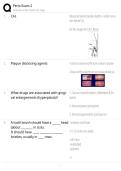
1. CAL Measured pocket (probe depth) + visible reces-
sion below CEJ
(In this image the CAL= 8mm)
2. Plaque disclosing agents -Fuchsia-colored erythrosine sodium solution
-Visual aid for patients to see plaque build up
3. What drugs are associated with gingi- 1. Calcium channel blackers (Nifedipine & Dil-
val enlargements (hyperplasia)? tazem)
2. Anticonvulsants (phenytoin)
3. Immunosuppressants (cyclosporin)
4. A tooth brush should have a ______ head -relatively small head
(about ________ in size).
It should have ____, _______, ________ -1-1.25 inches for adults
bristles, usually in ____ rows.
-soft nylon
-multitufted
-polished
-3
, Perio Exam 2
Study online at https://quizlet.com/_ezqqyt
5. The force of which bristles are applied 300-400g
to the tooth should not exceed
6. Modified Bass technique Effective toothbrush technique, ESPECIALLY for
patients with ginigivitis & periodontitis.
Bristles at 45 degree angle, small vibratory/cir-
cular motions (known as sulcular brushing).
7. Natural vs. Synthetic toothbrush bris- Natural bristles contain gaps that bacteria can
tles colonize.
They don't have rounded ends, which can cause
lesions to the gingiva.
Synthetic bristles have end-round filaments that
reduce the damage to gingiva.
8. Modified Stillman method -Vertical, Rotary brushing
-a series of brush movements repeated 5-10
times in the same area
9. When is vertical brushing indicated?
, Perio Exam 2
Study online at https://quizlet.com/_ezqqyt
-Overlapped teeth
-Open interproximal areas
-areas of recession
10. Fones method of brushing Max teeth closed, circular motion from max gin-
giva to mand gingiva
11. Where is toothbrush trauma most fre- The facial surfaces of canines & premolars
quently seen?
12. What is the purpose of interdental Disease originates in the interproximal areas.
care?
The purpose is to remove plaque, NOT food de-
bris.
13. What dictates the effectiveness of den- The anatomy of the tooth (areas might be missed
tal floss? due to shape of the tooth)
14. Pre-Armitage classification of gingival -Older classification system of gingivitis vs. peri-
diseases odontits based on probing depth (NOT attach-
ment loss)
Study online at https://quizlet.com/_ezqqyt
1. CAL Measured pocket (probe depth) + visible reces-
sion below CEJ
(In this image the CAL= 8mm)
2. Plaque disclosing agents -Fuchsia-colored erythrosine sodium solution
-Visual aid for patients to see plaque build up
3. What drugs are associated with gingi- 1. Calcium channel blackers (Nifedipine & Dil-
val enlargements (hyperplasia)? tazem)
2. Anticonvulsants (phenytoin)
3. Immunosuppressants (cyclosporin)
4. A tooth brush should have a ______ head -relatively small head
(about ________ in size).
It should have ____, _______, ________ -1-1.25 inches for adults
bristles, usually in ____ rows.
-soft nylon
-multitufted
-polished
-3
, Perio Exam 2
Study online at https://quizlet.com/_ezqqyt
5. The force of which bristles are applied 300-400g
to the tooth should not exceed
6. Modified Bass technique Effective toothbrush technique, ESPECIALLY for
patients with ginigivitis & periodontitis.
Bristles at 45 degree angle, small vibratory/cir-
cular motions (known as sulcular brushing).
7. Natural vs. Synthetic toothbrush bris- Natural bristles contain gaps that bacteria can
tles colonize.
They don't have rounded ends, which can cause
lesions to the gingiva.
Synthetic bristles have end-round filaments that
reduce the damage to gingiva.
8. Modified Stillman method -Vertical, Rotary brushing
-a series of brush movements repeated 5-10
times in the same area
9. When is vertical brushing indicated?
, Perio Exam 2
Study online at https://quizlet.com/_ezqqyt
-Overlapped teeth
-Open interproximal areas
-areas of recession
10. Fones method of brushing Max teeth closed, circular motion from max gin-
giva to mand gingiva
11. Where is toothbrush trauma most fre- The facial surfaces of canines & premolars
quently seen?
12. What is the purpose of interdental Disease originates in the interproximal areas.
care?
The purpose is to remove plaque, NOT food de-
bris.
13. What dictates the effectiveness of den- The anatomy of the tooth (areas might be missed
tal floss? due to shape of the tooth)
14. Pre-Armitage classification of gingival -Older classification system of gingivitis vs. peri-
diseases odontits based on probing depth (NOT attach-
ment loss)


