
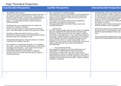
Major Theoretical Perspectives
Functionalist Perspective Conflict Perspective Interactionalist Perspective
• See Stability and Consensus • See a social world in continual struggle. • Interactionalist perceive generalizes abou
• “Thinks of society as a living organisms in which each part of • This perspective assumes that behaviour is best understood in of social interaction in order to explain so
the organism contributes to its survival.” These parts are terms of tension between groups over power, allocation of • It is also referred to as the symbolic intera
known as social structures. Central to the understanding of resources such as housing , money access to services and • It Is a framework in which human beings a
social structures are the concepts of status and role. A political representation. living in a world of meaningful objects.
status is a socially defined position (Ascribed statuses, • This tension is not always violent at times negotiations , • Symbols have a shared social meaning tha
Achieved statuses) competition and disputes can take place. all members of society.
• This perspective follows the Marxist View as well as the • Sometimes come in forms of nonverbal co
• Emphasizes the way in which the parts of a society are Feminist perspective. • All these symbols can be manipulated.
structured to maintain is stability.
• Parsons saw any society as a vast network of connected Marxist View • Many have moved from an excessive preo
parts , each which helps to maintain the system as a whole. • Karl Marx viewed struggle between social classes as inevitable the Macro level of social behaviour and re
given the exploitation of workers that he perceived under attention towards behaviour that occurs o
• Considers manifest and Latent functions as well as capitalism. Further expansion of his view suggests conflict is level.
Dysfunctions. Social structures can be dysfunctional when it not merely a class phenomenon , but a part of everyday life in
prevents society from meeting its needs. all societies. Conflict theorists are interested in how societies • The interactionalist method known as the
Social Institutions may help to maintain privileges of some Approach was popularized by Erwin Goffm
• Acknowledge dysfunctions in that not all parts of a society groups and keep others in a subservient position. Their
contribute to its stability al the time. emphasis on social change and the redistribution of resources
makes conflict theorists more activist and radial than
• The evaluation of a dysfunction depends on an individuals interactionalists.
own values , and we view these dysfunctions as undesirable.
• According to functionalists , social systems exist because • The Feminist Perspective
they fulfill some function for the society • Sees inequality in gender as central to all behaviour and
• Functionalists interpret social change as something organisation. It is allied with the conflict perspective.
introduced from the outside that interrupts the system’s • Contemporary Feminists theorists often view women's
smooth functioning subordination as inherent in capitalist societies. Some radical
feminist theorists however view the oppression of women as
inevitable in all male dominated societies , whether capitalist,
socialist or communist.
• I
,Culture
Functionalist Conflict Interactionalist
• Anthropologist Bronislaw Malinowski suggests that • Conflict theorists suggest that values and norms help • Recall that the Symbolic Interactionist persp
culture helps people meet their needs create and sustain the privileged position of the powerful engaged in micro-level analysis, and examines
• Biological needs (e.g.. food, procreation) According to Karl Marx, ideas are cultural creations sum of all people’s interactions
• Instrumental needs (e.g.. law, education)
• Integrative needs (e.g.. religion, art)
• It is therefore possible society’s leaders to use ideology • People create, maintain and modify culture
about their day-to-day activities
– that is, a system of ideas that guides the way people
• According to functionalist theorists, societies where • According to Symbolic Interactionists, our
think and act – to maintain their positions of dominance
people share a common language and core values are more values and norms do not automatically dete
in a society.
likely to have consensus and harmony behaviour. Rather, we re-interpret these valu
According to Marx, people are not aware that they are being
• All societies, however, have dysfunctions with each situation we come across. In othe
dominated because they have false consciousness, meaning
• Inequalities among class, racial and gender lines values and norms are dynamic; that is, we a
that people hold beliefs that they think promote their best
contribute to changing them.
interest when in fact they are damaging to their best interests.
• problems • Georg Simmel suggested that eventually cu
• For example, when hate groups “blame” certain people
• Also, multiple subcultures can lead to lack of life of its own – and begins to control us ins
for a society’s problems, they shift attention away from
consensus about • For example, people initially create
persons in position of political and economic power
• core values means of exchange. It is a social co
• Extremist groups may perpetuate the very “problem” they
• How are these problems resolved? was designed to facilitate economie
think exists, and may maintain status quo by protecting
• – Resolution of problems comes with education about the Now, however, money has taken on a new mea
people who are responsible for making important
value of cultural diversity (schools and families are become an end in itself (i.e.. material wealth),
decisions
charged with this responsibility) means to an end (i.e.. facilitating the exchange
What is a strength of the conflict perspective?
What is a strength of the functionalist perspective? services).Not only goods and services, but even
• It stresses how cultural values and norms may perpetuate
• It focuses on the needs of society and the fact that relative "worth” applied to them:
social inequalities
stability • Bill Gates – $50 billion
What are some weaknesses of the conflict perspective?
• is essential for a society’s continued success • Oprah Winfrey - $2.5 billion
• It focuses on societal discord and the divisiveness of
What are some weaknesses of the functionalist perspective? • Symbolic Interactionists examine how peop
culture
• It overemphasizes harmony and cooperation and change culture through interaction with
• It does not acknowledge all the societal factors that • As a result, Symbolic Interactionism does n
• Perceive that culture serves to help maintain the privileges
• contribute to conflict and strife outline to analyse how we shape culture and
of certain groups. Moreover while protecting their self
shapes us. It fails to take into account the la
interest , powerful groups may keep others in in a
• It perceives that a cultural trait or practice will persist if it level social structures (e.g.. social class) tha
subservient position Dominant ideology describes a set of
performs functions that society seems to need or considered in the Functionalist and Conflict
cultural beliefs and practices that helps to maintain
contributes to overall social stability and consensus
powerful social , economic and political interests.
, Socialization
Functionalist Conflict Interactionalist
• Functionalism stresses the way that groups work together to • The Conflict Perspective views socialization as a way of • Interactionism places a great importance
create a stable society. Schools and families work together, continuing the differences in society that already exist, for socialization. Interactionism uses several d
for example, to socialize children by teaching them the example: Class in society, social and economic status, explain the process of socialization.
norms, beliefs and values of a culture attitudes toward different groups, etc. The powerful • Self-Concept
people keep things the same
• The Looking Glass
• Self Significant Others
• Role Taking
• The Generalized Other
Functionalist Perspective Conflict Perspective Interactionalist Perspective
• See Stability and Consensus • See a social world in continual struggle. • Interactionalist perceive generalizes abou
• “Thinks of society as a living organisms in which each part of • This perspective assumes that behaviour is best understood in of social interaction in order to explain so
the organism contributes to its survival.” These parts are terms of tension between groups over power, allocation of • It is also referred to as the symbolic intera
known as social structures. Central to the understanding of resources such as housing , money access to services and • It Is a framework in which human beings a
social structures are the concepts of status and role. A political representation. living in a world of meaningful objects.
status is a socially defined position (Ascribed statuses, • This tension is not always violent at times negotiations , • Symbols have a shared social meaning tha
Achieved statuses) competition and disputes can take place. all members of society.
• This perspective follows the Marxist View as well as the • Sometimes come in forms of nonverbal co
• Emphasizes the way in which the parts of a society are Feminist perspective. • All these symbols can be manipulated.
structured to maintain is stability.
• Parsons saw any society as a vast network of connected Marxist View • Many have moved from an excessive preo
parts , each which helps to maintain the system as a whole. • Karl Marx viewed struggle between social classes as inevitable the Macro level of social behaviour and re
given the exploitation of workers that he perceived under attention towards behaviour that occurs o
• Considers manifest and Latent functions as well as capitalism. Further expansion of his view suggests conflict is level.
Dysfunctions. Social structures can be dysfunctional when it not merely a class phenomenon , but a part of everyday life in
prevents society from meeting its needs. all societies. Conflict theorists are interested in how societies • The interactionalist method known as the
Social Institutions may help to maintain privileges of some Approach was popularized by Erwin Goffm
• Acknowledge dysfunctions in that not all parts of a society groups and keep others in a subservient position. Their
contribute to its stability al the time. emphasis on social change and the redistribution of resources
makes conflict theorists more activist and radial than
• The evaluation of a dysfunction depends on an individuals interactionalists.
own values , and we view these dysfunctions as undesirable.
• According to functionalists , social systems exist because • The Feminist Perspective
they fulfill some function for the society • Sees inequality in gender as central to all behaviour and
• Functionalists interpret social change as something organisation. It is allied with the conflict perspective.
introduced from the outside that interrupts the system’s • Contemporary Feminists theorists often view women's
smooth functioning subordination as inherent in capitalist societies. Some radical
feminist theorists however view the oppression of women as
inevitable in all male dominated societies , whether capitalist,
socialist or communist.
• I
,Culture
Functionalist Conflict Interactionalist
• Anthropologist Bronislaw Malinowski suggests that • Conflict theorists suggest that values and norms help • Recall that the Symbolic Interactionist persp
culture helps people meet their needs create and sustain the privileged position of the powerful engaged in micro-level analysis, and examines
• Biological needs (e.g.. food, procreation) According to Karl Marx, ideas are cultural creations sum of all people’s interactions
• Instrumental needs (e.g.. law, education)
• Integrative needs (e.g.. religion, art)
• It is therefore possible society’s leaders to use ideology • People create, maintain and modify culture
about their day-to-day activities
– that is, a system of ideas that guides the way people
• According to functionalist theorists, societies where • According to Symbolic Interactionists, our
think and act – to maintain their positions of dominance
people share a common language and core values are more values and norms do not automatically dete
in a society.
likely to have consensus and harmony behaviour. Rather, we re-interpret these valu
According to Marx, people are not aware that they are being
• All societies, however, have dysfunctions with each situation we come across. In othe
dominated because they have false consciousness, meaning
• Inequalities among class, racial and gender lines values and norms are dynamic; that is, we a
that people hold beliefs that they think promote their best
contribute to changing them.
interest when in fact they are damaging to their best interests.
• problems • Georg Simmel suggested that eventually cu
• For example, when hate groups “blame” certain people
• Also, multiple subcultures can lead to lack of life of its own – and begins to control us ins
for a society’s problems, they shift attention away from
consensus about • For example, people initially create
persons in position of political and economic power
• core values means of exchange. It is a social co
• Extremist groups may perpetuate the very “problem” they
• How are these problems resolved? was designed to facilitate economie
think exists, and may maintain status quo by protecting
• – Resolution of problems comes with education about the Now, however, money has taken on a new mea
people who are responsible for making important
value of cultural diversity (schools and families are become an end in itself (i.e.. material wealth),
decisions
charged with this responsibility) means to an end (i.e.. facilitating the exchange
What is a strength of the conflict perspective?
What is a strength of the functionalist perspective? services).Not only goods and services, but even
• It stresses how cultural values and norms may perpetuate
• It focuses on the needs of society and the fact that relative "worth” applied to them:
social inequalities
stability • Bill Gates – $50 billion
What are some weaknesses of the conflict perspective?
• is essential for a society’s continued success • Oprah Winfrey - $2.5 billion
• It focuses on societal discord and the divisiveness of
What are some weaknesses of the functionalist perspective? • Symbolic Interactionists examine how peop
culture
• It overemphasizes harmony and cooperation and change culture through interaction with
• It does not acknowledge all the societal factors that • As a result, Symbolic Interactionism does n
• Perceive that culture serves to help maintain the privileges
• contribute to conflict and strife outline to analyse how we shape culture and
of certain groups. Moreover while protecting their self
shapes us. It fails to take into account the la
interest , powerful groups may keep others in in a
• It perceives that a cultural trait or practice will persist if it level social structures (e.g.. social class) tha
subservient position Dominant ideology describes a set of
performs functions that society seems to need or considered in the Functionalist and Conflict
cultural beliefs and practices that helps to maintain
contributes to overall social stability and consensus
powerful social , economic and political interests.
, Socialization
Functionalist Conflict Interactionalist
• Functionalism stresses the way that groups work together to • The Conflict Perspective views socialization as a way of • Interactionism places a great importance
create a stable society. Schools and families work together, continuing the differences in society that already exist, for socialization. Interactionism uses several d
for example, to socialize children by teaching them the example: Class in society, social and economic status, explain the process of socialization.
norms, beliefs and values of a culture attitudes toward different groups, etc. The powerful • Self-Concept
people keep things the same
• The Looking Glass
• Self Significant Others
• Role Taking
• The Generalized Other


