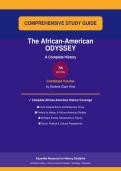
COMPREHENSIVE STUDY GUIDE
The African-American
ODYSSEY
A Complete History
7th
EDITION
Combined Volume
by Darlene Clark Hine
Complete African-American History Coverage
From Colonial Era to Contemporary Times
Perfect for History & African-American Studies
All Major Events, Movements & Figures
Social, Political & Cultural Perspectives
Essential Resource for History Students
American History • African-American Studies • Sociology • Education
Complete Historical Coverage
Comprehensive Historical Periods:
Africa and the Atlantic Slave Trade
Colonial America and Revolutionary Era
Slavery and the Antebellum Period
Civil War and Reconstruction
Jim Crow Era and Segregation
Great Migration and Urbanization
Harlem Renaissance and Cultural Movements
Civil Rights Movement
Black Power and Liberation Struggles
Contemporary Issues and Achievements
21st Century African-American Experience
Politics, Culture, and Social Change
Key Themes Explored:
• Resistance and Liberation Movements
• Cultural Identity and Heritage
• Economic Development and Entrepreneurship
• Education and Intellectual Traditions
• Politics and Civic Engagement
• Arts, Literature, and Music
• Family and Community Structures
Perfect For:
• American History Courses
• African-American Studies Programs
• Sociology and Ethnic Studies
• Education and Teacher Preparation
• General Education Requirements
• Historical Research and Papers
• Anyone Interested in American History and Social Justice
Educational Study Material • Copyright-Free Content
For Academic Use • Historical Content in Public Domain
Test Bank
The African-American
Odyssey
SEVENTH EDITION
Darlene Clark Hine
Northwestern University
William C. Hine
Formerly of South Carolina State University
Stanley Harrold
South Carolina State University
Copyright © 2018, 2014, 2011 by Pearson Education, Inc. or its affiliates.
All Rights Reserved. Printed in the United States of America.
This publication is protected by copyright, and permission should
be obtained from the publisher prior to any prohibited reproduction,
storage in a retrieval system, or transmission in any form or by any means,
electronic, mechanical, photocopying, recording, or otherwise. For
information regarding permissions, request forms and the appropriate
contacts within the Pearson Education Global Rights & Permissions
department, please visit
ISBN 10: 0-13-448543-2
ISBN 13: 978-0-13-448543-0
Copyright © 2018, 2014, 2011 Pearson Education, Inc. All rights reserved.
iii
CONTENTS
Chapter 1 Africa ca. 6000 BCE–ca. 1600 CE 1
Chapter 2 Middle Passage ca. 1450–1809 20
Chapter 3 Black People in Colonial North America 1526–1763 39
Chapter 4 Rising Expectations: African Americans and the Struggle for Independence
1763–1783 57
Chapter 5 African Americans in the New Nation 1783–1820 73
Chapter 6 Life in the Cotton Kingdom 1793–1861 91
Chapter 7 Free Black People in Antebellum America 1820–1861 109
Chapter 8 Opposition to Slavery 1730–1833 128
Chapter 9 Let Your Motto Be Resistance 1833–1850 145
Chapter 10 “And Black People Were at the Heart of It”: The United States Disunites
Over Slavery 1846–1861 164
Chapter 11 Liberation: African Americans and the Civil War 1861–1865 182
Chapter 12 The Meaning of Freedom: The Promise of Reconstruction 1865–1868 201
Chapter 13 The Meaning of Freedom: The Failure of Reconstruction 1868–1877 220
Chapter 14 White Supremacy Triumphant:
African Americans in the South in the Late Nineteenth Century 1877–1895 238
Chapter 15 African Americans Challenge White Supremacy 1877–1819 257
Chapter 16 Conciliation, Agitation, and Migration:
African Americans in the Early Twentieth Century 1895–1925 276
Chapter 17 African Americans and the 1920s 1918–1929 296
Chapter 18 Black Protest, the Great Depression, and the New Deals 1929–1940 315
Chapter 19 Meanings of Freedom: Culture and Society 1930–1950 334
Chapter 20 The World War II Era and the Seeds of a Revolution 1940–1950 354
Chapter 21 The Long Freedom Movement 1950–1970 373
Chapter 22 Black Nationalism, Black Power, and Black Arts 1965–1980 392
Chapter 23
Black Politics and President Barack Obama 1980–2016
411
Chapter 24
African Americans End the Twentieth Century and Enter into the Twenty-First Century
1980–2016
430
iv
Copyright © 2018, 2014, 2011 Pearson Education, Inc. All rights reserved.
Chapter 1
Africa ca. 6000 BCE–ca. 1600 CE
Multiple Choice
1. Africa is bounded by the __________ to the west.
A) Indian Ocean
B) Atlantic Ocean
C) Mediterranean Sea
D) Red Sea
Answer: B
Learning Objective: 1.1 Recognize the geographical characteristics of Africa.
Topic: 1.1 A Huge and Diverse Land
Difficulty Level: Easy
Skill Level: Remember the Facts
2. The Sahel is a(n) __________.
A) huge grassland
B) inland sea
C) vast desert
D) tropical rain forest
Answer: A
Learning Objective: 1.1 Recognize the geographical characteristics of Africa.
Topic: 1.1 A Huge and Diverse Land
Difficulty Level: Easy
Skill Level: Remember the Facts
3. The term habilis means __________.
A) “social bonding”
B) “habit forming”
C) “tool using”
D) “domesticated”
Answer: C
Learning Objective: 1.2 Be aware of current theories about where and how humans originated.
Topic: 1.2 The Birthplace of Humanity
Difficulty Level: Moderate
Skill Level: Understand the Connections
1
Copyright © 2018, 2014, 2011 Pearson Education, Inc. All rights reserved.
4. The term homo sapiens refers to __________.
A) modern humans
B) pre-humans
C) the great apes
D) the first tool-users
Answer: A
Learning Objective: 1.2 Be aware of current theories about where and how humans originated.
Topic: 1.2 The Birthplace of Humanity
Difficulty Level: Moderate
Skill Level: Understand the Connections
5. Evidence indicates that members of the Homo habilis species probably __________.
A) used metal tools
B) wore clothing
C) lived in small bands
D) had an early alphabet
Answer: C
Learning Objective: 1.2 Be aware of current theories about where and how humans originated.
Topic: 1.2 The Birthplace of Humanity
Difficulty Level: Moderate
Skill Level: Understand the Connections
6. Which of the following is true of both the multiregional and out-of-Africa models of the
evolution of Homo sapiens?
A) Both models are supported by genetic evidence.
B) Both models are largely unsupported by scientific evidence.
C) Both models assume that Homo sapiens evolved directly from Homo habilis.
D) Both models point to the emergence of Homo sapiens roughly 3.4 million years ago.
Answer: A
Learning Objective: 1.2 Be aware of current theories about where and how humans originated.
Topic: 1.2 The Birthplace of Humanity
Difficulty Level: Difficult
Skill Level: Analyze It
2
Copyright © 2018, 2014, 2011 Pearson Education, Inc. All rights reserved.
7. Which of the following was the earliest civilization in Africa?
A) Egypt
B) Mali
C) Great Zimbabwe
D) Ghana
Answer: A
Learning Objective: 1.3 Understand why ancient African civilizations are important.
Topic: 1.3 Ancient Civilizations and Old Arguments
Difficulty Level: Easy
Skill Level: Remember the Facts
8. Settled village life was the result of the emergence of __________.
A) tool making
B) writing
C) metallurgy
D) agriculture
Answer: D
Learning Objective: 1.3 Understand why ancient African civilizations are important.
Topic: 1.3 Ancient Civilizations and Old Arguments
Difficulty Level: Difficult
Skill Level: Analyze It
9. In the late twentieth century, Afrocentricists regarded ancient __________ as an essentially
black civilization.
A) Mesopotamia
B) Egypt
C) Italy
D) Greece
Answer: B
Learning Objective: 1.3 Understand why ancient African civilizations are important.
Topic: 1.3 Ancient Civilizations and Old Arguments
Difficulty Level: Easy
Skill Level: Remember the Facts
3
Copyright © 2018, 2014, 2011 Pearson Education, Inc. All rights reserved.
10. Ancient Egyptian society was profoundly shaped by the __________.
A) Nile River
B) annual monsoon rains
C) Atlas Mountains
D) peoples of the western rain forests
Answer: A
Learning Objective: 1.3 Understand why ancient African civilizations are important.
Topic: 1.3.1 Egyptian Civilization
Difficulty Level: Easy
Skill Level: Remember the Facts
11. Which statement best characterizes the power and status of women in ancient Egypt?
A) Women served as the rulers of Egypt because it was a matriarchal society.
B) Women were treated as property and were allowed no legal rights once married.
C) Women held a relatively high status, could own property, and be public officials.
D) Women lived separately from men, rarely interacting with Egyptian society.
Answer: C
Learning Objective: 1.3 Understand why ancient African civilizations are important.
Topic: 1.3.1 Egyptian Civilization
Difficulty Level: Moderate
Skill Level: Understand the Connections
12. Egyptian religion was __________.
A) monotheistic
B) completely separate from Egyptian government
C) led by a matriarchal priesthood
D) a complex form of polytheism
Answer: D
Learning Objective: 1.3 Understand why ancient African civilizations are important.
Topic: 1.3.1 Egyptian Civilization
Difficulty Level: Moderate
Skill Level: Understand the Connections
13. Which of the following may have originated in Nubia and then spread to Egypt?
A) the production of grain and the concept of monarchy
B) naval warfare and the institution of slavery
C) city and town formation and design
D) highway and canal construction
Answer: A
Learning Objective: 1.3 Understand why ancient African civilizations are important.
Topic: 1.3.2 Nubia, Kush, Meroë, and Axum
Difficulty Level: Difficult
Skill Level: Analyze It
4
Copyright © 2018, 2014, 2011 Pearson Education, Inc. All rights reserved.
14. The Nubians established an independent kingdom known as __________.
A) Kush
B) Axum
C) Meroë
D) Carthage
Answer: A
Learning Objective: 1.3 Understand why ancient African civilizations are important.
Topic: 1.3.2 Nubia, Kush, Meroë, and Axum
Difficulty Level: Easy
Skill Level: Remember the Facts
15. Which of the following was true of Meroë?
A) It was founded by the Romans.
B) It was the capital of Axum.
C) It grew rich from wheat cultivation.
D) It was Africa’s first industrial center.
Answer: D
Learning Objective: 1.3 Understand why ancient African civilizations are important.
Topic: 1.3.2 Nubia, Kush, Meroë, and Axum
Difficulty Level: Moderate
Skill Level: Understand the Connections
16. Which of the following played the largest role in the decline of Kush?
A) the decline of Rome
B) climate change
C) internal divisions
D) the rise of Athens
Answer: A
Learning Objective: 1.3 Understand why ancient African civilizations a
Voorbeeld van de inhoud
COMPREHENSIVE STUDY GUIDE
The African-American
ODYSSEY
A Complete History
7th
EDITION
Combined Volume
by Darlene Clark Hine
✓ Complete African-American History Coverage
■ From Colonial Era to Contemporary Times
■ Perfect for History & African-American Studies
■ All Major Events, Movements & Figures
■ Social, Political & Cultural Perspectives
Essential Resource for History Students
American History • African-American Studies • Sociology • Education
, Complete Historical Coverage
■ Comprehensive Historical Periods:
✓ Africa and the Atlantic Slave Trade
✓ Colonial America and Revolutionary Era
✓ Slavery and the Antebellum Period
✓ Civil War and Reconstruction
✓ Jim Crow Era and Segregation
✓ Great Migration and Urbanization
✓ Harlem Renaissance and Cultural Movements
✓ Civil Rights Movement
✓ Black Power and Liberation Struggles
✓ Contemporary Issues and Achievements
✓ 21st Century African-American Experience
✓ Politics, Culture, and Social Change
■ Key Themes Explored:
• Resistance and Liberation Movements
• Cultural Identity and Heritage
• Economic Development and Entrepreneurship
• Education and Intellectual Traditions
• Politics and Civic Engagement
• Arts, Literature, and Music
• Family and Community Structures
■ Perfect For:
• American History Courses
• African-American Studies Programs
• Sociology and Ethnic Studies
• Education and Teacher Preparation
• General Education Requirements
• Historical Research and Papers
• Anyone Interested in American History and Social Justice
Educational Study Material • Copyright-Free Content
For Academic Use • Historical Content in Public Domain
, Test Bank
The African-American
Odyssey
SEVENTH EDITION
Darlene Clark Hine
Northwestern University
William C. Hine
Formerly of South Carolina State University
Stanley Harrold
South Carolina State University
, Copyright © 2018, 2014, 2011 by Pearson Education, Inc. or its affiliates.
All Rights Reserved. Printed in the United States of America.
This publication is protected by copyright, and permission should
be obtained from the publisher prior to any prohibited reproduction,
storage in a retrieval system, or transmission in any form or by any means,
electronic, mechanical, photocopying, recording, or otherwise. For
information regarding permissions, request forms and the appropriate
contacts within the Pearson Education Global Rights & Permissions
department, please visit www.pearsoned.com/permissions/.
ISBN 10: 0-13-448543-2
ISBN 13: 978-0-13-448543-0