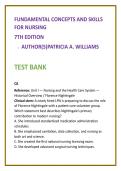
FUNDAMENTAL CONCEPTS AND SKILLS
FOR NURSING
7TH EDITION
• AUTHOR(S)PATRICIA A. WILLIAMS
TEST BANK
Q1
Reference: Unit I — Nursing and the Health Care System —
Historical Overview / Florence Nightingale
Clinical stem: A newly hired LPN is preparing to discuss the role
of Florence Nightingale with a patient-care volunteer group.
Which statement best describes Nightingale’s primary
contribution to modern nursing?
A. She introduced standardized medication administration
schedules.
B. She emphasized sanitation, data collection, and nursing as
both art and science.
C. She created the first national nursing licensing exam.
D. She developed advanced surgical nursing techniques.
,Correct answer: B
Rationales
B (Correct): Nightingale emphasized sanitation, systematic
data collection, and framed nursing as both art and science—
foundations of modern nursing practice and patient safety.
A: Medication schedules emerged later and are not
Nightingale’s primary legacy.
C: Licensing exams were developed long after Nightingale’s
era.
D: Advanced surgical techniques were developed in other
medical domains, not Nightingale’s main contribution.
Teaching point: Nightingale championed sanitation,
observation, and nursing as a scientific discipline.
Citation: Williams, P. A. (7th ed.). Fundamental Concepts and
Skills for Nursing. Unit I.
Q2
Reference: Unit I — Nursing and the Health Care System —
Nursing in North America / Nursing Education Pathways
Clinical stem: A student asks the LPN which pathway allows the
fastest entry into practice while still preparing for bedside
nursing in long-term care. Which response is best?
A. Registered Nursing (BSN) — fastest route to bedside care
B. Practical Nursing (LPN/LVN) — shorter program focused on
basic nursing care
,C. Advanced Practice Nursing — quickest for bedside work
D. Doctor of Nursing Practice — most appropriate for
immediate bedside practice
Correct answer: B
Rationales
B (Correct): Practical nursing (LPN/LVN) programs are
shorter and focus on foundational bedside skills suitable for
long-term and acute care under supervision.
A: BSN/RN programs require longer study and are not the
fastest route.
C: Advanced Practice requires RN preparation and graduate
education—longer pathway.
D: DNP is an advanced, lengthy degree, not for immediate
entry-level bedside nursing.
Teaching point: LPN/LVN programs offer the quickest route to
supervised bedside nursing.
Citation: Williams, P. A. (7th ed.). Fundamental Concepts and
Skills for Nursing. Unit I.
Q3
Reference: Unit I — The Art and Science of Nursing / Evidence-
Based Practice
Clinical stem: A charge nurse instructs staff to use a new
certified checklist to reduce catheter-associated urinary tract
, infections (CAUTI). An LPN asked why this checklist instead of
personal preference. What is the best rationale to
communicate?
A. Checklists are easier but lack evidence for outcomes.
B. Evidence-based checklists standardize care and reduce
variability in practice.
C. Personal preference is better because it’s faster.
D. Checklists are only for physicians, not nursing staff.
Correct answer: B
Rationales
B (Correct): Evidence-based checklists reduce variability and
improve outcomes by providing standard, proven practices for
infection prevention.
A: Many checklists are supported by evidence
demonstrating improved outcomes.
C: Personal preference increases variability and risk.
D: Checklists are interdisciplinary tools; nursing uses them
to improve safety.
Teaching point: Use evidence-based tools to reduce variation
and improve patient outcomes.
Citation: Williams, P. A. (7th ed.). Fundamental Concepts and
Skills for Nursing. Unit I.
Q4
FOR NURSING
7TH EDITION
• AUTHOR(S)PATRICIA A. WILLIAMS
TEST BANK
Q1
Reference: Unit I — Nursing and the Health Care System —
Historical Overview / Florence Nightingale
Clinical stem: A newly hired LPN is preparing to discuss the role
of Florence Nightingale with a patient-care volunteer group.
Which statement best describes Nightingale’s primary
contribution to modern nursing?
A. She introduced standardized medication administration
schedules.
B. She emphasized sanitation, data collection, and nursing as
both art and science.
C. She created the first national nursing licensing exam.
D. She developed advanced surgical nursing techniques.
,Correct answer: B
Rationales
B (Correct): Nightingale emphasized sanitation, systematic
data collection, and framed nursing as both art and science—
foundations of modern nursing practice and patient safety.
A: Medication schedules emerged later and are not
Nightingale’s primary legacy.
C: Licensing exams were developed long after Nightingale’s
era.
D: Advanced surgical techniques were developed in other
medical domains, not Nightingale’s main contribution.
Teaching point: Nightingale championed sanitation,
observation, and nursing as a scientific discipline.
Citation: Williams, P. A. (7th ed.). Fundamental Concepts and
Skills for Nursing. Unit I.
Q2
Reference: Unit I — Nursing and the Health Care System —
Nursing in North America / Nursing Education Pathways
Clinical stem: A student asks the LPN which pathway allows the
fastest entry into practice while still preparing for bedside
nursing in long-term care. Which response is best?
A. Registered Nursing (BSN) — fastest route to bedside care
B. Practical Nursing (LPN/LVN) — shorter program focused on
basic nursing care
,C. Advanced Practice Nursing — quickest for bedside work
D. Doctor of Nursing Practice — most appropriate for
immediate bedside practice
Correct answer: B
Rationales
B (Correct): Practical nursing (LPN/LVN) programs are
shorter and focus on foundational bedside skills suitable for
long-term and acute care under supervision.
A: BSN/RN programs require longer study and are not the
fastest route.
C: Advanced Practice requires RN preparation and graduate
education—longer pathway.
D: DNP is an advanced, lengthy degree, not for immediate
entry-level bedside nursing.
Teaching point: LPN/LVN programs offer the quickest route to
supervised bedside nursing.
Citation: Williams, P. A. (7th ed.). Fundamental Concepts and
Skills for Nursing. Unit I.
Q3
Reference: Unit I — The Art and Science of Nursing / Evidence-
Based Practice
Clinical stem: A charge nurse instructs staff to use a new
certified checklist to reduce catheter-associated urinary tract
, infections (CAUTI). An LPN asked why this checklist instead of
personal preference. What is the best rationale to
communicate?
A. Checklists are easier but lack evidence for outcomes.
B. Evidence-based checklists standardize care and reduce
variability in practice.
C. Personal preference is better because it’s faster.
D. Checklists are only for physicians, not nursing staff.
Correct answer: B
Rationales
B (Correct): Evidence-based checklists reduce variability and
improve outcomes by providing standard, proven practices for
infection prevention.
A: Many checklists are supported by evidence
demonstrating improved outcomes.
C: Personal preference increases variability and risk.
D: Checklists are interdisciplinary tools; nursing uses them
to improve safety.
Teaching point: Use evidence-based tools to reduce variation
and improve patient outcomes.
Citation: Williams, P. A. (7th ed.). Fundamental Concepts and
Skills for Nursing. Unit I.
Q4