
[Document title]
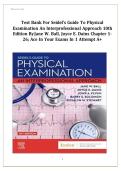
Test Bank For Seidel's Guide To Physical
Examination An Interprofessional Approach 10th
Edition By Jane W. Ball, Joyce E. Dains Chapter 1-
26; Ace In Your Exams In 1 Attempt A+
1
,[Document title]
chapter 01: cultural competency
ball: seidel’s guide to physical examination, 10th edition
multiple choice
1. mr. l presents to the clinic with severe groin pain and a history of kidney stones. mr.
l’s son tells you that for religious reasons, his father wishes to keep any stone that is
passed into the urine filter that he has been using. what is your most appropriate
response?
a. ―with your father’s permission, we will examine the stone and request
that it be returned to him.‖
b. ―the stone must be sent to the lab for examination and therefore cannot be kept.‖
c. ―we cannot let him keep his stone because it violates our infection control policy.‖
d. ―we don’t know yet if your father has another kidney stone, so we must
analyze this one.‖
Answer: a
we should be willing to modify the delivery of health care in a manner that is
respectful and in keeping with the patient’s cultural background. ―with your
father’s permission, we will examine the stone and request that it be returned to
him‖ is the most appropriate response.
―the stone must be sent to the lab for examination and therefore cannot be kept‖ and
―we don’t know yet if your father has another kidney stone, so we must analyze this
one‖ do not support the patient’s request. ―we cannot let him keep his stone because
it violates our infection control policy‖ does not provide a reason that it would violate
an infection control policy.
dif:cognitive level: analyzing (analysis)
obj:nursing process—assessment msc: physiologic integrity: physiologic adaptation
2. which statement is true regarding the relationship of physical characteristics and culture?
a. physical characteristics should be used to identify members of cultural groups.
b. there is a difference between distinguishing cultural
characteristics and distinguishing physical characteristics.
c. to be a member of a specific culture, an individual must have certain
identifiable physical characteristics.
d. gender and race are the two essential physical characteristics used to
identify cultural groups.
Answer: b
physical characteristics are not used to identify cultural groups; there is a difference
between the two, and they are considered separately. physical characteristics should
not be used to identify members of cultural groups. to be a member of a specific
culture, an individual does not need to have certain identifiable physical
2
,[Document title]
characteristics. you should not confuse physical characteristics with cultural
characteristics. gender and race are physical characteristics, not cultural
characteristics, and are not used to identify cultural groups.
dif:cognitive level: understanding (comprehension)
obj:nursing process—assessment msc: physiologic integrity: physiologic adaptation
3. an image of any group that rejects its potential for originality or individuality is
known as a(n)
a. acculturation.
b. norm.
c. stereotype.
d. ethnos.
Answer: c
a fixed image of any group that rejects its potential for originality or individuality is
the definition of stereotype. acculturation is the process of adopting another culture’s
behaviors. a norm is a standard of allowable behavior within a group. ethnos implies
the same race or nationality.
dif:cognitive level: remembering (knowledge)
obj:nursing process—assessment msc: physiologic integrity: physiologic adaptation
4. the motivation of the healthcare professional to ―want to‖ engage in the process of
becoming culturally competent, not ―have to,‖ is called
a. cultural knowledge.
b. cultural awareness.
c. cultural desire.
d. cultural skill.
Answer: c
cultural encounters are the continuous process of interacting with patients from
culturally diverse backgrounds to validate, refine, or modify existing values, beliefs, and
practices about a cultural group and to develop cultural desire, cultural awareness,
cultural skill, and cultural knowledge. cultural awareness is deliberate self-
examination and in-depth exploration of
one’s biases, stereotypes, prejudices, assumptions, and ―-isms‖ that one holds about
individuals and groups who are different from them. cultural knowledge is the process
of seeking and obtaining a sound educational base about culturally and ethnically
diverse groups. cultural skill is the ability to collect culturally relevant data regarding
the patient’s presenting problem, as well as accurately performing a culturally based
physical assessment in a culturally sensitive manner. cultural desire is the motivation
3
, [Document title]
of the healthcare professional to want to engage in the process of becoming culturally
competent, not have to.
dif:cognitive level: understanding (comprehension)
obj:nursing process—assessment msc: physiologic integrity: physiologic adaptation
5. mr. marks is a 66-year-old patient who presents for a physical examination to the
clinic. which question has the most potential for exploring a patient’s cultural
beliefs related to a health problem?
a. ―how often do you have medical examinations?‖
b. ―what is your age, race, and educational level?‖
c. ―what types of symptoms have you been having?‖
d. ―why do you think you are having these symptoms?‖
Answer: d
―why do you think you are having these symptoms?‖ is an open-ended question that
avoids stereotyping, is sensitive and respectful toward the individual, and allows for
cultural data to be exchanged. the other questions do not explore the patient’s
cultural beliefs about health problems.
dif:cognitive level: analyzing (analysis)
obj:nursing process—assessment msc: physiologic integrity: physiologic adaptation
6. the definition of ill or sick is based on a
a. stereotype.
b. cultural behavior.
c. belief system.
d. cultural attitude.
Answer: c
the definition of ill or sick is based on the individual’s belief system and is determined
in large part by his or her enculturation.
dif:cognitive level: understanding (comprehension)
obj:nursing process—assessment msc: physiologic integrity: physiologic adaptation
7. a 22-year-old female nurse is interviewing an 86-year-old male patient. the patient
avoids eye contact and answers questions only by saying, ―yeah,‖ ―no,‖ or ―i guess
so.‖ which of the following is appropriate for the interviewer to say or ask?
a. ―we will be able to communicate better if you look at me.‖
b. ―it’s hard for me to gather useful information because your answers are so short.‖
c. ―are you uncomfortable talking with me?‖
d. ―does your religion make it hard for you to answer my questions?‖
4
Test Bank For Seidel's Guide To Physical
Examination An Interprofessional Approach 10th
Edition By Jane W. Ball, Joyce E. Dains Chapter 1-
26; Ace In Your Exams In 1 Attempt A+
1
,[Document title]
chapter 01: cultural competency
ball: seidel’s guide to physical examination, 10th edition
multiple choice
1. mr. l presents to the clinic with severe groin pain and a history of kidney stones. mr.
l’s son tells you that for religious reasons, his father wishes to keep any stone that is
passed into the urine filter that he has been using. what is your most appropriate
response?
a. ―with your father’s permission, we will examine the stone and request
that it be returned to him.‖
b. ―the stone must be sent to the lab for examination and therefore cannot be kept.‖
c. ―we cannot let him keep his stone because it violates our infection control policy.‖
d. ―we don’t know yet if your father has another kidney stone, so we must
analyze this one.‖
Answer: a
we should be willing to modify the delivery of health care in a manner that is
respectful and in keeping with the patient’s cultural background. ―with your
father’s permission, we will examine the stone and request that it be returned to
him‖ is the most appropriate response.
―the stone must be sent to the lab for examination and therefore cannot be kept‖ and
―we don’t know yet if your father has another kidney stone, so we must analyze this
one‖ do not support the patient’s request. ―we cannot let him keep his stone because
it violates our infection control policy‖ does not provide a reason that it would violate
an infection control policy.
dif:cognitive level: analyzing (analysis)
obj:nursing process—assessment msc: physiologic integrity: physiologic adaptation
2. which statement is true regarding the relationship of physical characteristics and culture?
a. physical characteristics should be used to identify members of cultural groups.
b. there is a difference between distinguishing cultural
characteristics and distinguishing physical characteristics.
c. to be a member of a specific culture, an individual must have certain
identifiable physical characteristics.
d. gender and race are the two essential physical characteristics used to
identify cultural groups.
Answer: b
physical characteristics are not used to identify cultural groups; there is a difference
between the two, and they are considered separately. physical characteristics should
not be used to identify members of cultural groups. to be a member of a specific
culture, an individual does not need to have certain identifiable physical
2
,[Document title]
characteristics. you should not confuse physical characteristics with cultural
characteristics. gender and race are physical characteristics, not cultural
characteristics, and are not used to identify cultural groups.
dif:cognitive level: understanding (comprehension)
obj:nursing process—assessment msc: physiologic integrity: physiologic adaptation
3. an image of any group that rejects its potential for originality or individuality is
known as a(n)
a. acculturation.
b. norm.
c. stereotype.
d. ethnos.
Answer: c
a fixed image of any group that rejects its potential for originality or individuality is
the definition of stereotype. acculturation is the process of adopting another culture’s
behaviors. a norm is a standard of allowable behavior within a group. ethnos implies
the same race or nationality.
dif:cognitive level: remembering (knowledge)
obj:nursing process—assessment msc: physiologic integrity: physiologic adaptation
4. the motivation of the healthcare professional to ―want to‖ engage in the process of
becoming culturally competent, not ―have to,‖ is called
a. cultural knowledge.
b. cultural awareness.
c. cultural desire.
d. cultural skill.
Answer: c
cultural encounters are the continuous process of interacting with patients from
culturally diverse backgrounds to validate, refine, or modify existing values, beliefs, and
practices about a cultural group and to develop cultural desire, cultural awareness,
cultural skill, and cultural knowledge. cultural awareness is deliberate self-
examination and in-depth exploration of
one’s biases, stereotypes, prejudices, assumptions, and ―-isms‖ that one holds about
individuals and groups who are different from them. cultural knowledge is the process
of seeking and obtaining a sound educational base about culturally and ethnically
diverse groups. cultural skill is the ability to collect culturally relevant data regarding
the patient’s presenting problem, as well as accurately performing a culturally based
physical assessment in a culturally sensitive manner. cultural desire is the motivation
3
, [Document title]
of the healthcare professional to want to engage in the process of becoming culturally
competent, not have to.
dif:cognitive level: understanding (comprehension)
obj:nursing process—assessment msc: physiologic integrity: physiologic adaptation
5. mr. marks is a 66-year-old patient who presents for a physical examination to the
clinic. which question has the most potential for exploring a patient’s cultural
beliefs related to a health problem?
a. ―how often do you have medical examinations?‖
b. ―what is your age, race, and educational level?‖
c. ―what types of symptoms have you been having?‖
d. ―why do you think you are having these symptoms?‖
Answer: d
―why do you think you are having these symptoms?‖ is an open-ended question that
avoids stereotyping, is sensitive and respectful toward the individual, and allows for
cultural data to be exchanged. the other questions do not explore the patient’s
cultural beliefs about health problems.
dif:cognitive level: analyzing (analysis)
obj:nursing process—assessment msc: physiologic integrity: physiologic adaptation
6. the definition of ill or sick is based on a
a. stereotype.
b. cultural behavior.
c. belief system.
d. cultural attitude.
Answer: c
the definition of ill or sick is based on the individual’s belief system and is determined
in large part by his or her enculturation.
dif:cognitive level: understanding (comprehension)
obj:nursing process—assessment msc: physiologic integrity: physiologic adaptation
7. a 22-year-old female nurse is interviewing an 86-year-old male patient. the patient
avoids eye contact and answers questions only by saying, ―yeah,‖ ―no,‖ or ―i guess
so.‖ which of the following is appropriate for the interviewer to say or ask?
a. ―we will be able to communicate better if you look at me.‖
b. ―it’s hard for me to gather useful information because your answers are so short.‖
c. ―are you uncomfortable talking with me?‖
d. ―does your religion make it hard for you to answer my questions?‖
4


