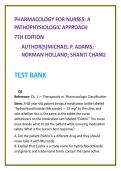
PHARMACOLOGY FOR NURSES: A
PATHOPHYSIOLOGIC APPROACH
7TH EDITION
• AUTHOR(S)MICHAEL P. ADAMS;
NORMAN HOLLAND; SHANTI CHANG
TEST BANK
Q1
Reference: Ch. 1 — Therapeutic vs. Pharmacologic Classification
Stem: A 68-year-old patient brings a medication bottle labeled
“hydrochlorothiazide (Microzide) — 25 mg” to the clinic and
asks whether this is the same as the tablet the nurse
administers on the medication cart labeled “Esidrix.” The nurse
must decide what to tell the patient while ensuring medication
safety. What is the nurse’s best response?
A. Tell the patient Esidrix is a different drug and they should
never take it with Microzide.
B. Explain that Esidrix is a trade name for hydrochlorothiazide
and generic and trade-name forms contain the same active
,drug.
C. Advise the patient to stop taking Microzide and request a
prescription for Esidrix from their provider.
D. Say trade-name drugs are always more effective than their
generic equivalents.
Correct Answer: B
Rationale — Correct (B): Hydrochlorothiazide is the generic
(chemical) name; Esidrix is a trade name. Generic and trade-
name products contain the same active ingredient and are
therapeutically equivalent when approved, so counseling that
they are the same active drug is correct and reduces confusion.
This supports safe medication reconciliation and avoids
unnecessary medication changes.
Rationale — Incorrect:
A. Incorrect — Esidrix is not a different drug; advising to never
take together is misleading and could cause harm.
C. Incorrect — Stopping a current medication without provider
input is unsafe and unnecessary because the active drug is the
same.
D. Incorrect — Trade-name drugs are not inherently more
effective; generics are required to have equivalent active
ingredients and bioavailability within regulatory limits.
Teaching Point: Generic and trade-name drugs share the same
active ingredient when approved.
,Citation: Adams, M. P., Holland, N., & Chang, S. (2024).
Pharmacology for Nurses: A Pathophysiologic Approach (7th
ed.). Ch. 1.
Q2
Reference: Ch. 1 — Prescription vs. Over-the-Counter Drugs
Stem: A 29-year-old patient with seasonal allergies asks
whether they can start an over-the-counter (OTC) antihistamine
they saw advertised alongside their prescribed nasal steroid.
The nurse considers interactions and regulatory status when
advising the patient. Which nursing action is most appropriate?
A. Recommend stopping the nasal steroid and using the OTC
antihistamine instead.
B. Tell the patient to take the OTC antihistamine in addition to
the steroid without checking further.
C. Ask about other medications and medical conditions, then
advise checking with the prescriber or pharmacist before
combining therapies.
D. State that OTC products are always safe and have no
interactions with prescription drugs.
Correct Answer: C
Rationale — Correct (C): Nursing assessment must include
current medications and conditions because OTC drugs can
interact with prescriptions and have contraindications. Advising
the patient to consult prescriber/pharmacist ensures safe
, combined therapy and aligns with nursing responsibility to
prevent adverse effects.
Rationale — Incorrect:
A. Incorrect — Substituting therapies without provider input
may worsen control of disease; the nasal steroid may be
necessary.
B. Incorrect — Recommending combination without
assessment risks interactions (e.g., anticholinergic effects) and
adverse effects.
D. Incorrect — OTC drugs can have significant interactions and
side effects; assuming safety is inaccurate and unsafe.
Teaching Point: Always assess OTC use and consult
prescriber/pharmacist before combining with prescriptions.
Citation: Adams, M. P., Holland, N., & Chang, S. (2024).
Pharmacology for Nurses: A Pathophysiologic Approach (7th
ed.). Ch. 1.
Q3
Reference: Ch. 1 — Chemical, Generic, and Trade Names
Stem: While performing medication reconciliation, a nurse
notes a home medication listed as “acetaminophen 500 mg”
and the unit stock shows “Tylenol 500 mg.” The patient insists
they are different because “Tylenol is stronger.” How should the
nurse respond to correct the misconception and ensure safe
use?
PATHOPHYSIOLOGIC APPROACH
7TH EDITION
• AUTHOR(S)MICHAEL P. ADAMS;
NORMAN HOLLAND; SHANTI CHANG
TEST BANK
Q1
Reference: Ch. 1 — Therapeutic vs. Pharmacologic Classification
Stem: A 68-year-old patient brings a medication bottle labeled
“hydrochlorothiazide (Microzide) — 25 mg” to the clinic and
asks whether this is the same as the tablet the nurse
administers on the medication cart labeled “Esidrix.” The nurse
must decide what to tell the patient while ensuring medication
safety. What is the nurse’s best response?
A. Tell the patient Esidrix is a different drug and they should
never take it with Microzide.
B. Explain that Esidrix is a trade name for hydrochlorothiazide
and generic and trade-name forms contain the same active
,drug.
C. Advise the patient to stop taking Microzide and request a
prescription for Esidrix from their provider.
D. Say trade-name drugs are always more effective than their
generic equivalents.
Correct Answer: B
Rationale — Correct (B): Hydrochlorothiazide is the generic
(chemical) name; Esidrix is a trade name. Generic and trade-
name products contain the same active ingredient and are
therapeutically equivalent when approved, so counseling that
they are the same active drug is correct and reduces confusion.
This supports safe medication reconciliation and avoids
unnecessary medication changes.
Rationale — Incorrect:
A. Incorrect — Esidrix is not a different drug; advising to never
take together is misleading and could cause harm.
C. Incorrect — Stopping a current medication without provider
input is unsafe and unnecessary because the active drug is the
same.
D. Incorrect — Trade-name drugs are not inherently more
effective; generics are required to have equivalent active
ingredients and bioavailability within regulatory limits.
Teaching Point: Generic and trade-name drugs share the same
active ingredient when approved.
,Citation: Adams, M. P., Holland, N., & Chang, S. (2024).
Pharmacology for Nurses: A Pathophysiologic Approach (7th
ed.). Ch. 1.
Q2
Reference: Ch. 1 — Prescription vs. Over-the-Counter Drugs
Stem: A 29-year-old patient with seasonal allergies asks
whether they can start an over-the-counter (OTC) antihistamine
they saw advertised alongside their prescribed nasal steroid.
The nurse considers interactions and regulatory status when
advising the patient. Which nursing action is most appropriate?
A. Recommend stopping the nasal steroid and using the OTC
antihistamine instead.
B. Tell the patient to take the OTC antihistamine in addition to
the steroid without checking further.
C. Ask about other medications and medical conditions, then
advise checking with the prescriber or pharmacist before
combining therapies.
D. State that OTC products are always safe and have no
interactions with prescription drugs.
Correct Answer: C
Rationale — Correct (C): Nursing assessment must include
current medications and conditions because OTC drugs can
interact with prescriptions and have contraindications. Advising
the patient to consult prescriber/pharmacist ensures safe
, combined therapy and aligns with nursing responsibility to
prevent adverse effects.
Rationale — Incorrect:
A. Incorrect — Substituting therapies without provider input
may worsen control of disease; the nasal steroid may be
necessary.
B. Incorrect — Recommending combination without
assessment risks interactions (e.g., anticholinergic effects) and
adverse effects.
D. Incorrect — OTC drugs can have significant interactions and
side effects; assuming safety is inaccurate and unsafe.
Teaching Point: Always assess OTC use and consult
prescriber/pharmacist before combining with prescriptions.
Citation: Adams, M. P., Holland, N., & Chang, S. (2024).
Pharmacology for Nurses: A Pathophysiologic Approach (7th
ed.). Ch. 1.
Q3
Reference: Ch. 1 — Chemical, Generic, and Trade Names
Stem: While performing medication reconciliation, a nurse
notes a home medication listed as “acetaminophen 500 mg”
and the unit stock shows “Tylenol 500 mg.” The patient insists
they are different because “Tylenol is stronger.” How should the
nurse respond to correct the misconception and ensure safe
use?