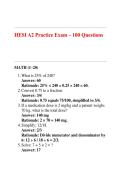
HESI A2 Practice Exam – 100 Questions
MATH (1–20)
1. What is 25% of 240?
Answer: 60
Rationale: 25% × 240 = 0.25 × 240 = 60.
2. Convert 0.75 to a fraction.
Answer: 3/4
Rationale: 0.75 equals 75/100, simplified to 3/4.
3. If a medication dose is 2 mg/kg and a patient weighs
70 kg, what is the total dose?
Answer: 140 mg
Rationale: 2 × 70 = 140 mg.
4. Simplify: 12/18.
Answer: 2/3
Rationale: Divide numerator and denominator by
6: 12 ÷ ÷ 6 = 2/3.
5. Solve: 7 + 5 × 2 = ?
Answer: 17
, Rationale: Order of operations: 5 × 2 = 10; 10 + 7
= 17.
6. Convert 3/5 to a decimal.
Answer: 0.6
Rationale: 3 ÷ 5 = 0.6.
7. If a patient’s heart rate increases from 72 bpm to 90
bpm, what is the percent increase?
Answer: 25%
Rationale: (90–72)/72 × 100 = 18/72 × 100 = 25%.
8. Solve: (8 + 4) ÷ 3 = ?
Answer: 4
Rationale: 8 + 4 = 12; 12 ÷ 3 = 4.
9. Convert 1500 mL to liters.
Answer: 1.5 L
Rationale: 1000 mL = 1 L, so 1500 ÷ 1000 = 1.5 L.
10. Round 27.689 to the nearest tenth.
Answer: 27.7
Rationale: The hundredth digit is 8 (>5), so the
tenth rounds up to 7.
11. Multiply: 4.2 × 3
Answer: 12.6
Rationale: 4.2 × 3 = 12.6.
12. Divide: 81 ÷ 9
Answer: 9
Rationale: 9 × 9 = 81.
13. A patient is prescribed 0.5 mg of a drug. The
stock solution is 2 mg/mL. How many mL do you
administer?
MATH (1–20)
1. What is 25% of 240?
Answer: 60
Rationale: 25% × 240 = 0.25 × 240 = 60.
2. Convert 0.75 to a fraction.
Answer: 3/4
Rationale: 0.75 equals 75/100, simplified to 3/4.
3. If a medication dose is 2 mg/kg and a patient weighs
70 kg, what is the total dose?
Answer: 140 mg
Rationale: 2 × 70 = 140 mg.
4. Simplify: 12/18.
Answer: 2/3
Rationale: Divide numerator and denominator by
6: 12 ÷ ÷ 6 = 2/3.
5. Solve: 7 + 5 × 2 = ?
Answer: 17
, Rationale: Order of operations: 5 × 2 = 10; 10 + 7
= 17.
6. Convert 3/5 to a decimal.
Answer: 0.6
Rationale: 3 ÷ 5 = 0.6.
7. If a patient’s heart rate increases from 72 bpm to 90
bpm, what is the percent increase?
Answer: 25%
Rationale: (90–72)/72 × 100 = 18/72 × 100 = 25%.
8. Solve: (8 + 4) ÷ 3 = ?
Answer: 4
Rationale: 8 + 4 = 12; 12 ÷ 3 = 4.
9. Convert 1500 mL to liters.
Answer: 1.5 L
Rationale: 1000 mL = 1 L, so 1500 ÷ 1000 = 1.5 L.
10. Round 27.689 to the nearest tenth.
Answer: 27.7
Rationale: The hundredth digit is 8 (>5), so the
tenth rounds up to 7.
11. Multiply: 4.2 × 3
Answer: 12.6
Rationale: 4.2 × 3 = 12.6.
12. Divide: 81 ÷ 9
Answer: 9
Rationale: 9 × 9 = 81.
13. A patient is prescribed 0.5 mg of a drug. The
stock solution is 2 mg/mL. How many mL do you
administer?