

1
Cell Biology Exam 3 Study Guide
Questions and Answers (100%
Correct Answers) Already Graded A+
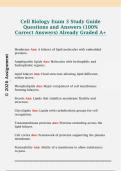
Membrane Ans: A bilayer of lipid molecules with embedded
proteins.
© 2026 Assignment
Amphipathic lipids Ans: Molecules with hydrophilic and
hydrophobic regions.
Guru01 - Stuvia
Expert
Lipid bilayer Ans: Fluid structure allowing lipid diffusion
within layers.
Phospholipids Ans: Major component of cell membranes
forming bilayers.
Sterols Ans: Lipids that stabilize membrane fluidity and
structure.
Glycolipids Ans: Lipids with carbohydrate groups for cell
recognition.
Transmembrane proteins Ans: Proteins extending across the
lipid bilayer.
Cell cortex Ans: Framework of proteins supporting the plasma
membrane.
Permeability Ans: Ability of a membrane to allow substances
to pass.
, 2
Transport proteins Ans: Proteins facilitating movement of
molecules across membranes.
Channel proteins Ans: Form pores for passive diffusion of
specific molecules.
Passive transport Ans: Movement of molecules down their
concentration gradient.
Sodium pump Ans: ATPase pumping 3 sodium out for 2
© 2026 Assignment
potassium in.
Ion channels Ans: Gated proteins allowing ion passage across
Guru01 - Stuvia
membranes.
Expert
Ligand-gated channels Ans: Ion channels activated by specific
molecules.
Mechanically-gated channels Ans: Ion channels activated by
physical forces.
Voltage-gated channels Ans: Ion channels activated by
membrane potential changes.
Nuclear envelope Ans: Barrier separating nuclear and
cytoplasmic elements.
Nuclear localization sequence (NLS) Ans: Signal directing
proteins to the nucleus.
Cotranslational import Ans: Protein transfer into ER during
synthesis.
Endoplasmic reticulum (ER) Ans: Site for membrane synthesis
and protein processing.
Cell Biology Exam 3 Study Guide
Questions and Answers (100%
Correct Answers) Already Graded A+
Membrane Ans: A bilayer of lipid molecules with embedded
proteins.
© 2026 Assignment
Amphipathic lipids Ans: Molecules with hydrophilic and
hydrophobic regions.
Guru01 - Stuvia
Expert
Lipid bilayer Ans: Fluid structure allowing lipid diffusion
within layers.
Phospholipids Ans: Major component of cell membranes
forming bilayers.
Sterols Ans: Lipids that stabilize membrane fluidity and
structure.
Glycolipids Ans: Lipids with carbohydrate groups for cell
recognition.
Transmembrane proteins Ans: Proteins extending across the
lipid bilayer.
Cell cortex Ans: Framework of proteins supporting the plasma
membrane.
Permeability Ans: Ability of a membrane to allow substances
to pass.
, 2
Transport proteins Ans: Proteins facilitating movement of
molecules across membranes.
Channel proteins Ans: Form pores for passive diffusion of
specific molecules.
Passive transport Ans: Movement of molecules down their
concentration gradient.
Sodium pump Ans: ATPase pumping 3 sodium out for 2
© 2026 Assignment
potassium in.
Ion channels Ans: Gated proteins allowing ion passage across
Guru01 - Stuvia
membranes.
Expert
Ligand-gated channels Ans: Ion channels activated by specific
molecules.
Mechanically-gated channels Ans: Ion channels activated by
physical forces.
Voltage-gated channels Ans: Ion channels activated by
membrane potential changes.
Nuclear envelope Ans: Barrier separating nuclear and
cytoplasmic elements.
Nuclear localization sequence (NLS) Ans: Signal directing
proteins to the nucleus.
Cotranslational import Ans: Protein transfer into ER during
synthesis.
Endoplasmic reticulum (ER) Ans: Site for membrane synthesis
and protein processing.


