
MBA 703 Final Exam UPDATED ACTUAL Questions
and CORRECT Answers
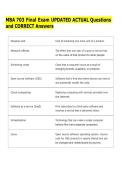
Marginal cost Cost of producing one more unit of a product.
Network effects The effect that one user of a good or service has
on the value of that product to other people.
Switching costs Costs that a consumer incurs as a result of
changing brands, suppliers, or products.
Open source software (OSS) Software that is free and where anyone can look at
and potentially modify the code.
Cloud computing Replacing computing with services provided over
the Internet.
Software as a service (SaaS) Firm subscribes to a third-party software and
receives a service that is delivered online.
Virtualization Technology that can make a single computer
behave like many separate computers.
Linux Open source software operating system. Source
code for OSS products is openly shared and can
be changed and redistributed by anyone.
, LAMP Acronym for Linux, Apache Web server software,
MySQL database, and Perl/Python/PHP.
Cost Free alternatives to costly commercial code can be
a tremendous motivator.
Reliability The more people who look at a program's code,
the greater the likelihood that an error will be
caught and corrected.
Security Technology products that contain particularly
strong security features.
Scalability Ability to either handle increasing workloads or to
be easily expanded to manage workload increases.
Agility and time to market Vendors able to skip whole segments of the
software development process, allowing new
products to reach the market faster.
Heartbleed An error in the OpenSSL security toolkit, which was
used by some two-thirds of Internet websites,
leading to a significant security breach.
Core Infrastructure Initiative A multimillion-dollar project developed by the
Linux Foundation to fund open source projects that
are in the critical path for core computing
functions.
Cautionary tale from Heartbleed Just because a tool is used by many doesn't mean
one shouldn't audit its software products to
understand the strength of support and potential
risks associated with use.
and CORRECT Answers
Marginal cost Cost of producing one more unit of a product.
Network effects The effect that one user of a good or service has
on the value of that product to other people.
Switching costs Costs that a consumer incurs as a result of
changing brands, suppliers, or products.
Open source software (OSS) Software that is free and where anyone can look at
and potentially modify the code.
Cloud computing Replacing computing with services provided over
the Internet.
Software as a service (SaaS) Firm subscribes to a third-party software and
receives a service that is delivered online.
Virtualization Technology that can make a single computer
behave like many separate computers.
Linux Open source software operating system. Source
code for OSS products is openly shared and can
be changed and redistributed by anyone.
, LAMP Acronym for Linux, Apache Web server software,
MySQL database, and Perl/Python/PHP.
Cost Free alternatives to costly commercial code can be
a tremendous motivator.
Reliability The more people who look at a program's code,
the greater the likelihood that an error will be
caught and corrected.
Security Technology products that contain particularly
strong security features.
Scalability Ability to either handle increasing workloads or to
be easily expanded to manage workload increases.
Agility and time to market Vendors able to skip whole segments of the
software development process, allowing new
products to reach the market faster.
Heartbleed An error in the OpenSSL security toolkit, which was
used by some two-thirds of Internet websites,
leading to a significant security breach.
Core Infrastructure Initiative A multimillion-dollar project developed by the
Linux Foundation to fund open source projects that
are in the critical path for core computing
functions.
Cautionary tale from Heartbleed Just because a tool is used by many doesn't mean
one shouldn't audit its software products to
understand the strength of support and potential
risks associated with use.


