

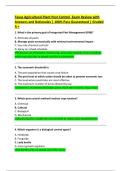
Texas Agricultural Plant Pest Control Exam Review with
Answers and Rationales | 100% Pass Guaranteed | Graded
A+
1. What is the primary goal of Integrated Pest Management (IPM)?
A. Eliminate all pests
B. Manage pests economically with minimal environmental impact
C. Use only chemical controls
D. Spray on a fixed schedule
IPM focuses on prevention, monitoring, and using multiple control methods
while reducing risks to people and the environment.
2. The economic threshold is:
A. The pest population that causes crop failure
B. The pest level at which action should be taken to prevent economic loss
C. The level where pesticides are most effective
D. The maximum number of pests allowed by law
Treatment is recommended before pests reach the economic injury level.
3. Which pest control method involves crop rotation?
A. Chemical
B. Cultural
C. Biological
D. Mechanical
Cultural practices modify the environment to reduce pest establishment.
4. Which organism is a biological control agent?
A. Herbicide
B. Fungicide
C. Lady beetle
D. Insect growth regulator
Lady beetles prey on aphids and other pests.
,5. A pesticide label is:
A. A suggestion
B. Optional information
C. A legal document
D. Only for manufacturers
Using a pesticide inconsistent with its label is a violation of law.
6. Which signal word indicates the highest toxicity?
A. Caution
B. Warning
C. Danger
D. Notice
“Danger” indicates highly toxic or corrosive products.
7. What does PPE stand for?
A. Pest Protection Equipment
B. Personal Protective Equipment
C. Plant Protection Equipment
D. Pesticide Prevention Equipment
PPE protects applicators from exposure.
8. Which formulation is ready-to-use without mixing?
A. Wettable powder
B. Granule
C. Emulsifiable concentrate
D. Soluble powder
Granules are typically applied directly to soil.
9. Drift is:
, A. Movement of pesticide into soil
B. Movement of pesticide away from the target area
C. Breakdown of pesticide
D. Mixing errors
Drift can harm non-target plants, animals, and people.
10. Which factor increases drift?
A. Large droplets
B. High wind speed
C. Low pressure
D. Low boom height
Wind carries fine droplets off target.
11. A systemic pesticide:
A. Kills only on contact
B. Moves within the plant
C. Works only in soil
D. Has no residual effect
Systemic products are absorbed and translocated.
12. Restricted Use Pesticides (RUPs) can be applied by:
A. Anyone
B. Farm workers
C. Certified applicators or those under supervision
D. Only manufacturers
RUPs require certification due to higher risk.
13. The LD50 measures:
A. Environmental persistence
B. Acute toxicity
C. Application rate
Answers and Rationales | 100% Pass Guaranteed | Graded
A+
1. What is the primary goal of Integrated Pest Management (IPM)?
A. Eliminate all pests
B. Manage pests economically with minimal environmental impact
C. Use only chemical controls
D. Spray on a fixed schedule
IPM focuses on prevention, monitoring, and using multiple control methods
while reducing risks to people and the environment.
2. The economic threshold is:
A. The pest population that causes crop failure
B. The pest level at which action should be taken to prevent economic loss
C. The level where pesticides are most effective
D. The maximum number of pests allowed by law
Treatment is recommended before pests reach the economic injury level.
3. Which pest control method involves crop rotation?
A. Chemical
B. Cultural
C. Biological
D. Mechanical
Cultural practices modify the environment to reduce pest establishment.
4. Which organism is a biological control agent?
A. Herbicide
B. Fungicide
C. Lady beetle
D. Insect growth regulator
Lady beetles prey on aphids and other pests.
,5. A pesticide label is:
A. A suggestion
B. Optional information
C. A legal document
D. Only for manufacturers
Using a pesticide inconsistent with its label is a violation of law.
6. Which signal word indicates the highest toxicity?
A. Caution
B. Warning
C. Danger
D. Notice
“Danger” indicates highly toxic or corrosive products.
7. What does PPE stand for?
A. Pest Protection Equipment
B. Personal Protective Equipment
C. Plant Protection Equipment
D. Pesticide Prevention Equipment
PPE protects applicators from exposure.
8. Which formulation is ready-to-use without mixing?
A. Wettable powder
B. Granule
C. Emulsifiable concentrate
D. Soluble powder
Granules are typically applied directly to soil.
9. Drift is:
, A. Movement of pesticide into soil
B. Movement of pesticide away from the target area
C. Breakdown of pesticide
D. Mixing errors
Drift can harm non-target plants, animals, and people.
10. Which factor increases drift?
A. Large droplets
B. High wind speed
C. Low pressure
D. Low boom height
Wind carries fine droplets off target.
11. A systemic pesticide:
A. Kills only on contact
B. Moves within the plant
C. Works only in soil
D. Has no residual effect
Systemic products are absorbed and translocated.
12. Restricted Use Pesticides (RUPs) can be applied by:
A. Anyone
B. Farm workers
C. Certified applicators or those under supervision
D. Only manufacturers
RUPs require certification due to higher risk.
13. The LD50 measures:
A. Environmental persistence
B. Acute toxicity
C. Application rate


