

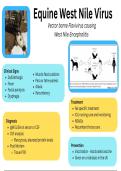
Equine West Nile Virus
Vector borne Flavivirus causing
West Nile Encephalitis
Clinical Signs
Muscle fasciculations
Dull/lethargic
Para or tetre-paresis
Fever
Ataxia
Facial paralysis
Recumbency
Dysphagia
Treatment
No specific treatment
ICU nursing care and monitoring
Diagnosis NSAIDs
IgM ELISA on serum or CSF Recumbent horse care
CSF analysis
Pleocytosis, elevated protein levels
Post Mortem Prevention
Tissue PCR Vaccination - Inactivated vaccine
Given on a risk basis in the UK
, Equine Herpesvirus
Myeloencephalopathy
Caused by EHV-1 that starts with
respiratory signs
Pathophysiology
1. Endotheliotoprism of EHV virulent strains Clinical Signs
2. Endothelial cell replication and infection History of respiratory disease
3. Vasculitis and thromboischaemia of small Pyrexia, dull, inappetent
arterioles Sudden onset of neuro signs
4. Nervous system effects Ataxia and paresis - hindlimbs>forelimbs
a. Ischaemic neuronal death Causal spinal cord segments
b. Multifocal Bladder distension
c. Myeloencephalopathy Urinary incontinence
Faecal retention
Diagnosis Penile protrusion
Nasal or nasopharyngeal swab PCR Flaccid tail and anus
Paired serology Treatment
Virus isolation Prevention - Vaccination
Symptomatic
CSF - Xanthochromic (yellow) On a at-risk basis
NSAIDs, IVFT
Competition horses
Nursing and Palatable feed
Prognosis subject to periods of
Anti-viral medication
Good is not recumbent stress
Valacyclovir
If recumbent >24hrs - Grave prognosis Not routine in UK
Isolation Essential - Biosecurity
Vector borne Flavivirus causing
West Nile Encephalitis
Clinical Signs
Muscle fasciculations
Dull/lethargic
Para or tetre-paresis
Fever
Ataxia
Facial paralysis
Recumbency
Dysphagia
Treatment
No specific treatment
ICU nursing care and monitoring
Diagnosis NSAIDs
IgM ELISA on serum or CSF Recumbent horse care
CSF analysis
Pleocytosis, elevated protein levels
Post Mortem Prevention
Tissue PCR Vaccination - Inactivated vaccine
Given on a risk basis in the UK
, Equine Herpesvirus
Myeloencephalopathy
Caused by EHV-1 that starts with
respiratory signs
Pathophysiology
1. Endotheliotoprism of EHV virulent strains Clinical Signs
2. Endothelial cell replication and infection History of respiratory disease
3. Vasculitis and thromboischaemia of small Pyrexia, dull, inappetent
arterioles Sudden onset of neuro signs
4. Nervous system effects Ataxia and paresis - hindlimbs>forelimbs
a. Ischaemic neuronal death Causal spinal cord segments
b. Multifocal Bladder distension
c. Myeloencephalopathy Urinary incontinence
Faecal retention
Diagnosis Penile protrusion
Nasal or nasopharyngeal swab PCR Flaccid tail and anus
Paired serology Treatment
Virus isolation Prevention - Vaccination
Symptomatic
CSF - Xanthochromic (yellow) On a at-risk basis
NSAIDs, IVFT
Competition horses
Nursing and Palatable feed
Prognosis subject to periods of
Anti-viral medication
Good is not recumbent stress
Valacyclovir
If recumbent >24hrs - Grave prognosis Not routine in UK
Isolation Essential - Biosecurity


