

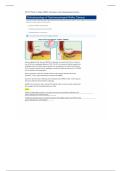
NR 507 Week 5: Edapt: GERD: Alterations in the Gastrointestinal System
Gastroesophageal reflux disease (GERD) is commonly associated with the loss of muscle
tone at the lower esophageal sphincter (LES). The LES is a muscular ring that separates the
esophagus from the stomach, and its relaxation or incompetence can lead to the backward
flow of stomach contents into the esophagus, causing the symptoms characteristic of GERD,
such as heartburn and regurgitation.
Reverse peristalsis, where the stomach contracts in the opposite direction of normal
peristalsis, is not a typical mechanism associated with GERD.
Excessive salivation and swallowing do not typically cause GERD. In fact, swallowing can
help clear refluxed material from the esophagus.
GERD is more related to issues with the LES and the reflux of acidic stomach contents into
the esophagus than the increased production of bile.
?????
1)When an individual consumes a very large meal, the nurse practitioner (NP) knows the
gastric emptying rate will be increased.
2) When an individual receives a hypertonic gastric tube feeding solution, the NP knows the
gastric emptying rate will be delayed.
, 1. Stomach0secretes0gastrin0into0bloodstream0in0response0to0meal.
2. Gastrin0returns0to0stomach0and0stimulates0muscle0contraction0and0acid0production.
3. Partially0digested0food0(chyme)0moves0into0small0intestine0and0stimulates0secretion0of0
CCK0and0secretin0into0the0blood.
4. CCK0and0secretin0stimulate0the0secretion0of0digestive0enzymes0and0bicarbonate0ions0f
rom0the0pancreas0into0the0small0intestines.
5. CCK0also0stimulates0contraction0of0the0gallbladder,0which0then0releases0bile0into0the0s
mall0intestine.
The0digestive0system0is0responsible0for0breaking0down0ingested0food,0facilitating0nutrient0abs
orption,0maintaining0body0water,0and0eliminating0waste.0Hormones0and0the0autonomic0nervo
us0system0regulate0most0digestive0activities,0including0the0release0of0hormones0that0stimulat
e0or0inhibit0gastric0motility0and0the0secretion0of0substances0that0aid0in0digestion.
Obesity, smoking, and hiatal hernias are risk factors associated with the development of
gastroesophageal reflux disease (GERD). Obesity slows gastric emptying, which leads to
prolonged retention of food in the stomach and increases the likelihood of stomach contents
Gastroesophageal reflux disease (GERD) is commonly associated with the loss of muscle
tone at the lower esophageal sphincter (LES). The LES is a muscular ring that separates the
esophagus from the stomach, and its relaxation or incompetence can lead to the backward
flow of stomach contents into the esophagus, causing the symptoms characteristic of GERD,
such as heartburn and regurgitation.
Reverse peristalsis, where the stomach contracts in the opposite direction of normal
peristalsis, is not a typical mechanism associated with GERD.
Excessive salivation and swallowing do not typically cause GERD. In fact, swallowing can
help clear refluxed material from the esophagus.
GERD is more related to issues with the LES and the reflux of acidic stomach contents into
the esophagus than the increased production of bile.
?????
1)When an individual consumes a very large meal, the nurse practitioner (NP) knows the
gastric emptying rate will be increased.
2) When an individual receives a hypertonic gastric tube feeding solution, the NP knows the
gastric emptying rate will be delayed.
, 1. Stomach0secretes0gastrin0into0bloodstream0in0response0to0meal.
2. Gastrin0returns0to0stomach0and0stimulates0muscle0contraction0and0acid0production.
3. Partially0digested0food0(chyme)0moves0into0small0intestine0and0stimulates0secretion0of0
CCK0and0secretin0into0the0blood.
4. CCK0and0secretin0stimulate0the0secretion0of0digestive0enzymes0and0bicarbonate0ions0f
rom0the0pancreas0into0the0small0intestines.
5. CCK0also0stimulates0contraction0of0the0gallbladder,0which0then0releases0bile0into0the0s
mall0intestine.
The0digestive0system0is0responsible0for0breaking0down0ingested0food,0facilitating0nutrient0abs
orption,0maintaining0body0water,0and0eliminating0waste.0Hormones0and0the0autonomic0nervo
us0system0regulate0most0digestive0activities,0including0the0release0of0hormones0that0stimulat
e0or0inhibit0gastric0motility0and0the0secretion0of0substances0that0aid0in0digestion.
Obesity, smoking, and hiatal hernias are risk factors associated with the development of
gastroesophageal reflux disease (GERD). Obesity slows gastric emptying, which leads to
prolonged retention of food in the stomach and increases the likelihood of stomach contents


