

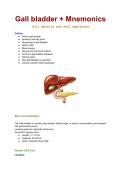
Gall bladder + Mnemonics
Full details and well explained
Outline:
● What's gall bladder
● Anatomy and key parts
● Physiology of gall bladder
● What is bile
● Blood supply
● Nerves and hormonal control
● Common gall bladder diseases
● Clinical signs
● Why gall bladder is important
● Clinical scenario (with examples)
What is the Gall bladder?
The Gall bladder is a small, pear-shaped, hollow organ. It stores, concentrates, and releases
bile (produced by liver).
Located under the right lobe of the liver.
Does NOT produce bile!
● Length: ~7–10 cm
● Capacity: 30–50 mL
● Color: Greenish due to bile
Anatomy & Key Parts
Location:
, It is located in the Right Upper Quadrant (RUQ) of the abdomen under the right lobe of the
liver.
Parts of the gall bladder:
● Fundus (rounded bottom; projects beyond the liver margin)
● Body (main middle; lies in contact with the liver)
● Neck ( Narrow part; continues as the cystic duct).
Ducts:
A duct is a channel that transports fluids.
Cystic duct: Comes out of the gall bladder
Connects gall bladder to the duct system
Bile enters and leaves the gall bladder through this duct.
Common Bile Duct: sends bile to duodenum
Pancreatic duct: joins near ampulla
Mnemonics:
Ducts: C.C.P. – Cool Common Paths
Cystic, Common, Pancreatic.
Physiology of the Gall bladder
Bile Storage: Liver produces bile continuously; gallbladder stores 30–60 mL.
Bile Concentration: Removes water & electrolytes, making bile 5–10x stronger for fat
digestion.
Bile Release: Fatty food in duodenum triggers CCK release, causing gallbladder
contraction.
Flow of bile:
● When gall bladder is filling:
Liver → Common hepatic duct → Cystic duct → Gall bladder
● When gall bladder is emptying (after fatty food):
Gall bladder → Cystic duct → Common bile duct → Duodenum
Full details and well explained
Outline:
● What's gall bladder
● Anatomy and key parts
● Physiology of gall bladder
● What is bile
● Blood supply
● Nerves and hormonal control
● Common gall bladder diseases
● Clinical signs
● Why gall bladder is important
● Clinical scenario (with examples)
What is the Gall bladder?
The Gall bladder is a small, pear-shaped, hollow organ. It stores, concentrates, and releases
bile (produced by liver).
Located under the right lobe of the liver.
Does NOT produce bile!
● Length: ~7–10 cm
● Capacity: 30–50 mL
● Color: Greenish due to bile
Anatomy & Key Parts
Location:
, It is located in the Right Upper Quadrant (RUQ) of the abdomen under the right lobe of the
liver.
Parts of the gall bladder:
● Fundus (rounded bottom; projects beyond the liver margin)
● Body (main middle; lies in contact with the liver)
● Neck ( Narrow part; continues as the cystic duct).
Ducts:
A duct is a channel that transports fluids.
Cystic duct: Comes out of the gall bladder
Connects gall bladder to the duct system
Bile enters and leaves the gall bladder through this duct.
Common Bile Duct: sends bile to duodenum
Pancreatic duct: joins near ampulla
Mnemonics:
Ducts: C.C.P. – Cool Common Paths
Cystic, Common, Pancreatic.
Physiology of the Gall bladder
Bile Storage: Liver produces bile continuously; gallbladder stores 30–60 mL.
Bile Concentration: Removes water & electrolytes, making bile 5–10x stronger for fat
digestion.
Bile Release: Fatty food in duodenum triggers CCK release, causing gallbladder
contraction.
Flow of bile:
● When gall bladder is filling:
Liver → Common hepatic duct → Cystic duct → Gall bladder
● When gall bladder is emptying (after fatty food):
Gall bladder → Cystic duct → Common bile duct → Duodenum


