

Marketing Communication
20 multiple choice questions about the book (guessing correction!)
6 open (sub)questions about the lectures and guest lectures
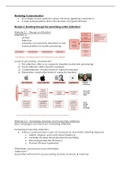
Module 2: Breaking through the advertising clutter (Attention)
Webclip 2.1 – Recap on Attention
Attention is:
- Limited
- Selective
- Voluntary or involuntary (intention or not)
- A precondition for further processing
Levels of processing / involvement:
1) Pre-attention: little or no capacity required (automatic processing)
2) Focal attention: little capacity required
3) Comprehension: modest levels of capacity required
4) Elaboration: substantial levels of capacity required
Webclip 2.2 – Increasing Voluntary and Involuntary Attention
How campaigns can stand out: increasing attention
Increasing Involuntary Attention:
Various communication cues can increase an automatic orienting response
Salient, original, and novel stimuli (Saliency)
Centrally located stimuli (Horizontal Centrality)
Stimuli presented first (Primacy)
Pictures (Picture Superiority)
Oftentimes unconscious and unintended
‘Attractors’*
Associated with bottom-up processing (outside senses memory)
,1) Salient, original and novel stimuli = Saliency
- Perceptually prominent (size, color, contrast)
- Novel, unexpected, and original stimuli
- stimuli related to life and death
These stimuli:
- Stick out and are hard to ignore
- Lead to mild psychological arousal
- Result in focal attention to the source of stimulation
2) Centrally located stimuli = Horizontal Centrality
Stimuli in the center receive more attention (and are more likely to be chosen)
(for example in the grocery store)
3) Stimuli presented first = Primacy
Consumers are more attentive to items that are presented first in a list.
(commercial break)
Google search page eye tracking focus on first items and first words ‘the
golden triangle of internet research’
4) Pictures = Picture Superiority
Pictorial information receives more information than textual information.
Analysis of 1363 print ads with eye tracking technology*:
- Pictures: attract attention, regardless of size
- Text: the bigger the text, the more attention
- Brand the bigger the brand name, the more attention
Increasing Voluntary Attention
How to increase voluntary attention:
- Increase self-relevance (Example: BOB commercial)
o Personal interest avoids inattentional blindness
o Self-referencing
o Proximity
- Curiosity
o Unfinished ads
o Mysterious ads
,Oftentimes conscious and intended
‘Magnitizers’*
Associated with top-down processing
1) Personal Interest and Inattentional Blindness
- Consumers allocate more attention to information that is consistent with their
goals
- Information that is not relevant , is often ignored, and will lead to inattentional
blindness (banner blindness and commercial messages)
Implications for SEA and SEO
- Organic results generate more attention and traffic because they are
immediately relevant
- Sponsored results often suffer from inattentional blindness
2) Self-Referencing
Attention increases when personalized information is used:
- Second person wording (you)
- Names
3) Proximity & EWOM
Consumers pay more attention to information that is ‘close’
The more proximate, the more relevant, the more attention
1) Sensory proximity: closeness in experience (friends/family)
2) Spatial proximity: closeness in physical space (things happening in own town)
3) Temporal proximity: closeness in time (city trip next month vs in two years)
A variety of applications:
- E(WOM) Electronic Word of Mouth comes from people close to use (spatial
and sensory proximity)
- Viral marketing is emotionally vivid (sensory proximity) and is shared via friends
- Blogs are written by influencers that feel close (sensory proximity)
- Billboards and Abri’s are prominent and often close in space
Webclip 2.3 – Increasing Ease of Processing
The easier to process:
- The less resources are needed for comprehension and elaboration
- The more likely it is that information is stored and retrieved
Existing knowledge structures
- Linking your appeal to what consumers already know makes it easier for them
to comprehend
- Concrete information helps to link to existing knowledge structures (Duracel)
o Visual (vs. verbal) information
o Concrete (vs. abstract) words
o Narrative (vs. statistical) information
- More “memory traces” lead to:
o Increased encoding
o Increased processing
o Increased retrieval
o Hence, less attention needed to thoroughly understand the message
, Stronger memory traces through:
- Visualization and imagination (Dual Coding Theory)
- Variability (Encoding variability)
Dual Coding Theory: (example: Coolblue commercial)
Visual and verbal modalities lead to different encoding strategies
- Words are stored in verbal codes
- Images are stored in visual codes
- The net result is more and distinct memory traces
Non-pictorial information, such as imagination, are also stored in visual codes
Recall:
High imagery and picture present scores lower because people got confused by the
two different pictures.
Encoding Variability
- The more memory traces available, the easier to encode, comprehend &
retrieve
- Novel (but related) information receives an extra memory trace
- Hence, novelty does not only affect “mere attention”, but also “processing
fluency” because it makes the associative network more elaborate and
stable
20 multiple choice questions about the book (guessing correction!)
6 open (sub)questions about the lectures and guest lectures
Module 2: Breaking through the advertising clutter (Attention)
Webclip 2.1 – Recap on Attention
Attention is:
- Limited
- Selective
- Voluntary or involuntary (intention or not)
- A precondition for further processing
Levels of processing / involvement:
1) Pre-attention: little or no capacity required (automatic processing)
2) Focal attention: little capacity required
3) Comprehension: modest levels of capacity required
4) Elaboration: substantial levels of capacity required
Webclip 2.2 – Increasing Voluntary and Involuntary Attention
How campaigns can stand out: increasing attention
Increasing Involuntary Attention:
Various communication cues can increase an automatic orienting response
Salient, original, and novel stimuli (Saliency)
Centrally located stimuli (Horizontal Centrality)
Stimuli presented first (Primacy)
Pictures (Picture Superiority)
Oftentimes unconscious and unintended
‘Attractors’*
Associated with bottom-up processing (outside senses memory)
,1) Salient, original and novel stimuli = Saliency
- Perceptually prominent (size, color, contrast)
- Novel, unexpected, and original stimuli
- stimuli related to life and death
These stimuli:
- Stick out and are hard to ignore
- Lead to mild psychological arousal
- Result in focal attention to the source of stimulation
2) Centrally located stimuli = Horizontal Centrality
Stimuli in the center receive more attention (and are more likely to be chosen)
(for example in the grocery store)
3) Stimuli presented first = Primacy
Consumers are more attentive to items that are presented first in a list.
(commercial break)
Google search page eye tracking focus on first items and first words ‘the
golden triangle of internet research’
4) Pictures = Picture Superiority
Pictorial information receives more information than textual information.
Analysis of 1363 print ads with eye tracking technology*:
- Pictures: attract attention, regardless of size
- Text: the bigger the text, the more attention
- Brand the bigger the brand name, the more attention
Increasing Voluntary Attention
How to increase voluntary attention:
- Increase self-relevance (Example: BOB commercial)
o Personal interest avoids inattentional blindness
o Self-referencing
o Proximity
- Curiosity
o Unfinished ads
o Mysterious ads
,Oftentimes conscious and intended
‘Magnitizers’*
Associated with top-down processing
1) Personal Interest and Inattentional Blindness
- Consumers allocate more attention to information that is consistent with their
goals
- Information that is not relevant , is often ignored, and will lead to inattentional
blindness (banner blindness and commercial messages)
Implications for SEA and SEO
- Organic results generate more attention and traffic because they are
immediately relevant
- Sponsored results often suffer from inattentional blindness
2) Self-Referencing
Attention increases when personalized information is used:
- Second person wording (you)
- Names
3) Proximity & EWOM
Consumers pay more attention to information that is ‘close’
The more proximate, the more relevant, the more attention
1) Sensory proximity: closeness in experience (friends/family)
2) Spatial proximity: closeness in physical space (things happening in own town)
3) Temporal proximity: closeness in time (city trip next month vs in two years)
A variety of applications:
- E(WOM) Electronic Word of Mouth comes from people close to use (spatial
and sensory proximity)
- Viral marketing is emotionally vivid (sensory proximity) and is shared via friends
- Blogs are written by influencers that feel close (sensory proximity)
- Billboards and Abri’s are prominent and often close in space
Webclip 2.3 – Increasing Ease of Processing
The easier to process:
- The less resources are needed for comprehension and elaboration
- The more likely it is that information is stored and retrieved
Existing knowledge structures
- Linking your appeal to what consumers already know makes it easier for them
to comprehend
- Concrete information helps to link to existing knowledge structures (Duracel)
o Visual (vs. verbal) information
o Concrete (vs. abstract) words
o Narrative (vs. statistical) information
- More “memory traces” lead to:
o Increased encoding
o Increased processing
o Increased retrieval
o Hence, less attention needed to thoroughly understand the message
, Stronger memory traces through:
- Visualization and imagination (Dual Coding Theory)
- Variability (Encoding variability)
Dual Coding Theory: (example: Coolblue commercial)
Visual and verbal modalities lead to different encoding strategies
- Words are stored in verbal codes
- Images are stored in visual codes
- The net result is more and distinct memory traces
Non-pictorial information, such as imagination, are also stored in visual codes
Recall:
High imagery and picture present scores lower because people got confused by the
two different pictures.
Encoding Variability
- The more memory traces available, the easier to encode, comprehend &
retrieve
- Novel (but related) information receives an extra memory trace
- Hence, novelty does not only affect “mere attention”, but also “processing
fluency” because it makes the associative network more elaborate and
stable


