

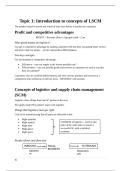
Topic 1: Introduction to concepts of LSCM
The product must be moved and stored at least once before it reaches the consumer.
Profit and competitive advantages
PROFIT = Revenue (Price x Quantity sold) – Cost
Why spend money on logistics?
Can get a competitive advantage by making customers feel that they are getting better service
and more value for money – service and product differentiation.
Two key concepts
Get and maintain a competitive advantage:
Efficiency – can you supply at the lowest possible cost?
Effectiveness – can you provide goods and services to consumers in such a way that
they are satisfied?
Customers who are satisfied (effectiveness) and who can buy products and services at a
competitive price (efficiency) will buy more – REVENUE will increase.
Concepts of logistics and supply chain management
(SCM)
Logistics move things from one SC partner to the next.
All supply chain (SC) partners must work together.
Things that logistics must get right
Critical for manufacturing that all parts are delivered at the:
Right quantity
Right quality 5 RIGHTS of logistics – need to take
Right time place at the same time, to ensure a
Right place successful SC with a satisfied
Right price customer
Product flows and direction
INBOUND FOCAL OUTBOUND
BUSINESS
Upstrea Downstre
m am
1|
,Different types of flows in an SC:
Product/material
Information
Money
“Elements” of an SC
Typical SC involves several components, stages/entities:
Customers (after doing market research about products and services)
Component / raw material suppliers
Manufactures
Wholesalers/distributors
Retailers
Customers (receive ordered goods and services)
Different ways to get products/services to customers
Direct channel
Indirect channel
DIRECT
FOCAL BUSINESS CUSTOME
R
DISTRIBUTIO
MANUFACTURER CUSTOMER
N CENTRE
INDIRECT
PL and LSP channel partners
1 PL (1st party logistics) Perform own logistics functions
2 PL (2nd party logistics provider) Transport goods from point A to B,
leasing/chartering own transportation
3 PL (3rd party logistics provider) Provides outsourced logistics services to
businesses
4 PL (4th party logistics provider) Manage resources, technology,
infrastructure, and external 3PLs to design,
build, and provide SC solutions for
businesses
LSP (Logistics service provider) A company that provides SCM services
such as transportation, warehousing, or
distribution services (including PL)
2|
,Freight forwarders
Typically, LSP’s involved in international shipments
Facilitate the flow of goods and information, but don’t necessarily handle the goods
themselves
Act as an intermediary between the shipper and the carrier
Experts when it comes to knowledge on import/export requirements
Handle documentation and take care of customs clearance
DEFINITION OF LOGISTICS AND SUPPLY CHAIN MANAGEMENT
“That part of SCM that plans, implements, and controls the efficient, effective physical
forward and reverse flow and storage of raw materials, work-in-process inventory, finished
goods, services, and related information between the point of origin and the point of
consumption to meet customer requirements.”
DEFINITION OF SUPPLY CHAIN MANAGEMENT
Encompasses the planning and management of all activities involved in sourcing and
procurement, conversion, and logistics management. Importantly, it also includes coordination
and collaboration with channel partners, which can include suppliers, intermediaries, third-
party service providers, and customers. In essence, therefore, SCM integrates supply and
demand management within and across organisations.
Concept of logistics
Steps in the logistics process
1. Customer order starts the logistics process
2. Draw up a production schedule and check the inventory
3. Purchase supplies needed for manufacturing
4. Receive, inspect, and manage purchased supplies
5. Produce products/services according to schedule
6. Package products correctly
7. Move goods to(wards) customer
8. Manage customer payment
3|
, Value-added role of logistics
Value from produce/service = happy customers
Utility – satisfaction derived from the use or consumption of a product/service
Four main types of utility:
TIME utility
FORM utility
PLACE utility
POSSESSION utility
Characteristics of customer service
Availability in the right quantity and quality, at the right time, place, and price
Effective after-sales and backup service
Competent technical representatives to assist prospective buyers
Acceptable lead-time – don’t want to wait too long
Reliability and consistency
Measure customer service through Perfect Order Fulfilment (POF)
(% received at the right place)
% received on time
% received damage-free
% of consignments received complete (in full)
% or orders billed accurately
Wealth creation through logistics
Revenue growth
Operating cost reduction
Fixed capital efficiency
Working capital efficiency
Key business logistics activities
Demand forecasting, estimating, and planning
Logistics, communication, and order processing
Procurement and purchasing
Packaging
Transportation
Reverse logistics
Materials management
4|
The product must be moved and stored at least once before it reaches the consumer.
Profit and competitive advantages
PROFIT = Revenue (Price x Quantity sold) – Cost
Why spend money on logistics?
Can get a competitive advantage by making customers feel that they are getting better service
and more value for money – service and product differentiation.
Two key concepts
Get and maintain a competitive advantage:
Efficiency – can you supply at the lowest possible cost?
Effectiveness – can you provide goods and services to consumers in such a way that
they are satisfied?
Customers who are satisfied (effectiveness) and who can buy products and services at a
competitive price (efficiency) will buy more – REVENUE will increase.
Concepts of logistics and supply chain management
(SCM)
Logistics move things from one SC partner to the next.
All supply chain (SC) partners must work together.
Things that logistics must get right
Critical for manufacturing that all parts are delivered at the:
Right quantity
Right quality 5 RIGHTS of logistics – need to take
Right time place at the same time, to ensure a
Right place successful SC with a satisfied
Right price customer
Product flows and direction
INBOUND FOCAL OUTBOUND
BUSINESS
Upstrea Downstre
m am
1|
,Different types of flows in an SC:
Product/material
Information
Money
“Elements” of an SC
Typical SC involves several components, stages/entities:
Customers (after doing market research about products and services)
Component / raw material suppliers
Manufactures
Wholesalers/distributors
Retailers
Customers (receive ordered goods and services)
Different ways to get products/services to customers
Direct channel
Indirect channel
DIRECT
FOCAL BUSINESS CUSTOME
R
DISTRIBUTIO
MANUFACTURER CUSTOMER
N CENTRE
INDIRECT
PL and LSP channel partners
1 PL (1st party logistics) Perform own logistics functions
2 PL (2nd party logistics provider) Transport goods from point A to B,
leasing/chartering own transportation
3 PL (3rd party logistics provider) Provides outsourced logistics services to
businesses
4 PL (4th party logistics provider) Manage resources, technology,
infrastructure, and external 3PLs to design,
build, and provide SC solutions for
businesses
LSP (Logistics service provider) A company that provides SCM services
such as transportation, warehousing, or
distribution services (including PL)
2|
,Freight forwarders
Typically, LSP’s involved in international shipments
Facilitate the flow of goods and information, but don’t necessarily handle the goods
themselves
Act as an intermediary between the shipper and the carrier
Experts when it comes to knowledge on import/export requirements
Handle documentation and take care of customs clearance
DEFINITION OF LOGISTICS AND SUPPLY CHAIN MANAGEMENT
“That part of SCM that plans, implements, and controls the efficient, effective physical
forward and reverse flow and storage of raw materials, work-in-process inventory, finished
goods, services, and related information between the point of origin and the point of
consumption to meet customer requirements.”
DEFINITION OF SUPPLY CHAIN MANAGEMENT
Encompasses the planning and management of all activities involved in sourcing and
procurement, conversion, and logistics management. Importantly, it also includes coordination
and collaboration with channel partners, which can include suppliers, intermediaries, third-
party service providers, and customers. In essence, therefore, SCM integrates supply and
demand management within and across organisations.
Concept of logistics
Steps in the logistics process
1. Customer order starts the logistics process
2. Draw up a production schedule and check the inventory
3. Purchase supplies needed for manufacturing
4. Receive, inspect, and manage purchased supplies
5. Produce products/services according to schedule
6. Package products correctly
7. Move goods to(wards) customer
8. Manage customer payment
3|
, Value-added role of logistics
Value from produce/service = happy customers
Utility – satisfaction derived from the use or consumption of a product/service
Four main types of utility:
TIME utility
FORM utility
PLACE utility
POSSESSION utility
Characteristics of customer service
Availability in the right quantity and quality, at the right time, place, and price
Effective after-sales and backup service
Competent technical representatives to assist prospective buyers
Acceptable lead-time – don’t want to wait too long
Reliability and consistency
Measure customer service through Perfect Order Fulfilment (POF)
(% received at the right place)
% received on time
% received damage-free
% of consignments received complete (in full)
% or orders billed accurately
Wealth creation through logistics
Revenue growth
Operating cost reduction
Fixed capital efficiency
Working capital efficiency
Key business logistics activities
Demand forecasting, estimating, and planning
Logistics, communication, and order processing
Procurement and purchasing
Packaging
Transportation
Reverse logistics
Materials management
4|


