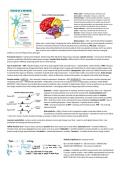
White matter = myelinated axons, interprets info
Grey matter = cell bodies of neurons, sends info
Communication = electrical (action potential = change in
electrical activity in neuron due to changes in input) and
chemical (neurotransmitters). AP reaches axon terminal =
release of neurotransmitters from presynaptic neuron, cross
synapse and bind to postsynaptic neuron receptors.
Corpus collosum = connects two hemispheres of brain
Cortex = outer layer, smooth folds that increase SA
Striatum= cluster of neurons, motor control, reward,
motivation, habit formation, processes signals from cortex
and to initiate/inhibit actions
Hippocampus = roles = special orientation/navigation
(place cells + mental maps), imagining the future, deliberative decision making, records episodic memories
and forms connections between memories (eg binds face to perfume) eg. HM study = damage to
hippocampus showed localized brain function (unable to form new episodic memories, but he was able to
learn to mirror trace (without remembering that he had performed that task)); need for converging
evidence as not all of hippocampus damaged
Procedural memory = learning from feedback, skill learning (NOT affected by hippocampus damage), episodic memory = memory from feedback,
conscious recollection (affected by hippocampus damage); Localized brain function= different parts of brain responsible for specific functions;
brocas’s aphasia= difficulty producing speech due to cortex damage
How to study brain = MRI: +detailed images of structure using magnetic fields and radio waves, - claustrophobia, metals interfere; fMRI: measures
difference in oxygenated and deoxygenated blood, signals from hydrogen atoms change when blood flows to a brain region, bringing oxygen with
it=show neural activity during task +non-invasive, -poor temporal and special resolution; Optogenetics: light used to turn different neurons on/off
to examine their impact on behavior, +activation of specific brain region and precise, - invasive (hole in skill), not used for humans, Brain damage:
compare lesions that suffered trauma/stroke to healthy, + allows to determine function and causality, -few patients with similar brain damage
Decision making = HABITUAL = fast, automatic, based on experiences, dopamine + RPE, DELIBERATIVE = slow, conscious, involves reasoning and
considering outcomes – PERCEPTUAL DECISIONS = deliberation of sensory info to evaluate world, no hippocampus activation; VALUE-BASED
DECISIONS= choice between several alternatives based on subjective value; activation in hippocampus when it comes to preference, eg amnesiacs
have longer reaction times when making value based decisions = converging evidence for hippocampus link to memory making
Dopamine – Schultz’s experiment on monkeys, trained to expect juice after a cue = dopamine
responds to reward prediction error and not the reward itself; reward prediction error =
difference in what you expect and what you get dopamine neurons project to striatum,
influencing activity during decision making and learning =increased neuron activity for positive
RPEs = brain learns from errors and improves future predictions; Parkinson’s and RPE = loss of
neurons containing dopamine = lower dopamine = impaired decision making
+ RPE = reward not expected, no RPE = expecting and receiving reward, -RPE = not receiving
expected reward
Brain plasticity = ability of brain to form/reorganize synaptic connections based on new
circumstances and stimuli; experiment with sea slugs (aplysia) = stimulate the cells to see effects
= short term memory involves functional changes at synapse vs long term memory requires new synaptic growth
Long term potentiation = process where connections between neurons get stronger over time = easier to send signals between them = key
mechanism for learning and storing memories
TERMS: Random error = due to chance, decreases precision (how close values are to each other); Systematic error = consistent difference,
introduces bias, decreases accuracy (how close values are to true value); Falsifiability = scientific hypothesis must be testable in a way that it can be
proven wrong through experimentation; Correlation = relationship between 2 variables, Causation = 1 variable directly causes change in other
Statistical significance to compare results
CIs = DO NOT OVERLAP (+/- 2SE from mean) = STATISTICALLY
SIGNIFICANT DIFFERENCE = true means are different
p-values = probability we obtain measurements when null hypothesis
is correct, smaller p-value = more unlikely measurements occurred by
chance, p LESS THAN/EQUAL to 0.05 = SIGNIFICANT difference=
REJECT NULL HYP. As less than 5% chance of achieving results
Grey matter = cell bodies of neurons, sends info
Communication = electrical (action potential = change in
electrical activity in neuron due to changes in input) and
chemical (neurotransmitters). AP reaches axon terminal =
release of neurotransmitters from presynaptic neuron, cross
synapse and bind to postsynaptic neuron receptors.
Corpus collosum = connects two hemispheres of brain
Cortex = outer layer, smooth folds that increase SA
Striatum= cluster of neurons, motor control, reward,
motivation, habit formation, processes signals from cortex
and to initiate/inhibit actions
Hippocampus = roles = special orientation/navigation
(place cells + mental maps), imagining the future, deliberative decision making, records episodic memories
and forms connections between memories (eg binds face to perfume) eg. HM study = damage to
hippocampus showed localized brain function (unable to form new episodic memories, but he was able to
learn to mirror trace (without remembering that he had performed that task)); need for converging
evidence as not all of hippocampus damaged
Procedural memory = learning from feedback, skill learning (NOT affected by hippocampus damage), episodic memory = memory from feedback,
conscious recollection (affected by hippocampus damage); Localized brain function= different parts of brain responsible for specific functions;
brocas’s aphasia= difficulty producing speech due to cortex damage
How to study brain = MRI: +detailed images of structure using magnetic fields and radio waves, - claustrophobia, metals interfere; fMRI: measures
difference in oxygenated and deoxygenated blood, signals from hydrogen atoms change when blood flows to a brain region, bringing oxygen with
it=show neural activity during task +non-invasive, -poor temporal and special resolution; Optogenetics: light used to turn different neurons on/off
to examine their impact on behavior, +activation of specific brain region and precise, - invasive (hole in skill), not used for humans, Brain damage:
compare lesions that suffered trauma/stroke to healthy, + allows to determine function and causality, -few patients with similar brain damage
Decision making = HABITUAL = fast, automatic, based on experiences, dopamine + RPE, DELIBERATIVE = slow, conscious, involves reasoning and
considering outcomes – PERCEPTUAL DECISIONS = deliberation of sensory info to evaluate world, no hippocampus activation; VALUE-BASED
DECISIONS= choice between several alternatives based on subjective value; activation in hippocampus when it comes to preference, eg amnesiacs
have longer reaction times when making value based decisions = converging evidence for hippocampus link to memory making
Dopamine – Schultz’s experiment on monkeys, trained to expect juice after a cue = dopamine
responds to reward prediction error and not the reward itself; reward prediction error =
difference in what you expect and what you get dopamine neurons project to striatum,
influencing activity during decision making and learning =increased neuron activity for positive
RPEs = brain learns from errors and improves future predictions; Parkinson’s and RPE = loss of
neurons containing dopamine = lower dopamine = impaired decision making
+ RPE = reward not expected, no RPE = expecting and receiving reward, -RPE = not receiving
expected reward
Brain plasticity = ability of brain to form/reorganize synaptic connections based on new
circumstances and stimuli; experiment with sea slugs (aplysia) = stimulate the cells to see effects
= short term memory involves functional changes at synapse vs long term memory requires new synaptic growth
Long term potentiation = process where connections between neurons get stronger over time = easier to send signals between them = key
mechanism for learning and storing memories
TERMS: Random error = due to chance, decreases precision (how close values are to each other); Systematic error = consistent difference,
introduces bias, decreases accuracy (how close values are to true value); Falsifiability = scientific hypothesis must be testable in a way that it can be
proven wrong through experimentation; Correlation = relationship between 2 variables, Causation = 1 variable directly causes change in other
Statistical significance to compare results
CIs = DO NOT OVERLAP (+/- 2SE from mean) = STATISTICALLY
SIGNIFICANT DIFFERENCE = true means are different
p-values = probability we obtain measurements when null hypothesis
is correct, smaller p-value = more unlikely measurements occurred by
chance, p LESS THAN/EQUAL to 0.05 = SIGNIFICANT difference=
REJECT NULL HYP. As less than 5% chance of achieving results