

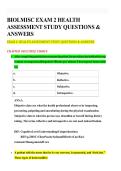
Answer Key- BIOLMISC EXAM 2 HEALTH ASSESSMENT STUDY QUESTIONS
Page 1 of 366
& ANSWERS 2/1/2026
BIOLMISC EXAM 2 HEALTH
ASSESSMENT STUDY QUESTIONS &
ANSWERS
EXAM 2: HEALTH ASSESSMENT STUDY QUESTIONS & ANSWERS
CHAPTER 1MULTIPLE CHOICE
Aftercompletinganinitialassessmentofapatient,thenursehaschartedthathisresp
irations areeupneicandhispulseis 58beats per minute.Thesetypesof datawould
be:
a. Objective.
b. Reflective.
c. Subjective.
d. Introspective.
ANS:A
Objective data are what the health professional observes by inspecting,
percussing, palpating,and auscultating during the physical examination.
Subjective data is what the person says abouthim or herself during history
taking. The terms reflective and introspective are not used todescribedata.
DIF: CognitiveLevel:Understanding(Comprehension)
REF:p.2MSC:ClientNeeds:SafeandEffectiveCareEnvi
ronment:ManagementofCare
A patient tells the nurse that he is very nervous, is nauseated, and “feels hot.”
These types of datawouldbe:
Page 1 BIOLMISC EXAM 2 HEALTH ASSESSMENT
BIOLMISC STUDY
EXAM 2QUESTIONS
HEALTH ASSESSMENT
& ANSWERS.pdf
STUDY QUESTIONS & ANSWERS.pdf
,Answer Key- BIOLMISC EXAM 2 HEALTH ASSESSMENT STUDY QUESTIONS
Page 2 of 366
& ANSWERS 2/1/2026
a. Objective.
b. Reflective.
c. Subjective.
d. Introspective.
ANS:C
Subjective data are what the person says about him or herself during history
taking. Objectivedata are what the health professional observes by inspecting,
percussing, palpating,
andauscultatingduringthephysicalexamination.Theterms
reflectiveandintrospectivearenotusedto describedata.
DIF: CognitiveLevel:Understanding(Comprehension)
REF:p.2MSC:ClientNeeds:SafeandEffectiveCareEnvi
ronment:ManagementofCare
Thepatient’srecord,laboratorystudies,objectivedata,andsubjectivedatacombine
toformthe:
a. Database.
b. Admittingdata.
c. Financialstatement.
d. Dischargesummary.
Page 2 BIOLMISC EXAM 2 HEALTH ASSESSMENT
BIOLMISC STUDY
EXAM 2QUESTIONS
HEALTH ASSESSMENT
& ANSWERS.pdf
STUDY QUESTIONS & ANSWERS.pdf
,Answer Key- BIOLMISC EXAM 2 HEALTH ASSESSMENT STUDY QUESTIONS
Page 3 of 366
& ANSWERS 2/1/2026
ANS:A
Togetherwiththepatient’srecordandlaboratorystudies,theobjectiveandsubjecti
vedataformthedatabase.Theotheritems
arenotpartofthepatient’srecord,laboratorystudies,ordata.
DIF: CognitiveLevel:Remembering(Knowledge)
REF:p.2MSC:ClientNeeds:SafeandEffectiveCareEnvi
ronment:ManagementofCare
Thenurseisconductingaclassonprioritysettingfora groupofnewgraduate
nurses.Whichisanexample of afirst-levelpriorityproblem?
a. Patientwithpostoperativepain
b. Newlydiagnosedpatientwithdia
beteswhoneedsdiabeticteachin
g
c. Individualwithasmalllaceration
onthesoleof thefoot
d. Individualwithshortnessofbrea
thandrespiratorydistress
ANS:D
First-level priority problems are those that are emergent, life threatening, and
immediate
(e.g.,establishinganairway,supportingbreathing,maintainingcirculation,monito
ringabnormalvitalsigns)(seeTable1-1).
DIF: CognitiveLevel:Understanding(Comprehension)
REF:p.4MSC:ClientNeeds:SafeandEffectiveCareEnvi
ronment:ManagementofCare
Page 3 BIOLMISC EXAM 2 HEALTH ASSESSMENT
BIOLMISC STUDY
EXAM 2QUESTIONS
HEALTH ASSESSMENT
& ANSWERS.pdf
STUDY QUESTIONS & ANSWERS.pdf
, Answer Key- BIOLMISC EXAM 2 HEALTH ASSESSMENT STUDY QUESTIONS
Page 4 of 366
& ANSWERS 2/1/2026
When considering priority setting of problems, the nurse keeps in mind that
second-level priorityproblemsincludewhich of theseaspects?
a. Lowself-esteem
b. Lackofknowledge
c. Abnormallaboratoryvalues
d. Severelyabnormal vitalsigns
ANS:C
Second-level priority problems are those that require prompt intervention
to forestall furtherdeterioration (e.g., mental status change, acute pain,
abnormal laboratory values, risks to safetyorsecurity)(seeTable1-1).
DIF: CognitiveLevel:Understanding(Comprehension)
REF:p.4MSC:ClientNeeds:SafeandEffectiveCareEnvi
ronment:ManagementofCare
Whichcriticalthinkingskillhelpsthenurseseerelationshipsamongthedata?
a. Validation
b. Clusteringrelatedcues
c. Identifyinggapsindata
Page 4 BIOLMISC EXAM 2 HEALTH ASSESSMENT
BIOLMISC STUDY
EXAM 2QUESTIONS
HEALTH ASSESSMENT
& ANSWERS.pdf
STUDY QUESTIONS & ANSWERS.pdf
Page 1 of 366
& ANSWERS 2/1/2026
BIOLMISC EXAM 2 HEALTH
ASSESSMENT STUDY QUESTIONS &
ANSWERS
EXAM 2: HEALTH ASSESSMENT STUDY QUESTIONS & ANSWERS
CHAPTER 1MULTIPLE CHOICE
Aftercompletinganinitialassessmentofapatient,thenursehaschartedthathisresp
irations areeupneicandhispulseis 58beats per minute.Thesetypesof datawould
be:
a. Objective.
b. Reflective.
c. Subjective.
d. Introspective.
ANS:A
Objective data are what the health professional observes by inspecting,
percussing, palpating,and auscultating during the physical examination.
Subjective data is what the person says abouthim or herself during history
taking. The terms reflective and introspective are not used todescribedata.
DIF: CognitiveLevel:Understanding(Comprehension)
REF:p.2MSC:ClientNeeds:SafeandEffectiveCareEnvi
ronment:ManagementofCare
A patient tells the nurse that he is very nervous, is nauseated, and “feels hot.”
These types of datawouldbe:
Page 1 BIOLMISC EXAM 2 HEALTH ASSESSMENT
BIOLMISC STUDY
EXAM 2QUESTIONS
HEALTH ASSESSMENT
& ANSWERS.pdf
STUDY QUESTIONS & ANSWERS.pdf
,Answer Key- BIOLMISC EXAM 2 HEALTH ASSESSMENT STUDY QUESTIONS
Page 2 of 366
& ANSWERS 2/1/2026
a. Objective.
b. Reflective.
c. Subjective.
d. Introspective.
ANS:C
Subjective data are what the person says about him or herself during history
taking. Objectivedata are what the health professional observes by inspecting,
percussing, palpating,
andauscultatingduringthephysicalexamination.Theterms
reflectiveandintrospectivearenotusedto describedata.
DIF: CognitiveLevel:Understanding(Comprehension)
REF:p.2MSC:ClientNeeds:SafeandEffectiveCareEnvi
ronment:ManagementofCare
Thepatient’srecord,laboratorystudies,objectivedata,andsubjectivedatacombine
toformthe:
a. Database.
b. Admittingdata.
c. Financialstatement.
d. Dischargesummary.
Page 2 BIOLMISC EXAM 2 HEALTH ASSESSMENT
BIOLMISC STUDY
EXAM 2QUESTIONS
HEALTH ASSESSMENT
& ANSWERS.pdf
STUDY QUESTIONS & ANSWERS.pdf
,Answer Key- BIOLMISC EXAM 2 HEALTH ASSESSMENT STUDY QUESTIONS
Page 3 of 366
& ANSWERS 2/1/2026
ANS:A
Togetherwiththepatient’srecordandlaboratorystudies,theobjectiveandsubjecti
vedataformthedatabase.Theotheritems
arenotpartofthepatient’srecord,laboratorystudies,ordata.
DIF: CognitiveLevel:Remembering(Knowledge)
REF:p.2MSC:ClientNeeds:SafeandEffectiveCareEnvi
ronment:ManagementofCare
Thenurseisconductingaclassonprioritysettingfora groupofnewgraduate
nurses.Whichisanexample of afirst-levelpriorityproblem?
a. Patientwithpostoperativepain
b. Newlydiagnosedpatientwithdia
beteswhoneedsdiabeticteachin
g
c. Individualwithasmalllaceration
onthesoleof thefoot
d. Individualwithshortnessofbrea
thandrespiratorydistress
ANS:D
First-level priority problems are those that are emergent, life threatening, and
immediate
(e.g.,establishinganairway,supportingbreathing,maintainingcirculation,monito
ringabnormalvitalsigns)(seeTable1-1).
DIF: CognitiveLevel:Understanding(Comprehension)
REF:p.4MSC:ClientNeeds:SafeandEffectiveCareEnvi
ronment:ManagementofCare
Page 3 BIOLMISC EXAM 2 HEALTH ASSESSMENT
BIOLMISC STUDY
EXAM 2QUESTIONS
HEALTH ASSESSMENT
& ANSWERS.pdf
STUDY QUESTIONS & ANSWERS.pdf
, Answer Key- BIOLMISC EXAM 2 HEALTH ASSESSMENT STUDY QUESTIONS
Page 4 of 366
& ANSWERS 2/1/2026
When considering priority setting of problems, the nurse keeps in mind that
second-level priorityproblemsincludewhich of theseaspects?
a. Lowself-esteem
b. Lackofknowledge
c. Abnormallaboratoryvalues
d. Severelyabnormal vitalsigns
ANS:C
Second-level priority problems are those that require prompt intervention
to forestall furtherdeterioration (e.g., mental status change, acute pain,
abnormal laboratory values, risks to safetyorsecurity)(seeTable1-1).
DIF: CognitiveLevel:Understanding(Comprehension)
REF:p.4MSC:ClientNeeds:SafeandEffectiveCareEnvi
ronment:ManagementofCare
Whichcriticalthinkingskillhelpsthenurseseerelationshipsamongthedata?
a. Validation
b. Clusteringrelatedcues
c. Identifyinggapsindata
Page 4 BIOLMISC EXAM 2 HEALTH ASSESSMENT
BIOLMISC STUDY
EXAM 2QUESTIONS
HEALTH ASSESSMENT
& ANSWERS.pdf
STUDY QUESTIONS & ANSWERS.pdf


