

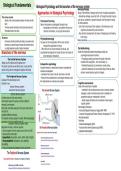
Biological Fundamentals Biological Psychology and the branches of the nervous system
Neuropsychology
Approaches in Biological Psychology Study of the effects of damage to the brain in patient populations.
The nervous system – Sometimes damage caused at birth, or through traumatic injuries
- Based on the communications between the brain and the Physiological Psychology such as car accidents or gunshot wounds. Also through the study
body Neural mechanisms investigated through direct of stroke patients.
- The brain sends information to the body and body send manipulation of the brain, using direct electrical or – Links the functioning of brain regions to the behaviours and
information back to the brain. chemical stimulation, or surgical interventions. cognitive processes they are involved in.
– Also aids the developments of means of diagnosing and treating
Hormones brain injury.
Psychopharmacology Bàlint’s Syndrome
- Hormones (chemicals withing the body) can explain some Focusses on the manipulation of the brain activity
behaviour as internal factors interact with external stimuli. through the application of drugs.
- (e.g high dopamine results in higher motivation) – Often the aim can be to develop new drugs, but Psychophysiology
Branches of the nervous psychopharmacologists also study the basic principles of Studies the relationship between physiological activity and
psychological processes in humans.
brain behaviour interaction.
system
The Central Nervous System – Physiological activity could mean the activity of the brain,
-Made up of the brain and the spinal cord recorded at the scalp (EEG – more on this later). Or...
Comparative psychology – Peripheral Responses: Eye movements, muscle activity...
The brain controls how we think, learn, move and the Compare behaviour in animals and humans to understand its
spinal cord gives the message throughout the body – Autonomic Responses (see next section today): Heart rate, blood
evolution and adaptation pressure, sweat response, pupil size changes....
– Sometimes this is done in the lab, other times in the field
The Peripheral Nervous System – Works on the assumption that to some degree behaviours and
Outside of the brain/spinal cord. their antecedents are universal across species
Divided in two Cognitive neuroscience
-Somatic Nervous system Study of the neural basis of cognition
-Autonomic Nervous System – Interested in the way that processes such as memory, attention,
-Somatic Nervous System language, as well as social processes such as empathy and
Includes neurons that carry sensory perspective taking are ‘represented’ in the brain.
information toward the spine and brain (afferent – Builds models and theories of how networks of brain regions
neurons), and neurons support cognition.
that send commands away from the spine and brain to Neuroimaging Techniques
muscles for – (functional) Magnetic Resonance Imaging (MRI / fMRI)
example (efferent neurons) – Computer Tomography and Positron Emission Tomography (CT / PET)
The somatic nervous system in action: Microneurography • Neurophysiological
recording of a touch sensitive hair cell. Techniques
-Autonomic Nervous System (ANS) – Electroencephalography (EEG)
Regulates the body’s internal systems – Functional Near Infrared Spectroscopy (fNIRS)
• Carries signals from the organs to and from the CNS – Magnetoencephalography
• Two branches of the ANS
– Sympathetic (activation, action, effort, fight or flight)
– Parasympathetic (relaxation, rest, digestion,
immobility)
– Push-pull relationship between the two branches
, Biological Fundamentals 2 Nerves
Afferent and Efferent Neurons Sensory, Relay and Motor Neurons
Afferent: sensory Sensory neurons (are afferents) have receptors that
- Afferent’ meaning that the neuron convert external stimuli into signals (action
conducts information TO a location. potentials).
• Afferent most commonly refers to They may detect signals from the outside world, such
sensory neurons relaying information as
from the periphery, back to the spinal smell, taste, vision, touch or sound, or temperature.
cord and on to the brain. Or they may detect internal stimuli such as blood
pressure or the position of the limbs (proprioception)
Efferent: motor neurons
- ‘Efferent’ meaning that the neuron
carries information AWAY from a
structure
• Efferent most commonly refers to
motor neurons that send signals to
muscles or organs of the body.
Motor Neurons send signal to
motor units on muscles.
• Motor units activate few or many
individual muscle fibres, with those
activating fewer fibres providing more
selective muscle control.
• Motor neurons release a
neurotransmitter called acetylcholine at
the neuromuscular junction, causing
the
muscle to contract.
Neuropsychology
Approaches in Biological Psychology Study of the effects of damage to the brain in patient populations.
The nervous system – Sometimes damage caused at birth, or through traumatic injuries
- Based on the communications between the brain and the Physiological Psychology such as car accidents or gunshot wounds. Also through the study
body Neural mechanisms investigated through direct of stroke patients.
- The brain sends information to the body and body send manipulation of the brain, using direct electrical or – Links the functioning of brain regions to the behaviours and
information back to the brain. chemical stimulation, or surgical interventions. cognitive processes they are involved in.
– Also aids the developments of means of diagnosing and treating
Hormones brain injury.
Psychopharmacology Bàlint’s Syndrome
- Hormones (chemicals withing the body) can explain some Focusses on the manipulation of the brain activity
behaviour as internal factors interact with external stimuli. through the application of drugs.
- (e.g high dopamine results in higher motivation) – Often the aim can be to develop new drugs, but Psychophysiology
Branches of the nervous psychopharmacologists also study the basic principles of Studies the relationship between physiological activity and
psychological processes in humans.
brain behaviour interaction.
system
The Central Nervous System – Physiological activity could mean the activity of the brain,
-Made up of the brain and the spinal cord recorded at the scalp (EEG – more on this later). Or...
Comparative psychology – Peripheral Responses: Eye movements, muscle activity...
The brain controls how we think, learn, move and the Compare behaviour in animals and humans to understand its
spinal cord gives the message throughout the body – Autonomic Responses (see next section today): Heart rate, blood
evolution and adaptation pressure, sweat response, pupil size changes....
– Sometimes this is done in the lab, other times in the field
The Peripheral Nervous System – Works on the assumption that to some degree behaviours and
Outside of the brain/spinal cord. their antecedents are universal across species
Divided in two Cognitive neuroscience
-Somatic Nervous system Study of the neural basis of cognition
-Autonomic Nervous System – Interested in the way that processes such as memory, attention,
-Somatic Nervous System language, as well as social processes such as empathy and
Includes neurons that carry sensory perspective taking are ‘represented’ in the brain.
information toward the spine and brain (afferent – Builds models and theories of how networks of brain regions
neurons), and neurons support cognition.
that send commands away from the spine and brain to Neuroimaging Techniques
muscles for – (functional) Magnetic Resonance Imaging (MRI / fMRI)
example (efferent neurons) – Computer Tomography and Positron Emission Tomography (CT / PET)
The somatic nervous system in action: Microneurography • Neurophysiological
recording of a touch sensitive hair cell. Techniques
-Autonomic Nervous System (ANS) – Electroencephalography (EEG)
Regulates the body’s internal systems – Functional Near Infrared Spectroscopy (fNIRS)
• Carries signals from the organs to and from the CNS – Magnetoencephalography
• Two branches of the ANS
– Sympathetic (activation, action, effort, fight or flight)
– Parasympathetic (relaxation, rest, digestion,
immobility)
– Push-pull relationship between the two branches
, Biological Fundamentals 2 Nerves
Afferent and Efferent Neurons Sensory, Relay and Motor Neurons
Afferent: sensory Sensory neurons (are afferents) have receptors that
- Afferent’ meaning that the neuron convert external stimuli into signals (action
conducts information TO a location. potentials).
• Afferent most commonly refers to They may detect signals from the outside world, such
sensory neurons relaying information as
from the periphery, back to the spinal smell, taste, vision, touch or sound, or temperature.
cord and on to the brain. Or they may detect internal stimuli such as blood
pressure or the position of the limbs (proprioception)
Efferent: motor neurons
- ‘Efferent’ meaning that the neuron
carries information AWAY from a
structure
• Efferent most commonly refers to
motor neurons that send signals to
muscles or organs of the body.
Motor Neurons send signal to
motor units on muscles.
• Motor units activate few or many
individual muscle fibres, with those
activating fewer fibres providing more
selective muscle control.
• Motor neurons release a
neurotransmitter called acetylcholine at
the neuromuscular junction, causing
the
muscle to contract.


