
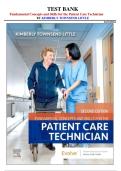
TEST BANK
Fundamental Concepts and Skills for the Patient Care Technician
BY KIMBERLY TOWNSEND LITTLE
2nd Edition
,
,Test Bank For
Fundamental Concepts and Skills for the Patient Care Technician, 2nd Edition by
Kimberly Townsend Little, PhD, RN, WHNP-BC, CNE
Chapter 1-35
Chapter 01: Today’s Healthcare
MULTIPLE CHOICE
1. Which of the following must the patient care technician (PCT) recognize
regarding the healthcare delivery system?
a. It includes all states.
b. It affects the illness of patients.
c. Insurance companies are not involved.
d. The major goal is to achieve optimal levels of healthcare.
ANS: D
The PCT must recognize that in the healthcare delivery system, the major goal is
to achieve optimal levels of healthcare. The healthcare system consists of a
network of agencies, facilities, and providers involved with healthcare in a
specified geographic area. Insurance companies do have involvement in the
healthcare system. The illness of patients is not necessarily affected by the
healthcare system.
OBJ: 1
2. What is required by the healthcare team to identify the needs of a patient and to
design care to meet those needs?
a. The white board
b. The nurse’s notes
c. The physician’s order sheet
d. An individualized care plan
ANS: D
An individualized care plan involves all healthcare workers and outlines care to
meet the needs of the individual patient. The white board, physician’s order
sheet, and nurse’s notes do not identify the needs of the patient nor are they
designed to assist all members of the healthcare team to meet those needs.
OBJ: 3
3. How does an interdisciplinary approach to patient treatment enhance care?
a. By improving efficiency of care
b. By reducing the number of caregivers
c. By preventing the fragmentation of patient care
d. By shortening hospital stay
ANS: C
, An interdisciplinary approach prevents fragmentation of care by involving and
including all care providers. An interdisciplinary approach does not improve the
efficiency of care, reduce the number of caregivers, or shorten hospital stay.
OBJ: 3, 4
4. How may a newly licensed practical nurse/ licensed vocational nurse (LPN/LVN)
practice?
a. Independently in a hospital setting
b. With an experienced LPN/LVN
c. Under the supervision of a physician or registered nurse (RN)
d. As a sole practitioner in a clinic setting
ANS: C
An LPN/LVN practices under the supervision of a physician, dentist, or RN. An
LPN/LVN is not to practice independently in a hospital setting, under the
supervision of a more experienced LPN/LVN, or as a sole practitioner in a clinic
setting.
OBJ: 5
5. What document identifies the roles and responsibilities of the LPN/LVN?
a. The nurse’s employer
b. College Accreditation Standards
c. Nurse Practice Act
d. Nurse Association Code
ANS: C
The LPN/LVN functions under the Nurse Practice Act. The nurse’s employer may
outline the working responsibilities of the nurse, but it is the nurse’s
responsibility to make sure they stay within their scope of practice as described
by the Nurse Practice Act.
OBJ: 5
6. What is the title of the American Hospital Association’s 1972 document that
outlines the patient’s expectations to be treated with dignity and
compassion?
a. Code of Ethics
b. Patient’s Bill of Rights
c. The Omnibus Reconciliation Act (OBRA)
d. Advance directives
ANS: B
The title of the American Hospital Association’s 1972 document that outlines the
patient’s expectations is the Patient’s Bill of Rights. Patient expectations are not
outlined in the Code of Ethics, OBRA, or advance directives.
OBJ: 2
7. What system reduces the number of employees but still provides quality care for
patients?
a. Team nursing
b. Cross-training
c. Use of critical pathways
d. Case management
Fundamental Concepts and Skills for the Patient Care Technician
BY KIMBERLY TOWNSEND LITTLE
2nd Edition
,
,Test Bank For
Fundamental Concepts and Skills for the Patient Care Technician, 2nd Edition by
Kimberly Townsend Little, PhD, RN, WHNP-BC, CNE
Chapter 1-35
Chapter 01: Today’s Healthcare
MULTIPLE CHOICE
1. Which of the following must the patient care technician (PCT) recognize
regarding the healthcare delivery system?
a. It includes all states.
b. It affects the illness of patients.
c. Insurance companies are not involved.
d. The major goal is to achieve optimal levels of healthcare.
ANS: D
The PCT must recognize that in the healthcare delivery system, the major goal is
to achieve optimal levels of healthcare. The healthcare system consists of a
network of agencies, facilities, and providers involved with healthcare in a
specified geographic area. Insurance companies do have involvement in the
healthcare system. The illness of patients is not necessarily affected by the
healthcare system.
OBJ: 1
2. What is required by the healthcare team to identify the needs of a patient and to
design care to meet those needs?
a. The white board
b. The nurse’s notes
c. The physician’s order sheet
d. An individualized care plan
ANS: D
An individualized care plan involves all healthcare workers and outlines care to
meet the needs of the individual patient. The white board, physician’s order
sheet, and nurse’s notes do not identify the needs of the patient nor are they
designed to assist all members of the healthcare team to meet those needs.
OBJ: 3
3. How does an interdisciplinary approach to patient treatment enhance care?
a. By improving efficiency of care
b. By reducing the number of caregivers
c. By preventing the fragmentation of patient care
d. By shortening hospital stay
ANS: C
, An interdisciplinary approach prevents fragmentation of care by involving and
including all care providers. An interdisciplinary approach does not improve the
efficiency of care, reduce the number of caregivers, or shorten hospital stay.
OBJ: 3, 4
4. How may a newly licensed practical nurse/ licensed vocational nurse (LPN/LVN)
practice?
a. Independently in a hospital setting
b. With an experienced LPN/LVN
c. Under the supervision of a physician or registered nurse (RN)
d. As a sole practitioner in a clinic setting
ANS: C
An LPN/LVN practices under the supervision of a physician, dentist, or RN. An
LPN/LVN is not to practice independently in a hospital setting, under the
supervision of a more experienced LPN/LVN, or as a sole practitioner in a clinic
setting.
OBJ: 5
5. What document identifies the roles and responsibilities of the LPN/LVN?
a. The nurse’s employer
b. College Accreditation Standards
c. Nurse Practice Act
d. Nurse Association Code
ANS: C
The LPN/LVN functions under the Nurse Practice Act. The nurse’s employer may
outline the working responsibilities of the nurse, but it is the nurse’s
responsibility to make sure they stay within their scope of practice as described
by the Nurse Practice Act.
OBJ: 5
6. What is the title of the American Hospital Association’s 1972 document that
outlines the patient’s expectations to be treated with dignity and
compassion?
a. Code of Ethics
b. Patient’s Bill of Rights
c. The Omnibus Reconciliation Act (OBRA)
d. Advance directives
ANS: B
The title of the American Hospital Association’s 1972 document that outlines the
patient’s expectations is the Patient’s Bill of Rights. Patient expectations are not
outlined in the Code of Ethics, OBRA, or advance directives.
OBJ: 2
7. What system reduces the number of employees but still provides quality care for
patients?
a. Team nursing
b. Cross-training
c. Use of critical pathways
d. Case management


