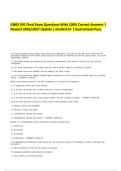
TECC TEST EXAM QUESTIONS AND ANSWERS
(VERIFIED ANSWERS) GRADED A+ | LATEST UPDATE
2026/2027 | GUARANTEED PASS.
1. How does a nasopharyngeal airway maintain a patent airway?
A. Displaces the jaw forward
B. Keeps the tongue in an anterior position
C. Ensures complete dilation of the nares
D. Blocks salivary and secretion glands - ANSWER : B.
2) A 28 year old officer was struck in the head while entering a hostile
environment. Upon assessment, you note that he has an irregular respiratory
pattern, elevated blood pressure, and a decreased pulse. At what level should you
maintain this patient's capnography?
A) 45-50 mmHg
B) 36-40 mmHg
C) Less than 30 mmHg
D) 30-35 mmHg - ANSWER : B.
3) An unconscious casualty has suffered multiple injuries as a result of an IED
blast. Vital signs P 132, R 22. During the Indirect Threat Care phase, what should
you do to ensure the patient has a patent airway? A) Insert an oropharyngeal
airway
,B) Place the patient in the recovery position
C) Perform a surgical cricothyroidotomy
D) Perform endotracheal intubation - ANSWER : B.
4) An adult patient only responds to painful stimuli. She is bleeding from multiple
entrance and exit wounds. She has a weak moan and is writhing in pain. Several
attempts at peripheral IV access was unsuccessful. What should you do?
A) Administer morphine per oral
B) Attempt IV access for a 3rd time
C) Establish external jugular
D) Establish I/0 access - ANSWER : D.
6) Applying direct pressure to a wound is an appropriate intervention for which of
the following casualties?
A) Conscious victim with heavy bleeding during Indirect Threat Care
B) Unconscious victim with no visible bleeding during Indirect Threat Care
C) Conscious victim with trickling bleeding during Direct Threat Care
D) Conscious victim with heavy bleeding during Direct Threat Care - ANSWER :
A.
7) A 30 ear old female has partial-thickness burns on 60% of her total body surface
area. Vital signs are BP 76/50, P 140, R 26. When should fluid resuscitation be
initiated?
A) As soon as venous access is obtained
,B) Only en route to the hospital
C) After analgesia administration
D) When the patient becomes unconscious - ANSWER : A.
8) What is the most immediate threat to a patient with burns covering greater than
20% total body surface area?
A) Infection
B) Massive fluid shifts
C) Hypothermia
D) Compartment syndrome - ANSWER : C.
5) A 41 year old male has suffered a gunshot wound to the right shoulder. The
bleeding is controlled but he begins to present with difficulty breathing and
decreased chest rise on the right side. What should you suspect?
A) Airway obstruction
B) Hemothorax
C. Tension pneumothorax
D) Hypoperfusion - ANSWER : B.
9) After a mass casualty incident, you are re-triaging patients. A 35 year old male
has a gunshot wound to the upper right chest. He was treated with a non-vented
occlusive dressing. Now he is anxious and complains of difficulty breathing. What
should you do?
A) Place in position of comfort
B) Apply a second occlusive dressing
, C) Manually burp the occlusive dressing
D) Perform needle decompression - ANSWER : C.
10) A 29 year old bystander has a gunshot wound to the upper right leg. A
tourniquet was applied prior to arrival at the treatment area. He complains of
severe leg pain. Vital signs are BP 110/50, P 100, R 24. What should you do?
A) Administer 2 acetaminophen 650 mg bilayer caplets PO and Meloxicam 15 mg
PO
B) Reassess tourniquet effectiveness and administer 50 mg of ketamine IM
C) Continue to monitor casualty and move on to the next patient
D) Initiate an IV of normal saline and administer a 500 mL fluid bolus - ANSWER :
C
11) A 35 year old male has suffered partial thickness burns to his chest, arms, and
face. He complains of severe pain. He speaks in 2-3 word sentences with a raspy
voice. His facial hair is singed. Vital signs are BP 150/80, P 130, R 32 and shallow.
What should you do?
A) Establish IV access and begin fluid resuscitation
B) Manually stabilize the spine
C) Administer oxygen by non-rebreather mask
D) Obtain the patient's room air SpO2 - ANSWER : A.
12) Which of the following is true of IV fluid administration?
A) Initial fluid bolus begins with 1 liter
B) Administered to all casualties with traumatic injuries
C) Preferred method over PO fluids
D) Titrated to maintain a systolic BP of 80-90 mmH - ANSWER : D.
(VERIFIED ANSWERS) GRADED A+ | LATEST UPDATE
2026/2027 | GUARANTEED PASS.
1. How does a nasopharyngeal airway maintain a patent airway?
A. Displaces the jaw forward
B. Keeps the tongue in an anterior position
C. Ensures complete dilation of the nares
D. Blocks salivary and secretion glands - ANSWER : B.
2) A 28 year old officer was struck in the head while entering a hostile
environment. Upon assessment, you note that he has an irregular respiratory
pattern, elevated blood pressure, and a decreased pulse. At what level should you
maintain this patient's capnography?
A) 45-50 mmHg
B) 36-40 mmHg
C) Less than 30 mmHg
D) 30-35 mmHg - ANSWER : B.
3) An unconscious casualty has suffered multiple injuries as a result of an IED
blast. Vital signs P 132, R 22. During the Indirect Threat Care phase, what should
you do to ensure the patient has a patent airway? A) Insert an oropharyngeal
airway
,B) Place the patient in the recovery position
C) Perform a surgical cricothyroidotomy
D) Perform endotracheal intubation - ANSWER : B.
4) An adult patient only responds to painful stimuli. She is bleeding from multiple
entrance and exit wounds. She has a weak moan and is writhing in pain. Several
attempts at peripheral IV access was unsuccessful. What should you do?
A) Administer morphine per oral
B) Attempt IV access for a 3rd time
C) Establish external jugular
D) Establish I/0 access - ANSWER : D.
6) Applying direct pressure to a wound is an appropriate intervention for which of
the following casualties?
A) Conscious victim with heavy bleeding during Indirect Threat Care
B) Unconscious victim with no visible bleeding during Indirect Threat Care
C) Conscious victim with trickling bleeding during Direct Threat Care
D) Conscious victim with heavy bleeding during Direct Threat Care - ANSWER :
A.
7) A 30 ear old female has partial-thickness burns on 60% of her total body surface
area. Vital signs are BP 76/50, P 140, R 26. When should fluid resuscitation be
initiated?
A) As soon as venous access is obtained
,B) Only en route to the hospital
C) After analgesia administration
D) When the patient becomes unconscious - ANSWER : A.
8) What is the most immediate threat to a patient with burns covering greater than
20% total body surface area?
A) Infection
B) Massive fluid shifts
C) Hypothermia
D) Compartment syndrome - ANSWER : C.
5) A 41 year old male has suffered a gunshot wound to the right shoulder. The
bleeding is controlled but he begins to present with difficulty breathing and
decreased chest rise on the right side. What should you suspect?
A) Airway obstruction
B) Hemothorax
C. Tension pneumothorax
D) Hypoperfusion - ANSWER : B.
9) After a mass casualty incident, you are re-triaging patients. A 35 year old male
has a gunshot wound to the upper right chest. He was treated with a non-vented
occlusive dressing. Now he is anxious and complains of difficulty breathing. What
should you do?
A) Place in position of comfort
B) Apply a second occlusive dressing
, C) Manually burp the occlusive dressing
D) Perform needle decompression - ANSWER : C.
10) A 29 year old bystander has a gunshot wound to the upper right leg. A
tourniquet was applied prior to arrival at the treatment area. He complains of
severe leg pain. Vital signs are BP 110/50, P 100, R 24. What should you do?
A) Administer 2 acetaminophen 650 mg bilayer caplets PO and Meloxicam 15 mg
PO
B) Reassess tourniquet effectiveness and administer 50 mg of ketamine IM
C) Continue to monitor casualty and move on to the next patient
D) Initiate an IV of normal saline and administer a 500 mL fluid bolus - ANSWER :
C
11) A 35 year old male has suffered partial thickness burns to his chest, arms, and
face. He complains of severe pain. He speaks in 2-3 word sentences with a raspy
voice. His facial hair is singed. Vital signs are BP 150/80, P 130, R 32 and shallow.
What should you do?
A) Establish IV access and begin fluid resuscitation
B) Manually stabilize the spine
C) Administer oxygen by non-rebreather mask
D) Obtain the patient's room air SpO2 - ANSWER : A.
12) Which of the following is true of IV fluid administration?
A) Initial fluid bolus begins with 1 liter
B) Administered to all casualties with traumatic injuries
C) Preferred method over PO fluids
D) Titrated to maintain a systolic BP of 80-90 mmH - ANSWER : D.