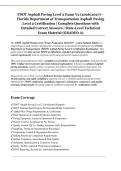
FDOT ASPHALT PAVING LEVEL 2 EXAM PREPARATION (2026/2027) | COMPLETE
QUESTIONS AND 100% CORRECT DETAILED ANSWERS | JUST RELEASED
Florida Department of Transportation (FDOT) Asphalt Paving Level 2 Certification Examination
Preparation | Core Domains: FDOT Asphalt Specifications & Standards (Section 334), Mix Design &
Material Properties, Plant Production & Quality Control, Paving Operations & Placement Techniques,
Compaction Principles & Density Requirements, Joint Construction & Surface Smoothness,
Troubleshooting & Defect Identification, and Safety & Environmental Compliance | Transportation
Construction Certification Focus | State-Level Technical Exam Format
Exam Structure
The FDOT Asphalt Paving Level 2 Exam for the 2026/2027 certification cycle is a 75-question,
multiple-choice question (MCQ) examination.
Introduction
This FDOT Asphalt Paving Level 2 Exam Preparation guide for the 2026/2027 cycle prepares paving
professionals for the Florida Department of Transportation's intermediate-level certification examination.
The content tests in-depth knowledge of FDOT specifications, asphalt mix technology, production and
placement processes, quality assurance testing, and the technical skills required to supervise and ensure
compliance on FDOT paving projects.
Answer Format
All correct answers and technical standards must be presented in bold and green, followed by detailed
rationales that cite specific FDOT specifications (e.g., Section 334), explain asphalt material science,
justify placement and compaction methods, interpret quality control test results (e.g., density, gradation),
and apply troubleshooting techniques for common paving issues.
Questions (75 Total)
1. According to FDOT Section 334, what is the minimum required in-place density for asphalt pavement?
A. 90% of theoretical maximum density
B. 92% of theoretical maximum density
C. 95% of laboratory-compacted density
D. 98% of field core density
Rationale: FDOT Specification Section 334.3.4.1 requires a minimum in-place density of 92% of the
theoretical maximum density (TMD) as determined by AASHTO T 209. This ensures adequate
compaction to prevent premature rutting and moisture damage.
2. What is the primary purpose of a tack coat in asphalt paving?
A. To provide a wearing surface
B. To bond the new lift to the existing surface
,C. To seal cracks in the base
D. To reduce rolling resistance
Rationale: A tack coat (typically an emulsified asphalt) creates a strong adhesive bond between
pavement layers, preventing slippage and delamination. FDOT Section 334.2.5 specifies application
rates and curing requirements to ensure proper adhesion without excess pickup.
3. During paving operations, segregation of aggregate in the asphalt mix is most likely caused by:
A. Excessive compaction
B. Improper handling at the plant or during dumping into the paver
C. Low mix temperature
D. Overuse of anti-stripping agents
Rationale: Segregation occurs when coarse and fine aggregates separate due to improper transfer,
conveyor use, or paver hopper management. FDOT Section 334.3.2.2 emphasizes uniform delivery and
paver operation to maintain homogeneity and prevent weak, porous areas.
4. What is the maximum allowable temperature differential between the center and edge of a mat during
compaction per FDOT guidelines?
A. 10°F
B. 25°F
C. 50°F
D. 75°F
Rationale: FDOT requires that the temperature difference across the mat not exceed 25°F during
compaction to ensure uniform density and avoid tender zones or inadequate compaction at cooler
edges. Temperature is monitored using infrared thermometers.
5. Which test is used to determine the theoretical maximum specific gravity (Gmm) of an asphalt mix?
A. Marshall Stability Test
B. AASHTO T 209 (Vacuum Saturation)
C. Hveem Stabilometer
D. Lottman Test
Rationale: AASHTO T 209 measures Gmm by removing air from the mix under vacuum, allowing
calculation of density without voids. This value is critical for determining in-place density (e.g., 92% of
Gmm). Marshall and Hveem are mix design methods; Lottman assesses moisture susceptibility.
, 6. Longitudinal joints should be constructed such that:
A. They are left un-compacted until the next lane is paved
B. The hot side is placed against the cold, compacted edge with proper overlap
C. They are sealed with crack filler immediately after paving
D. They are raked smooth before compaction
Rationale: FDOT Section 334.3.3.3 requires that the longitudinal joint be formed by placing the hot
mat adjacent to the previously compacted cold mat with a 1–2 inch overlap. The joint is then rolled from
the hot side to ensure interlock and density, minimizing permeability and raveling.
7. What is the primary cause of “shoving” in asphalt pavement?
A. Excessive compaction
B. Low shear strength of the mix under traffic load
C. High air voids
D. Poor drainage
Rationale: Shoving (plastic deformation) occurs when the asphalt mix lacks sufficient stability to resist
horizontal forces from turning or braking vehicles. Contributing factors include high asphalt content,
low angularity aggregate, or insufficient compaction. FDOT mix designs address this through
gradation and binder selection.
8. According to FDOT, what is the minimum temperature for placing Type S asphalt mix?
A. 225°F
B. 250°F
C. 275°F
D. 300°F
Rationale: FDOT Table 334-1 specifies minimum placement temperatures based on mix type. Type S
(surface course) must be placed at ≥250°F to ensure workability and proper compaction before cooling
below the cessation temperature (~185°F).
9. What does a high percent of air voids (>8%) in a field core indicate?
A. Optimal compaction
B. Inadequate compaction, leading to premature aging and raveling
C. Excess asphalt binder
QUESTIONS AND 100% CORRECT DETAILED ANSWERS | JUST RELEASED
Florida Department of Transportation (FDOT) Asphalt Paving Level 2 Certification Examination
Preparation | Core Domains: FDOT Asphalt Specifications & Standards (Section 334), Mix Design &
Material Properties, Plant Production & Quality Control, Paving Operations & Placement Techniques,
Compaction Principles & Density Requirements, Joint Construction & Surface Smoothness,
Troubleshooting & Defect Identification, and Safety & Environmental Compliance | Transportation
Construction Certification Focus | State-Level Technical Exam Format
Exam Structure
The FDOT Asphalt Paving Level 2 Exam for the 2026/2027 certification cycle is a 75-question,
multiple-choice question (MCQ) examination.
Introduction
This FDOT Asphalt Paving Level 2 Exam Preparation guide for the 2026/2027 cycle prepares paving
professionals for the Florida Department of Transportation's intermediate-level certification examination.
The content tests in-depth knowledge of FDOT specifications, asphalt mix technology, production and
placement processes, quality assurance testing, and the technical skills required to supervise and ensure
compliance on FDOT paving projects.
Answer Format
All correct answers and technical standards must be presented in bold and green, followed by detailed
rationales that cite specific FDOT specifications (e.g., Section 334), explain asphalt material science,
justify placement and compaction methods, interpret quality control test results (e.g., density, gradation),
and apply troubleshooting techniques for common paving issues.
Questions (75 Total)
1. According to FDOT Section 334, what is the minimum required in-place density for asphalt pavement?
A. 90% of theoretical maximum density
B. 92% of theoretical maximum density
C. 95% of laboratory-compacted density
D. 98% of field core density
Rationale: FDOT Specification Section 334.3.4.1 requires a minimum in-place density of 92% of the
theoretical maximum density (TMD) as determined by AASHTO T 209. This ensures adequate
compaction to prevent premature rutting and moisture damage.
2. What is the primary purpose of a tack coat in asphalt paving?
A. To provide a wearing surface
B. To bond the new lift to the existing surface
,C. To seal cracks in the base
D. To reduce rolling resistance
Rationale: A tack coat (typically an emulsified asphalt) creates a strong adhesive bond between
pavement layers, preventing slippage and delamination. FDOT Section 334.2.5 specifies application
rates and curing requirements to ensure proper adhesion without excess pickup.
3. During paving operations, segregation of aggregate in the asphalt mix is most likely caused by:
A. Excessive compaction
B. Improper handling at the plant or during dumping into the paver
C. Low mix temperature
D. Overuse of anti-stripping agents
Rationale: Segregation occurs when coarse and fine aggregates separate due to improper transfer,
conveyor use, or paver hopper management. FDOT Section 334.3.2.2 emphasizes uniform delivery and
paver operation to maintain homogeneity and prevent weak, porous areas.
4. What is the maximum allowable temperature differential between the center and edge of a mat during
compaction per FDOT guidelines?
A. 10°F
B. 25°F
C. 50°F
D. 75°F
Rationale: FDOT requires that the temperature difference across the mat not exceed 25°F during
compaction to ensure uniform density and avoid tender zones or inadequate compaction at cooler
edges. Temperature is monitored using infrared thermometers.
5. Which test is used to determine the theoretical maximum specific gravity (Gmm) of an asphalt mix?
A. Marshall Stability Test
B. AASHTO T 209 (Vacuum Saturation)
C. Hveem Stabilometer
D. Lottman Test
Rationale: AASHTO T 209 measures Gmm by removing air from the mix under vacuum, allowing
calculation of density without voids. This value is critical for determining in-place density (e.g., 92% of
Gmm). Marshall and Hveem are mix design methods; Lottman assesses moisture susceptibility.
, 6. Longitudinal joints should be constructed such that:
A. They are left un-compacted until the next lane is paved
B. The hot side is placed against the cold, compacted edge with proper overlap
C. They are sealed with crack filler immediately after paving
D. They are raked smooth before compaction
Rationale: FDOT Section 334.3.3.3 requires that the longitudinal joint be formed by placing the hot
mat adjacent to the previously compacted cold mat with a 1–2 inch overlap. The joint is then rolled from
the hot side to ensure interlock and density, minimizing permeability and raveling.
7. What is the primary cause of “shoving” in asphalt pavement?
A. Excessive compaction
B. Low shear strength of the mix under traffic load
C. High air voids
D. Poor drainage
Rationale: Shoving (plastic deformation) occurs when the asphalt mix lacks sufficient stability to resist
horizontal forces from turning or braking vehicles. Contributing factors include high asphalt content,
low angularity aggregate, or insufficient compaction. FDOT mix designs address this through
gradation and binder selection.
8. According to FDOT, what is the minimum temperature for placing Type S asphalt mix?
A. 225°F
B. 250°F
C. 275°F
D. 300°F
Rationale: FDOT Table 334-1 specifies minimum placement temperatures based on mix type. Type S
(surface course) must be placed at ≥250°F to ensure workability and proper compaction before cooling
below the cessation temperature (~185°F).
9. What does a high percent of air voids (>8%) in a field core indicate?
A. Optimal compaction
B. Inadequate compaction, leading to premature aging and raveling
C. Excess asphalt binder