OpenStax Organic Chemistry: A Tenth Edition Student Solutions Manual
Chapter 18 – Ethers and Epoxides; Thiols and Sulfides
Solutions to Problems
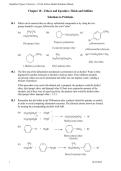
18.1 Ethers can be named either as alkoxy-substituted compounds or by citing the two
groups bonded to oxygen, followed by the word “ether”.
(a) (b) (c)
(d) (e) (f)
18.2 The first step of the dehydration mechanism is protonation of an alcohol. Water is then
displaced by another molecule of alcohol to form an ether. If two different alcohols
are present, either one can be protonated and either one can displace water, yielding a
mixture of products.
If this procedure were used with ethanol and 1-propanol, the products would be diethyl
ether, ethyl propyl ether, and dipropyl ether. If there were equimolar amounts of the
alcohols, and if they were of equal reactivity, the product ratio would be diethyl ether:
ethyl propyl ether: dipropyl ether = 1:2:1.
18.3 Remember that the halide in the Williamson ether synthesis should be primary or methyl,
in order to avoid competing elimination reactions. The alkoxide anions shown are formed
by treating the corresponding alcohols with NaH.
(a)
(b)
(c)
1 10/27/2023
, OpenStax Organic Chemistry: A Tenth Edition Student Solutions Manual
(d)
18.4
The reaction mechanism of alkoxymercuration/demercuration of an alkene is similar to
other electrophilic additions we have studied. First, the cyclopentene π electrons attack
Hg2+ with formation of a mercurinium ion. Next, the nucleophilic alcohol displaces
mercury. Markovnikov addition occurs because the carbon bearing the methyl group is
better able to stabilize the partial positive charge arising from cleavage of the carbon-
mercury bond. The ethoxyl and mercuric groups are trans to each other. Finally, removal
of mercury by NaBH4 by a mechanism that is not fully understood results in the
formation of 1-ethoxy-1-methylcyclopentane.
10/27/2023 2
, OpenStax Organic Chemistry: A Tenth Edition Student Solutions Manual
18.5 Use the Williamson synthesis when one of the ether components can be a primary or
benzylic halide. Use alkoxymercuration when one or both components are branched.
(a) Either method of synthesis is appropriate.
Williamson:
Alkoxymercuration:
(b) Either method is possible, but the Williamson synthesis is simpler.
(c) Use alkoxymercuration because both parts of the ether are branched.
(d) The Williamson synthesis must be used.
3 10/27/2023
Chapter 18 – Ethers and Epoxides; Thiols and Sulfides
Solutions to Problems
18.1 Ethers can be named either as alkoxy-substituted compounds or by citing the two
groups bonded to oxygen, followed by the word “ether”.
(a) (b) (c)
(d) (e) (f)
18.2 The first step of the dehydration mechanism is protonation of an alcohol. Water is then
displaced by another molecule of alcohol to form an ether. If two different alcohols
are present, either one can be protonated and either one can displace water, yielding a
mixture of products.
If this procedure were used with ethanol and 1-propanol, the products would be diethyl
ether, ethyl propyl ether, and dipropyl ether. If there were equimolar amounts of the
alcohols, and if they were of equal reactivity, the product ratio would be diethyl ether:
ethyl propyl ether: dipropyl ether = 1:2:1.
18.3 Remember that the halide in the Williamson ether synthesis should be primary or methyl,
in order to avoid competing elimination reactions. The alkoxide anions shown are formed
by treating the corresponding alcohols with NaH.
(a)
(b)
(c)
1 10/27/2023
, OpenStax Organic Chemistry: A Tenth Edition Student Solutions Manual
(d)
18.4
The reaction mechanism of alkoxymercuration/demercuration of an alkene is similar to
other electrophilic additions we have studied. First, the cyclopentene π electrons attack
Hg2+ with formation of a mercurinium ion. Next, the nucleophilic alcohol displaces
mercury. Markovnikov addition occurs because the carbon bearing the methyl group is
better able to stabilize the partial positive charge arising from cleavage of the carbon-
mercury bond. The ethoxyl and mercuric groups are trans to each other. Finally, removal
of mercury by NaBH4 by a mechanism that is not fully understood results in the
formation of 1-ethoxy-1-methylcyclopentane.
10/27/2023 2
, OpenStax Organic Chemistry: A Tenth Edition Student Solutions Manual
18.5 Use the Williamson synthesis when one of the ether components can be a primary or
benzylic halide. Use alkoxymercuration when one or both components are branched.
(a) Either method of synthesis is appropriate.
Williamson:
Alkoxymercuration:
(b) Either method is possible, but the Williamson synthesis is simpler.
(c) Use alkoxymercuration because both parts of the ether are branched.
(d) The Williamson synthesis must be used.
3 10/27/2023