
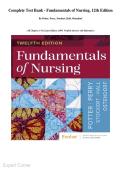
Complete Test Bank - Fundamentals of Nursing, 12th Edition
By Potter, Perry, Stockert, Hall, Ostendorf
(All Chapters 1-50, Latest Edition, 100% Verified Answers with Rationales)
,Table of Contents 25. Patient Education
26. Informatics and Documentation
Unit 1: Nursing and the Health Care Environment
Unit 5: Foundations for Nursing Practice
1. Nursing Today
27. Patient Safety and Quality
2. The Health Care Delivery System
28. Infection Prevention and Control
3. Community Based Nursing Practice
29. Vital Signs
4. Theoretical Foundations of Nursing Practice
30. Health Assessment and Physical Examination
5. Evidence-Based Practice
31. Medication Administration
Unit 2: Caring Throughout the Life Span
32. Complementary, Alternative, and Integrative
6. Health and Wellness
Therapies
7. Caring in Nursing Practice
Unit 6: Psychosocial Basis for Nursing Practice
8. Caring for Patients With Chronic Illness
33. Self-Concept
9. Cultural Competence
34. Sexuality
10. Family Dynamics
35. Spiritual Health
11. Developmental Theories
36. Loss and Grief
12. Conception Through Adolescence
37. Stress and Coping
13. Young and Middle Adults
Unit 7: Physiological Basis for Nursing Practice
14. Older Adults
38. Activity and Exercise
Unit 3: Clinical Judgment in Nursing Practice
39. Immobility
15. Critical Thinking and Clinical Judgment
40. Hygiene
16. Nursing Assessment
41. Oxygenation
17. Analysis and Nursing Diagnosis
42. Fluid, Electrolyte, Acid-Base Balance
18. Planning and Outcomes Identification in Nursing
43. Sleep
Care
44. Pain Management
19. Implementing Nursing Care
45. Nutrition
20. Evaluation
46. Urinary Elimination
21. Managing Patient Care
47. Bowel Elimination
Unit 4: Professional Standards in Nursing Practice
48. Skin Integrity and Wound Care
22. Ethics and Values
49. Sensory Alterations
23. Legal Implications in Nursing Practice
50. Perioperative Nursing Care
24. Communication
,Unit 1: Nursing and the Health Care Environment
Chapter 1: Nursing Today
MULTIPLE CHOICE
1. Which nurse most likely kept records on sanitation techniques and the effects on health?
a. Florence Nightingale
b. Mary Nutting
c. Clara Barton
d. Lillian Wald
Answer: A
Nightingale was the first practicing nurse epidemiologist. Her statistical analyses connected poor sanitation with
cholera and dysentery. Mary Nutting, Clara Barton, and Lillian Wald came after Nightingale, each contributing
to the nursing profession in her own way. Mary Nutting was instrumental in moving nursing education into
universities. Clara Barton founded the American Red Cross. Lillian Wald helped open the Henry Street
Settlement.
DIF: Understand (comprehension)
OBJ: Discuss the influence of social, historical, political, and economic changes on nursing practices.
TOP: Evaluation MSC: Health Promotion and Maintenance
2. The nurse prescribes strategies and alternatives to attain expected outcome. Which standard of nursing
practice is the nurse following?
a. Assessment
b. Diagnosis
c. Planning
d. Implementation
Answer: C
In planning, the registered nurse develops a plan that prescribes strategies and alternatives to attain expected
outcomes. During assessment, the registered nurse collects comprehensive data pertinent to the patient’s health
, and/or the situation. In diagnosis, the registered nurse analyzes the assessment data to determine the diagnoses
or issues. During implementation, the registered nurse implements (carries out) the identified plan.
DIF: Understand (comprehension)
OBJ: Discuss the development of professional nursing roles. TOP: Planning MSC: Management of Care
3. An experienced medical-surgical nurse chooses to work in obstetrics. Which level of proficiency is the
nurse upon initial transition to the obstetrical floor?
a. Novice
b. Proficient
c. Competent
d. Advanced beginner
Answer: A
A beginning nursing student or any nurse entering a situation in which there is no previous level of experience
(e.g., an experienced operating room nurse chooses to now practice in home health) is an example of a novice
nurse. A proficient nurse perceives a patient’s clinical situation as a whole, is able to assess an entire situation,
and can readily transfer knowledge gained from multiple previous experiences to a situation. A competent nurse
understands the organization and specific care required by the type of patients (e.g., surgical, oncology, or
orthopedic patients). This nurse is a competent practitioner who is able to anticipate nursing care and establish
long-range goals. A nurse who has had some level of experience with the situation is an advanced beginner.
This experience may only be observational in nature, but the nurse is able to identify meaningful aspects or
principles of nursing care.
DIF: Apply (application)
OBJ: Discuss the development of professional nursing roles. TOP: Evaluation MSC: Management of
Care
4. A nurse assesses a patient’s fluid status and decides that the patient needs to drink more fluids. The
nurse then encourages the patient to drink more fluids. Which concept is the nurse demonstrating?
a. Licensure
b. Autonomy
By Potter, Perry, Stockert, Hall, Ostendorf
(All Chapters 1-50, Latest Edition, 100% Verified Answers with Rationales)
,Table of Contents 25. Patient Education
26. Informatics and Documentation
Unit 1: Nursing and the Health Care Environment
Unit 5: Foundations for Nursing Practice
1. Nursing Today
27. Patient Safety and Quality
2. The Health Care Delivery System
28. Infection Prevention and Control
3. Community Based Nursing Practice
29. Vital Signs
4. Theoretical Foundations of Nursing Practice
30. Health Assessment and Physical Examination
5. Evidence-Based Practice
31. Medication Administration
Unit 2: Caring Throughout the Life Span
32. Complementary, Alternative, and Integrative
6. Health and Wellness
Therapies
7. Caring in Nursing Practice
Unit 6: Psychosocial Basis for Nursing Practice
8. Caring for Patients With Chronic Illness
33. Self-Concept
9. Cultural Competence
34. Sexuality
10. Family Dynamics
35. Spiritual Health
11. Developmental Theories
36. Loss and Grief
12. Conception Through Adolescence
37. Stress and Coping
13. Young and Middle Adults
Unit 7: Physiological Basis for Nursing Practice
14. Older Adults
38. Activity and Exercise
Unit 3: Clinical Judgment in Nursing Practice
39. Immobility
15. Critical Thinking and Clinical Judgment
40. Hygiene
16. Nursing Assessment
41. Oxygenation
17. Analysis and Nursing Diagnosis
42. Fluid, Electrolyte, Acid-Base Balance
18. Planning and Outcomes Identification in Nursing
43. Sleep
Care
44. Pain Management
19. Implementing Nursing Care
45. Nutrition
20. Evaluation
46. Urinary Elimination
21. Managing Patient Care
47. Bowel Elimination
Unit 4: Professional Standards in Nursing Practice
48. Skin Integrity and Wound Care
22. Ethics and Values
49. Sensory Alterations
23. Legal Implications in Nursing Practice
50. Perioperative Nursing Care
24. Communication
,Unit 1: Nursing and the Health Care Environment
Chapter 1: Nursing Today
MULTIPLE CHOICE
1. Which nurse most likely kept records on sanitation techniques and the effects on health?
a. Florence Nightingale
b. Mary Nutting
c. Clara Barton
d. Lillian Wald
Answer: A
Nightingale was the first practicing nurse epidemiologist. Her statistical analyses connected poor sanitation with
cholera and dysentery. Mary Nutting, Clara Barton, and Lillian Wald came after Nightingale, each contributing
to the nursing profession in her own way. Mary Nutting was instrumental in moving nursing education into
universities. Clara Barton founded the American Red Cross. Lillian Wald helped open the Henry Street
Settlement.
DIF: Understand (comprehension)
OBJ: Discuss the influence of social, historical, political, and economic changes on nursing practices.
TOP: Evaluation MSC: Health Promotion and Maintenance
2. The nurse prescribes strategies and alternatives to attain expected outcome. Which standard of nursing
practice is the nurse following?
a. Assessment
b. Diagnosis
c. Planning
d. Implementation
Answer: C
In planning, the registered nurse develops a plan that prescribes strategies and alternatives to attain expected
outcomes. During assessment, the registered nurse collects comprehensive data pertinent to the patient’s health
, and/or the situation. In diagnosis, the registered nurse analyzes the assessment data to determine the diagnoses
or issues. During implementation, the registered nurse implements (carries out) the identified plan.
DIF: Understand (comprehension)
OBJ: Discuss the development of professional nursing roles. TOP: Planning MSC: Management of Care
3. An experienced medical-surgical nurse chooses to work in obstetrics. Which level of proficiency is the
nurse upon initial transition to the obstetrical floor?
a. Novice
b. Proficient
c. Competent
d. Advanced beginner
Answer: A
A beginning nursing student or any nurse entering a situation in which there is no previous level of experience
(e.g., an experienced operating room nurse chooses to now practice in home health) is an example of a novice
nurse. A proficient nurse perceives a patient’s clinical situation as a whole, is able to assess an entire situation,
and can readily transfer knowledge gained from multiple previous experiences to a situation. A competent nurse
understands the organization and specific care required by the type of patients (e.g., surgical, oncology, or
orthopedic patients). This nurse is a competent practitioner who is able to anticipate nursing care and establish
long-range goals. A nurse who has had some level of experience with the situation is an advanced beginner.
This experience may only be observational in nature, but the nurse is able to identify meaningful aspects or
principles of nursing care.
DIF: Apply (application)
OBJ: Discuss the development of professional nursing roles. TOP: Evaluation MSC: Management of
Care
4. A nurse assesses a patient’s fluid status and decides that the patient needs to drink more fluids. The
nurse then encourages the patient to drink more fluids. Which concept is the nurse demonstrating?
a. Licensure
b. Autonomy


