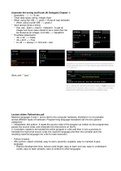
Automate the boring stuff boek (Al Sweigart) Chapter 1:
- Operaters: - + * // / % etc
- Three data types: string, integer, float
- When using int(1.99) —> gives 1 Rond af naar beneden
- When using round(1.99) —> gives 2
- Input always gives a string
- Can use - spam = input () ; int(spam) - to get an
integer but input value needs to be a value that can
be stored as an integer, not 0.99) —> ValueError
- True/false statements:
- 42==’42’ —> False
- 42==42.0 —> True
- A<=B —> always </> first and = last
Work with “ ”and ‘ ’
Lecture slides: PythonIntro.pdf
Machine language: 0 and 1, and is tied to the computer hardware, therefore it is not portable
across different types of hardware. Programming language translators fall into two general
categories:
1. Interpreters: like python. It reads the source code of the program as written by the programmer,
parses the source code, and interprets the instructions on the fly
2. Compilers: needs to be handed the entire program in a file and then it runs a process to
translate the high-level source code into machine language and then the compiler puts the
resulting machine language into a file for later execution.
- Python timeline
- Why python: object-oriented, easy to learn, powerful, scalable, easy to maintain & glue
language
- Reduce development time, reduce code length, easy to learn and use, easy to understand
codes, easy to team projects, easy to extend to other languages
,Type of errors:
- SyntaxError: violating the
“grammar” rules of python.
- bv primt
- Logic error: good syntax but there is a mistake in the order of the statement or perhaps a
mistake in how the statements relate to one another.
- Semantic errors: your description of the steps to take is syntactically perfect and in the right
order, but there is simply a mistake in the program. It does not do what you intended for it to
do.
- NameError:
- Indentation error: mostly when space or tab errors in the code. When adding unnecessary
spaces at the front of a line will result in an indentation error.
Lecture slides: Amrit_sdm.pdf (software development methodologies)
Waterfall: Sequential design process, flowing steadily downwards through SDLC
- Requirements —> Design __> implementation —> Verification —> Maintenance
- PRO: detailed early analysis, bug found earlier = much cheeper, requirements should be set
before design starts, focusses on importance of documentation, disciplined and well
structured approach, effective for stable software projects, easy to plan form project
management point of view.
- CON: changes are expensive, client does not explicitly know what he/she wants, need to
finish every phase fully, long projects, difficult to plan, designers may not know in advance
how complex a feature’s implementation is.
Prototyping: creating prototypes of software applications, typically simulates only a few aspects
of and may be completely different from the final product.
Incremental Build Model: Model is designed, implemented and tested incrementally (a little more
added each time). Finished when satisfies all the requirements. Combines elements of the
waterfall model with the iterative philosophy of prototyping.
Iterative and Incremental Development: any combination of both
iterative design or iterative method and incremental build model for
development.
Spiral Model: combining elements of design and prototyping-in-
stages. Advantages of top-down and bottom-up concepts
Rapid Application Development RAD: Minimal planning and fast
prototyping, developing instead of planning. Much more compressed than the SDLC. Is better
suited for smaller projects and gives users the ability to provide feedback throughout the process.
1. Requirements Planning, 2. User Design, 3. Construction, 4. Cutover
, Agile: Group of software development methods, based on iterative and incremental development.
Each increment is released in a specified period of time (time box), creating a regular release
schedule with very specific objectives. Has some same principles as the RAD.
Most important phrases:
- Self-organizing, cross-functional teams
- Adaptive planning
- Evolutionary development and delivery
- A time boxed iterative approach
- Rapid and flexible response to change
Goal is to provide the flexibility of an iterative approach while ensuring a quality product.
—> Agile overall more successful than Waterfall
Scrum: iterative and incremental agile software development framework, flexible, holistic product
development strategy, development team works as an atomic unit, opposing to sequential
approach. (Silicon Valley Scrum scene)
Lean (Kanban): Toyota production system, today part of agile community. Developing a minimum
viable product (MVP)
1. Eliminate wast, 2. Amplify learning, 3. Decide as late as possible, 4. Deliver as fast as possible,
5. Empower the team, 6. Build integrity in, 7. See the whole.
Difference of lean with other methodologies is that the full set of requirements for the system are
not known when the project is launched. Works best in entrepreneurial environment where a
company is interested in determining if their idea for a software application is worth developing.
Extreme Programming (XP): improve software quality and responsiveness to changing customer
requirements, a type of agile software development, frequent “releases” in short development
cycles, introduce checkpoints where new customer requirements can be adopted.
XP concepts: pair programming, planning game, test-driven development (TDD), continuous
integration
Test-driven development (TDD): relies on the repetition of a very short development cylcle.
First part of XP but now stand alone methodology.
Feature-driven development (FDD): iterative and incremental development process, agile method,
driven from a client-valued functionality (feature) perspective, mostly part of other methodologies
Rational Unified Process (RUP): iterative and incremental development process, created by IBM,
not a concrete prescriptive process, but an adaptable framework intended to be tailored by the
development organizations. Expected to select elements of the process that are appropriate.
Programming language:
All true except from A!
- Operaters: - + * // / % etc
- Three data types: string, integer, float
- When using int(1.99) —> gives 1 Rond af naar beneden
- When using round(1.99) —> gives 2
- Input always gives a string
- Can use - spam = input () ; int(spam) - to get an
integer but input value needs to be a value that can
be stored as an integer, not 0.99) —> ValueError
- True/false statements:
- 42==’42’ —> False
- 42==42.0 —> True
- A<=B —> always </> first and = last
Work with “ ”and ‘ ’
Lecture slides: PythonIntro.pdf
Machine language: 0 and 1, and is tied to the computer hardware, therefore it is not portable
across different types of hardware. Programming language translators fall into two general
categories:
1. Interpreters: like python. It reads the source code of the program as written by the programmer,
parses the source code, and interprets the instructions on the fly
2. Compilers: needs to be handed the entire program in a file and then it runs a process to
translate the high-level source code into machine language and then the compiler puts the
resulting machine language into a file for later execution.
- Python timeline
- Why python: object-oriented, easy to learn, powerful, scalable, easy to maintain & glue
language
- Reduce development time, reduce code length, easy to learn and use, easy to understand
codes, easy to team projects, easy to extend to other languages
,Type of errors:
- SyntaxError: violating the
“grammar” rules of python.
- bv primt
- Logic error: good syntax but there is a mistake in the order of the statement or perhaps a
mistake in how the statements relate to one another.
- Semantic errors: your description of the steps to take is syntactically perfect and in the right
order, but there is simply a mistake in the program. It does not do what you intended for it to
do.
- NameError:
- Indentation error: mostly when space or tab errors in the code. When adding unnecessary
spaces at the front of a line will result in an indentation error.
Lecture slides: Amrit_sdm.pdf (software development methodologies)
Waterfall: Sequential design process, flowing steadily downwards through SDLC
- Requirements —> Design __> implementation —> Verification —> Maintenance
- PRO: detailed early analysis, bug found earlier = much cheeper, requirements should be set
before design starts, focusses on importance of documentation, disciplined and well
structured approach, effective for stable software projects, easy to plan form project
management point of view.
- CON: changes are expensive, client does not explicitly know what he/she wants, need to
finish every phase fully, long projects, difficult to plan, designers may not know in advance
how complex a feature’s implementation is.
Prototyping: creating prototypes of software applications, typically simulates only a few aspects
of and may be completely different from the final product.
Incremental Build Model: Model is designed, implemented and tested incrementally (a little more
added each time). Finished when satisfies all the requirements. Combines elements of the
waterfall model with the iterative philosophy of prototyping.
Iterative and Incremental Development: any combination of both
iterative design or iterative method and incremental build model for
development.
Spiral Model: combining elements of design and prototyping-in-
stages. Advantages of top-down and bottom-up concepts
Rapid Application Development RAD: Minimal planning and fast
prototyping, developing instead of planning. Much more compressed than the SDLC. Is better
suited for smaller projects and gives users the ability to provide feedback throughout the process.
1. Requirements Planning, 2. User Design, 3. Construction, 4. Cutover
, Agile: Group of software development methods, based on iterative and incremental development.
Each increment is released in a specified period of time (time box), creating a regular release
schedule with very specific objectives. Has some same principles as the RAD.
Most important phrases:
- Self-organizing, cross-functional teams
- Adaptive planning
- Evolutionary development and delivery
- A time boxed iterative approach
- Rapid and flexible response to change
Goal is to provide the flexibility of an iterative approach while ensuring a quality product.
—> Agile overall more successful than Waterfall
Scrum: iterative and incremental agile software development framework, flexible, holistic product
development strategy, development team works as an atomic unit, opposing to sequential
approach. (Silicon Valley Scrum scene)
Lean (Kanban): Toyota production system, today part of agile community. Developing a minimum
viable product (MVP)
1. Eliminate wast, 2. Amplify learning, 3. Decide as late as possible, 4. Deliver as fast as possible,
5. Empower the team, 6. Build integrity in, 7. See the whole.
Difference of lean with other methodologies is that the full set of requirements for the system are
not known when the project is launched. Works best in entrepreneurial environment where a
company is interested in determining if their idea for a software application is worth developing.
Extreme Programming (XP): improve software quality and responsiveness to changing customer
requirements, a type of agile software development, frequent “releases” in short development
cycles, introduce checkpoints where new customer requirements can be adopted.
XP concepts: pair programming, planning game, test-driven development (TDD), continuous
integration
Test-driven development (TDD): relies on the repetition of a very short development cylcle.
First part of XP but now stand alone methodology.
Feature-driven development (FDD): iterative and incremental development process, agile method,
driven from a client-valued functionality (feature) perspective, mostly part of other methodologies
Rational Unified Process (RUP): iterative and incremental development process, created by IBM,
not a concrete prescriptive process, but an adaptable framework intended to be tailored by the
development organizations. Expected to select elements of the process that are appropriate.
Programming language:
All true except from A!