
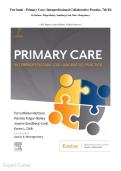
Test bank - Primary Care: Interprofessional Collaborative Practice, 7th Ed
By Buttaro, Polgar-Bailey, Sandberg-Cook, Dick, Montgomery
(All Chapters, Latest Edition, Verified Answers)
,Chapter 1: The Evolving Landscape of Collaborative Practice
1. Which assessments of care providers are performed as part of the Value Based Purchasing initiative?
Select all that apply.
a. Appraising costs per case of care for Medicare patients
b. Assessing patients’ satisfaction with hospital care
c. Evaluating available evidence to guide clinical care guidelines
d. Monitoring mortality rates of all patients with pneumonia
e. Requiring advanced IT standards and minimum cash reserves
Answer: A, B, D
Value Based Purchasing looks at five domain areas of processes of care, including efficiency of care (cost per
case), experience of care (patient satisfaction measures), and outcomes of care (mortality rates for certain
conditions. Evaluation of evidence to guide clinical care is part of evidence-based practice. The requirements
for IT standards and financial status are part of Accountable Care Organization standards. REF: Value Based
Purchasing
2. What was an important finding of the Advisory Board survey of 2014 about
primary care preferences of patients?
a. Associations with area hospitals
b. Costs of ambulatory care
c. Ease of access to care
d. The ratio of providers to patients
Answer: C
As part of the 2014 survey, the Advisory Board learned that patients desired 24/7 access to care, walk-in
settings and the ability to be seen within 30 minutes, and care that is close to home. Associations with hospitals,
costs of care, and the ratio of providers to patients were not part of these results. REF: The New Look of
Primary Care
,3. A small, rural hospital is part of an Accountable Care Organization (ACO) and is designated as a Level
1 ACO. What is part of this designation?
a. Bonuses based on achievement of benchmarks
b. Care coordination for chronic diseases
c. Standards for minimum cash reserves
d. Strict requirements for financial reporting
Answer: A
A Level 1 ACO has the least amount of financial risk and requirements, but receives shared savings bonuses
based on achievement of benchmarks for quality measures and expenditures. Care coordination and minimum
cash reserves standards are part of Level 2 ACO requirements. Level 3 ACOs have strict requirements for
financial reporting. REF: Accountable Care Organizations
Chapter 2: Transitional Care
1. To reduce adverse events associated with care transitions, the Centers for Medicare and Medicaid
Service have implemented which policy?
a. Mandates for communication among primary caregivers and hospitalists
b. Penalties for failure to perform medication reconciliations at time of discharge
c. Reduction of payments for patients readmitted within 30 days after discharge
d. Requirements for written discharge instructions for patients and caregivers
Answer: C
As a component of the Affordable Care Act, the Centers for Medicare and Medicaid Service developed the
Readmissions Reduction Program reducing payments for certain patients readmitted within 30 days of
discharge. The CMS did not mandate communication, institute penalties for failure to perform medication
reconciliations, or require written discharge instructions. REF: Transitional Care
, 2. According to Naylor’s transitional care model, which intervention has resulted in lower costs and fewer
re hospitalizations in high-risk older patients?
a. Coordination of post-hospital care by advanced practice nurses
b. Frequent post-hospital clinic visits with a primary care provider
c. Inclusion of extended family members in the outpatient plan of care
d. Telephone follow up by the pharmacist to assess medication compliance
Answer: A
Naylor’s transitional care model provided evidence that high risk older patients who had post- hospital care
coordinated by an APN had reduced re hospitalization rates. It did not include clinic visits with a primary care
provider, inclusion of extended family members in the plan of care, or telephone follow up by a pharmacist.
REF: Transitional Care
3. Which approaches are among those recommended by the Agency for Healthcare Research and Quality
to improve health literacy in patients?
Select all that apply.
a. Empowering patients and families
b. Giving written handouts for all teaching
c. Highlighting no more than 7 key points
d. Repeating the instructions
e. Supplementing teaching with visual aids
Answer: A, D, E
By Buttaro, Polgar-Bailey, Sandberg-Cook, Dick, Montgomery
(All Chapters, Latest Edition, Verified Answers)
,Chapter 1: The Evolving Landscape of Collaborative Practice
1. Which assessments of care providers are performed as part of the Value Based Purchasing initiative?
Select all that apply.
a. Appraising costs per case of care for Medicare patients
b. Assessing patients’ satisfaction with hospital care
c. Evaluating available evidence to guide clinical care guidelines
d. Monitoring mortality rates of all patients with pneumonia
e. Requiring advanced IT standards and minimum cash reserves
Answer: A, B, D
Value Based Purchasing looks at five domain areas of processes of care, including efficiency of care (cost per
case), experience of care (patient satisfaction measures), and outcomes of care (mortality rates for certain
conditions. Evaluation of evidence to guide clinical care is part of evidence-based practice. The requirements
for IT standards and financial status are part of Accountable Care Organization standards. REF: Value Based
Purchasing
2. What was an important finding of the Advisory Board survey of 2014 about
primary care preferences of patients?
a. Associations with area hospitals
b. Costs of ambulatory care
c. Ease of access to care
d. The ratio of providers to patients
Answer: C
As part of the 2014 survey, the Advisory Board learned that patients desired 24/7 access to care, walk-in
settings and the ability to be seen within 30 minutes, and care that is close to home. Associations with hospitals,
costs of care, and the ratio of providers to patients were not part of these results. REF: The New Look of
Primary Care
,3. A small, rural hospital is part of an Accountable Care Organization (ACO) and is designated as a Level
1 ACO. What is part of this designation?
a. Bonuses based on achievement of benchmarks
b. Care coordination for chronic diseases
c. Standards for minimum cash reserves
d. Strict requirements for financial reporting
Answer: A
A Level 1 ACO has the least amount of financial risk and requirements, but receives shared savings bonuses
based on achievement of benchmarks for quality measures and expenditures. Care coordination and minimum
cash reserves standards are part of Level 2 ACO requirements. Level 3 ACOs have strict requirements for
financial reporting. REF: Accountable Care Organizations
Chapter 2: Transitional Care
1. To reduce adverse events associated with care transitions, the Centers for Medicare and Medicaid
Service have implemented which policy?
a. Mandates for communication among primary caregivers and hospitalists
b. Penalties for failure to perform medication reconciliations at time of discharge
c. Reduction of payments for patients readmitted within 30 days after discharge
d. Requirements for written discharge instructions for patients and caregivers
Answer: C
As a component of the Affordable Care Act, the Centers for Medicare and Medicaid Service developed the
Readmissions Reduction Program reducing payments for certain patients readmitted within 30 days of
discharge. The CMS did not mandate communication, institute penalties for failure to perform medication
reconciliations, or require written discharge instructions. REF: Transitional Care
, 2. According to Naylor’s transitional care model, which intervention has resulted in lower costs and fewer
re hospitalizations in high-risk older patients?
a. Coordination of post-hospital care by advanced practice nurses
b. Frequent post-hospital clinic visits with a primary care provider
c. Inclusion of extended family members in the outpatient plan of care
d. Telephone follow up by the pharmacist to assess medication compliance
Answer: A
Naylor’s transitional care model provided evidence that high risk older patients who had post- hospital care
coordinated by an APN had reduced re hospitalization rates. It did not include clinic visits with a primary care
provider, inclusion of extended family members in the plan of care, or telephone follow up by a pharmacist.
REF: Transitional Care
3. Which approaches are among those recommended by the Agency for Healthcare Research and Quality
to improve health literacy in patients?
Select all that apply.
a. Empowering patients and families
b. Giving written handouts for all teaching
c. Highlighting no more than 7 key points
d. Repeating the instructions
e. Supplementing teaching with visual aids
Answer: A, D, E



