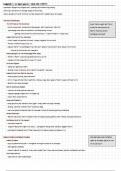
NR328 week 1
Erickson’s Stages of psychological developmental
o Trust vs mistrust
o Autonomy vs shame/doubt
o Initiative vs guilt
o Identity vs role confusion
o Industry vs inferiority
Kohlberg’s Stages of Moral Development
o Preconventional
o Conventional
o Postconventional
Piaget’s Stages of Cognitive Development
o Sensorimotor period
o Preoperational thought
o Concrete operation
o Formal operation
Infant (1 month to 1 year):
Birth weight doubles by 5 months.
Height increases about 2.5 cm monthly during the first 6
months and then about 1.2 cm monthly until 1 year.
Physical Vision and hearing develop.
Some newborn reflexes disappear (grasping, sucking, etc.).
By 4 months, an infant can hold their head up.
Learning to sit, stand and walk.
Cognitive Develop in the sensorimotor period by Piaget.
Explore through senses and learn through trial and error.
Shake, throw, and put things in their mouth.
Important milestone: Object permanence develops between
, 7-9 months (knowing things still exist even if not seen).
Language develops from crying, cooing, and laughing to
imitating sounds, comprehending the meaning of simple
commands, and repeating words.
Experience Erikson’s period of trust vs. mistrust (learning to
trust self and others through caregiver interactions).
Begin to separate self from others.
Psychosocial
By 8 months, differentiates strangers from familiar people and
close attachment to caregiver occurs.
By 9 months, able to play simple games, such as peekaboo.
Injury: motor vehicle, aspiration, suffocation, falls and
poisoning.
Health Risks
Physical or emotional abuse or neglect.
Sexual abuse.
Health Promotion Quality and quantity of nutrition:
Breastfeeding is recommended for the first year of life.
Iron-fortified commercially prepared infant formula as
an alternative.
No solid foods until 6 months.
After 6 months, cereals, fruits, vegetables and meats
can be introduced one new food at a time.
Ensure adequate iron and fluoride intake.
The total daily sleep time is 15 hours with 1-2 daytime naps.
Immunizations:
Influenza: age 6 months and older annually
Hepatitis B (HepB): 3 dose series at birth, 1-2 months,
and 6 to 18 months.
Rotavirus: 2-dose series at 2 and 4 months, or 3-dose
series at 2, 4, and 6 months
Diphtheria, tetanus, and acellular pertussis (DTap): 4-
, dose series at 2, 4, 6, 15 months
Haemophilus influenzae type b (Hib): 4-dose series at
2, 4, 6, 12–15 months, or 3-dose series at 2, 4, 12–15
months
Pneumococcal conjugate (PCV13): 4-dose series at 2,
4, 6, 12–15 months
Inactivated poliovirus (IPV): 3-dose series at 2, 4, and
6-15 months
Assessment—opportunities for developing and using senses,
developmental delays, parents' knowledge, abuse, and
growth.
Intervention—use stimulation strategies to optimize
Nursing Process development and use of senses while conserving energy
during hospitalizations, limit negative experiences, encourage
parents to provide care during hospitalization, limit the
number of caregivers, anticipatory parental guidance
(nutrition, back to sleep, car seat safety, and immunizations).
Toddler (12 to 36 months)
Grows about 3 inches in height and 4-6 pounds in weight
each year. Height at 2 years (24 months) is approximately
50% of their final adult height.
Starts to participate in self-care such as eating, dressing,
Physical and toileting.
Gross motor skills develop from walking to running,
jumping, climbing, and riding a tricycle.
Fine motor skills develop in drawing, stacking blocks, and
feeding self.
Cognitive Start of the Preoperational Stage of Development
according to Piaget (covers the age span from 2 to 7
Erickson’s Stages of psychological developmental
o Trust vs mistrust
o Autonomy vs shame/doubt
o Initiative vs guilt
o Identity vs role confusion
o Industry vs inferiority
Kohlberg’s Stages of Moral Development
o Preconventional
o Conventional
o Postconventional
Piaget’s Stages of Cognitive Development
o Sensorimotor period
o Preoperational thought
o Concrete operation
o Formal operation
Infant (1 month to 1 year):
Birth weight doubles by 5 months.
Height increases about 2.5 cm monthly during the first 6
months and then about 1.2 cm monthly until 1 year.
Physical Vision and hearing develop.
Some newborn reflexes disappear (grasping, sucking, etc.).
By 4 months, an infant can hold their head up.
Learning to sit, stand and walk.
Cognitive Develop in the sensorimotor period by Piaget.
Explore through senses and learn through trial and error.
Shake, throw, and put things in their mouth.
Important milestone: Object permanence develops between
, 7-9 months (knowing things still exist even if not seen).
Language develops from crying, cooing, and laughing to
imitating sounds, comprehending the meaning of simple
commands, and repeating words.
Experience Erikson’s period of trust vs. mistrust (learning to
trust self and others through caregiver interactions).
Begin to separate self from others.
Psychosocial
By 8 months, differentiates strangers from familiar people and
close attachment to caregiver occurs.
By 9 months, able to play simple games, such as peekaboo.
Injury: motor vehicle, aspiration, suffocation, falls and
poisoning.
Health Risks
Physical or emotional abuse or neglect.
Sexual abuse.
Health Promotion Quality and quantity of nutrition:
Breastfeeding is recommended for the first year of life.
Iron-fortified commercially prepared infant formula as
an alternative.
No solid foods until 6 months.
After 6 months, cereals, fruits, vegetables and meats
can be introduced one new food at a time.
Ensure adequate iron and fluoride intake.
The total daily sleep time is 15 hours with 1-2 daytime naps.
Immunizations:
Influenza: age 6 months and older annually
Hepatitis B (HepB): 3 dose series at birth, 1-2 months,
and 6 to 18 months.
Rotavirus: 2-dose series at 2 and 4 months, or 3-dose
series at 2, 4, and 6 months
Diphtheria, tetanus, and acellular pertussis (DTap): 4-
, dose series at 2, 4, 6, 15 months
Haemophilus influenzae type b (Hib): 4-dose series at
2, 4, 6, 12–15 months, or 3-dose series at 2, 4, 12–15
months
Pneumococcal conjugate (PCV13): 4-dose series at 2,
4, 6, 12–15 months
Inactivated poliovirus (IPV): 3-dose series at 2, 4, and
6-15 months
Assessment—opportunities for developing and using senses,
developmental delays, parents' knowledge, abuse, and
growth.
Intervention—use stimulation strategies to optimize
Nursing Process development and use of senses while conserving energy
during hospitalizations, limit negative experiences, encourage
parents to provide care during hospitalization, limit the
number of caregivers, anticipatory parental guidance
(nutrition, back to sleep, car seat safety, and immunizations).
Toddler (12 to 36 months)
Grows about 3 inches in height and 4-6 pounds in weight
each year. Height at 2 years (24 months) is approximately
50% of their final adult height.
Starts to participate in self-care such as eating, dressing,
Physical and toileting.
Gross motor skills develop from walking to running,
jumping, climbing, and riding a tricycle.
Fine motor skills develop in drawing, stacking blocks, and
feeding self.
Cognitive Start of the Preoperational Stage of Development
according to Piaget (covers the age span from 2 to 7