
WALLSTREET PREP VALUATION QUESTIONS &
DETAILED CORRECT SOLUTIONS PASSED
100%
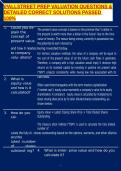
1. Could you ex-
The present value concept is based on the premise that "a dollar in
plain the
the present is worth more than a dollar in the future" due to the time
concept of
value of money. The reason being money currently in possession has
present value
the potential to earn interest by
and how it relates being invested today.
to company For intrinsic valuation methods, the value of a company will be equal to
valu- ations? the sum of the present value of all the future cash flows it generates.
Therefore, a company with a high valuation would imply it receives high
returns on its invested capital by investing in positive net present value
("NPV") projects consistently while having low risk associated with its
cash flows.
2. What is
equity value Often used interchangeably with the term market capitalization
and how is it
("market cap"), equity value represents a company's value to its equity
calculated?
shareholders. A company's equity value is calculated by multiplying its
latest closing share price by its total diluted shares outstanding, as
shown below:
3. How do you Equity Value = Latest Closing Share Price × Total Diluted Shares
cal- Outstanding
The treasury stock method ("TSM") is used to calculate the fully diluted
number of
culate the fully di- shares outstanding based on the options, warrants, and other dilutive
securities
luted number
of shares
outstand- ing? 4. What is enter- prise value and how do you
calculate it?
,WALLSTREET PREP VALUATION QUESTIONS &
DETAILED CORRECT SOLUTIONS PASSED
100%
that are currently "in-the- which is attected by financing decisions.
money" (i.e., profitable to Enterprise value is calculated by taking the company's equity value and
exercise). adding
The TSM involves summing
up the number of in-the-
money ("ITM") options and
warrants and then adding
that figure to the number
of basic shares
outstanding. In the
proceeding step, the TSM
assumes the proceeds
from exercising those
dilutive options will go
towards repurchasing
stock at the current share
price to reduce the net
dilutive impact.
Conceptually, enterprise
value ("EV") represents the
value of the operations of
a company to all
stakeholders including
common shareholders,
preferred share- holders,
and debt lenders.
Thus, enterprise value is
considered capital structure
neutral, unlike equity value,
,WALLSTREET PREP VALUATION QUESTIONS &
DETAILED CORRECT SOLUTIONS PASSED
100%
net debt, preferred stock, and minority interest.
Enterprise Value = Equity Value + Net Debt + Preferred Stock + Minority
Interest
5. How do you
cal- culate To get to equity value from enterprise value, you would first subtract net
equity val- ue debt, where net debt equals the company's gross debt and debt-like
from enter- claims (e.g., preferred stock), net of cash, and non-operating assets.
prise value?
Equity Value = Enterprise Value - Net Debt - Preferred Stock - Minority
Interest
6. Which line
items are The calculation of net debt accounts for all interest-bearing debt, such as
included in the short-term and long- term loans and bonds, as well as non-equity
calculation of financial claims such as preferred stock and non- controlling interests.
net debt? From this gross debt amount, cash and other non-operating assets
such as short-term investments and equity investments are
subtracted to arrive at net debt.
Net Debt = Total Debt - Cash & Equivalents
7. When
calculating
The underlying idea of net debt is that the cash on a company's
enterprise
balance sheet could pay down the outstanding debt if needed. For this
value, why do
reason, cash and cash equivalents are netted against the company's
we add net
debt, and many leverage ratios use net debt rather than the gross
debt?
amount.
8. What is the differ- Enterprise value represents all stakeholders in a business, including
equity share-
ence between holders, debt lenders, and preferred stock owners. Therefore, it's independent of
enterprise the capital structure. In addition, enterprise value is closer to the actual
value
, WALLSTREET PREP VALUATION QUESTIONS &
DETAILED CORRECT SOLUTIONS PASSED
100%
value of
and equity value? the business since it accounts for all ownership stakes (as opposed to
just equity owners).
To tie this to a recent example, many investors were astonished that
Zoom, a video conferencing platform, had a higher market capitalization
than seven of the largest airlines combined at one point. The points
being neglected were:
1. The equity values of the airline companies were temporarily deflated
given the
DETAILED CORRECT SOLUTIONS PASSED
100%
1. Could you ex-
The present value concept is based on the premise that "a dollar in
plain the
the present is worth more than a dollar in the future" due to the time
concept of
value of money. The reason being money currently in possession has
present value
the potential to earn interest by
and how it relates being invested today.
to company For intrinsic valuation methods, the value of a company will be equal to
valu- ations? the sum of the present value of all the future cash flows it generates.
Therefore, a company with a high valuation would imply it receives high
returns on its invested capital by investing in positive net present value
("NPV") projects consistently while having low risk associated with its
cash flows.
2. What is
equity value Often used interchangeably with the term market capitalization
and how is it
("market cap"), equity value represents a company's value to its equity
calculated?
shareholders. A company's equity value is calculated by multiplying its
latest closing share price by its total diluted shares outstanding, as
shown below:
3. How do you Equity Value = Latest Closing Share Price × Total Diluted Shares
cal- Outstanding
The treasury stock method ("TSM") is used to calculate the fully diluted
number of
culate the fully di- shares outstanding based on the options, warrants, and other dilutive
securities
luted number
of shares
outstand- ing? 4. What is enter- prise value and how do you
calculate it?
,WALLSTREET PREP VALUATION QUESTIONS &
DETAILED CORRECT SOLUTIONS PASSED
100%
that are currently "in-the- which is attected by financing decisions.
money" (i.e., profitable to Enterprise value is calculated by taking the company's equity value and
exercise). adding
The TSM involves summing
up the number of in-the-
money ("ITM") options and
warrants and then adding
that figure to the number
of basic shares
outstanding. In the
proceeding step, the TSM
assumes the proceeds
from exercising those
dilutive options will go
towards repurchasing
stock at the current share
price to reduce the net
dilutive impact.
Conceptually, enterprise
value ("EV") represents the
value of the operations of
a company to all
stakeholders including
common shareholders,
preferred share- holders,
and debt lenders.
Thus, enterprise value is
considered capital structure
neutral, unlike equity value,
,WALLSTREET PREP VALUATION QUESTIONS &
DETAILED CORRECT SOLUTIONS PASSED
100%
net debt, preferred stock, and minority interest.
Enterprise Value = Equity Value + Net Debt + Preferred Stock + Minority
Interest
5. How do you
cal- culate To get to equity value from enterprise value, you would first subtract net
equity val- ue debt, where net debt equals the company's gross debt and debt-like
from enter- claims (e.g., preferred stock), net of cash, and non-operating assets.
prise value?
Equity Value = Enterprise Value - Net Debt - Preferred Stock - Minority
Interest
6. Which line
items are The calculation of net debt accounts for all interest-bearing debt, such as
included in the short-term and long- term loans and bonds, as well as non-equity
calculation of financial claims such as preferred stock and non- controlling interests.
net debt? From this gross debt amount, cash and other non-operating assets
such as short-term investments and equity investments are
subtracted to arrive at net debt.
Net Debt = Total Debt - Cash & Equivalents
7. When
calculating
The underlying idea of net debt is that the cash on a company's
enterprise
balance sheet could pay down the outstanding debt if needed. For this
value, why do
reason, cash and cash equivalents are netted against the company's
we add net
debt, and many leverage ratios use net debt rather than the gross
debt?
amount.
8. What is the differ- Enterprise value represents all stakeholders in a business, including
equity share-
ence between holders, debt lenders, and preferred stock owners. Therefore, it's independent of
enterprise the capital structure. In addition, enterprise value is closer to the actual
value
, WALLSTREET PREP VALUATION QUESTIONS &
DETAILED CORRECT SOLUTIONS PASSED
100%
value of
and equity value? the business since it accounts for all ownership stakes (as opposed to
just equity owners).
To tie this to a recent example, many investors were astonished that
Zoom, a video conferencing platform, had a higher market capitalization
than seven of the largest airlines combined at one point. The points
being neglected were:
1. The equity values of the airline companies were temporarily deflated
given the


