

Lesson 2 – The neuron – Basic structure and action potential
Part 1 – Cells of the nervous system:
CNS = Brain and spinal cord
PNS – Nerves from spinal cord – hands and feet
2 main types of cells –
Neuron = Receives and transmits information in electrochemical form to
other cells. –
1 billion – In humans
Glial cells – supports neurons in functions – eg provide structure,
nutrition and. Doesn’t conduct impulses over long distances
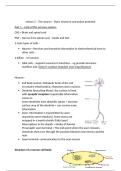
Neuron –
Cell body (soma): Metabolic brain of the cell
It contains mitochondria, ribosomes and a nucleus.
Dendrite (branching fibres): the surface is lined
with synaptic receptors responsible Information
comes in.
Some dendrites have dendritic spines = increase
surface area of the dendrite = can receive more
information
Axon: Information is transmitted via axon
(transmits nerve impulses). Some axons are
wrapped in a myelin sheath (fatty layer)
Interruptions in the sheath = Nodes of Ranvier
Presynaptic axon terminal = The end point where the axon releases
chemicals that cross through the junction between one neuron and the
next
Axon terminal: communication to the next neuron
Structure of a neuron cell body:
, Membrane: 2 layer of phospholipid molecules, Uncharged ions past
through (like co2, H2o, 02)
Protein channels – Charged ions pass through (Sodium, potassium)
Nucleus – Contains DNA
Mitochondria – Provides energy, Fuel and oxygen needed.
Ribosomes – Synthesizes new proteins
Endoplasmic reticulum – Transports protein to other cell locations
Neurons are classified in 2 ways – shape and connection:
SHAPE
Multipolar neurons = multiple dendrites and a single axon
Bipolar neurons = Singe dendrite at one end and a single axon at the other end
Monopolar neuron = A single branch extending in 2 directions (soma in the
middle)
CONNECTION
Afferent – receiver information comes into structure
Efferent – sends information away from structure
Part 1 – Cells of the nervous system:
CNS = Brain and spinal cord
PNS – Nerves from spinal cord – hands and feet
2 main types of cells –
Neuron = Receives and transmits information in electrochemical form to
other cells. –
1 billion – In humans
Glial cells – supports neurons in functions – eg provide structure,
nutrition and. Doesn’t conduct impulses over long distances
Neuron –
Cell body (soma): Metabolic brain of the cell
It contains mitochondria, ribosomes and a nucleus.
Dendrite (branching fibres): the surface is lined
with synaptic receptors responsible Information
comes in.
Some dendrites have dendritic spines = increase
surface area of the dendrite = can receive more
information
Axon: Information is transmitted via axon
(transmits nerve impulses). Some axons are
wrapped in a myelin sheath (fatty layer)
Interruptions in the sheath = Nodes of Ranvier
Presynaptic axon terminal = The end point where the axon releases
chemicals that cross through the junction between one neuron and the
next
Axon terminal: communication to the next neuron
Structure of a neuron cell body:
, Membrane: 2 layer of phospholipid molecules, Uncharged ions past
through (like co2, H2o, 02)
Protein channels – Charged ions pass through (Sodium, potassium)
Nucleus – Contains DNA
Mitochondria – Provides energy, Fuel and oxygen needed.
Ribosomes – Synthesizes new proteins
Endoplasmic reticulum – Transports protein to other cell locations
Neurons are classified in 2 ways – shape and connection:
SHAPE
Multipolar neurons = multiple dendrites and a single axon
Bipolar neurons = Singe dendrite at one end and a single axon at the other end
Monopolar neuron = A single branch extending in 2 directions (soma in the
middle)
CONNECTION
Afferent – receiver information comes into structure
Efferent – sends information away from structure


