

WGU LEARNING AS A SCIENCE - D186 EXAM
QUESTIONS & DETAILED COMPLETE SOLUTIONS
PASSED ALREADY GRADED A+ NEWEST VERSION
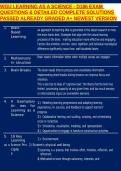
1. Brain-
an approach to teaching that is grounded in the latest research on how
Based
the brain learns best. Strategies that align with the natural learning
Learning
processes of the brain, making education more effective and engaging.
Factors like emotion, environ- ment, repetition, and individual neurological
differences significantly impact how well students learn.
2. Multisensory Brain retains information better when multiple senses are engaged.
In- struction
3. Brain Breaks The brain needs time to process and consolidate information.
Implementing short breaks during lessons can improve focus and
retention.
This is also tied to ideas of "cognitive load," the theory that the brain has
limited processing capacity at any given time, and too much sensory
or informational input can overwhelm learners.
4. 4 Exemplary 1) Modeling learning progressions and adapting learning
Ar- eas for experiences, re- sources, and feedback to support learners'
Learning as a progress.
Science
2) Collaborative learning and scuttling, scripting, and orchestrating
social in- teraction.
3) Simulations, visualization, modeling, and representation.
4) Opportunities to engage in hands-on constructive activities.
5. 10 Key
Learning 1) Environment
as a Science Prin- 2) Student's physical well-being
ciple 3)Learning is a process that involves effort, mistakes, reflection, and
s refinement.
4)Motivated to learn through autonomy, interests, and
1/
31
,WGU LEARNING AS A SCIENCE - D186 EXAM
QUESTIONS & DETAILED COMPLETE SOLUTIONS
PASSED ALREADY GRADED A+ NEWEST VERSION
un to pay attention, build mem- ories, and make meaning.
de 6)Retrieval practice.
rst 7)Spacing out learning and interweaving different content.
an 8)Communicating high expectations.
di
ng
th
e
pu
r-
p
os
e.
5)T
hin
k
de
epl
y
ab
out
the
"to-
be-
lea
rne
d"
ma
teri
al
2/
31
,WGU LEARNING AS A SCIENCE - D186 EXAM
QUESTIONS & DETAILED COMPLETE SOLUTIONS
PASSED ALREADY GRADED A+ NEWEST VERSION
9) Students feel safe in their learning.
10)Collaboration and social interaction.
6. Retrieval Practice A learning strategy where you actively recall information from
memory, rather than passively reviewing it.
Strengthens memory; helps students flexibly apply what they learn, which
strengthens the neural pathways associated with that information.
7. Collaborati Encourages deeper processing
on and
social
interaction
Increases learning
8. Deliberately
cre- ating
learning
spaces,
including desk
placement,
1) Summarizing
lighting, etc.
2) Drawing
9. Strategies
to
elaborate
on
learning:
10. Summarizing to create a verbal description that distills the most important information
from a set of materials
11. Drawings they use graphic strategies to portray important concepts and relationships
3/
31
QUESTIONS & DETAILED COMPLETE SOLUTIONS
PASSED ALREADY GRADED A+ NEWEST VERSION
1. Brain-
an approach to teaching that is grounded in the latest research on how
Based
the brain learns best. Strategies that align with the natural learning
Learning
processes of the brain, making education more effective and engaging.
Factors like emotion, environ- ment, repetition, and individual neurological
differences significantly impact how well students learn.
2. Multisensory Brain retains information better when multiple senses are engaged.
In- struction
3. Brain Breaks The brain needs time to process and consolidate information.
Implementing short breaks during lessons can improve focus and
retention.
This is also tied to ideas of "cognitive load," the theory that the brain has
limited processing capacity at any given time, and too much sensory
or informational input can overwhelm learners.
4. 4 Exemplary 1) Modeling learning progressions and adapting learning
Ar- eas for experiences, re- sources, and feedback to support learners'
Learning as a progress.
Science
2) Collaborative learning and scuttling, scripting, and orchestrating
social in- teraction.
3) Simulations, visualization, modeling, and representation.
4) Opportunities to engage in hands-on constructive activities.
5. 10 Key
Learning 1) Environment
as a Science Prin- 2) Student's physical well-being
ciple 3)Learning is a process that involves effort, mistakes, reflection, and
s refinement.
4)Motivated to learn through autonomy, interests, and
1/
31
,WGU LEARNING AS A SCIENCE - D186 EXAM
QUESTIONS & DETAILED COMPLETE SOLUTIONS
PASSED ALREADY GRADED A+ NEWEST VERSION
un to pay attention, build mem- ories, and make meaning.
de 6)Retrieval practice.
rst 7)Spacing out learning and interweaving different content.
an 8)Communicating high expectations.
di
ng
th
e
pu
r-
p
os
e.
5)T
hin
k
de
epl
y
ab
out
the
"to-
be-
lea
rne
d"
ma
teri
al
2/
31
,WGU LEARNING AS A SCIENCE - D186 EXAM
QUESTIONS & DETAILED COMPLETE SOLUTIONS
PASSED ALREADY GRADED A+ NEWEST VERSION
9) Students feel safe in their learning.
10)Collaboration and social interaction.
6. Retrieval Practice A learning strategy where you actively recall information from
memory, rather than passively reviewing it.
Strengthens memory; helps students flexibly apply what they learn, which
strengthens the neural pathways associated with that information.
7. Collaborati Encourages deeper processing
on and
social
interaction
Increases learning
8. Deliberately
cre- ating
learning
spaces,
including desk
placement,
1) Summarizing
lighting, etc.
2) Drawing
9. Strategies
to
elaborate
on
learning:
10. Summarizing to create a verbal description that distills the most important information
from a set of materials
11. Drawings they use graphic strategies to portray important concepts and relationships
3/
31


